How to Remove Malware for Free in 2026: Step-by-Step Guide for PC and Android

Ransomware, trojans, spyware, and viruses—malware comes in many forms. In many cases, you can remove an infection by following the right steps.
In this guide, we’ll show you how to get rid of malware on your PC or smartphone and protect yourself from future infections.


If your device suddenly slows down, programs launch on their own, or unexpected pop-ups appear, malware could be the cause.
In case you suspect malware, disconnect your device from the internet and isolate it. This can prevent the malware from communicating with external servers or spreading to other devices.
If the malware hasn’t deeply infected your system, you can usually remove it easily. Start by booting your system in safe mode, where only essential apps run.
Use your device’s built-in antivirus to remove the malware. For extra security, run a second anti-malware tool to double-check.
The best defense is prevention: only download apps and software from trusted sources, keep your system updated, and use strong passwords.
Do I Have Malware? Watch for These Warning Signs
Not every odd behavior on your device points to malware. Computers slow down over time for many reasons, and occasional crashes aren’t necessarily a red flag. Often, the cause is something simple: outdated drivers, a full hard drive, or a hardware issue.
Still, some clear warning signs are worth watching for:
Your device slows down noticeably, lags, or crashes regularly.
Unknown programs, toolbars, or apps appear that you didn’t install.
Your antivirus software won’t start or turns off by itself.
You see more pop-ups, notifications, or ads than usual.
Your browser redirects you to unfamiliar websites without your input.
Your browser’s homepage changes on its own.
Your device uses an unusually high amount of data.
Files disappear, won’t open, or are suddenly encrypted.
Your battery drains much faster than usual (especially on smartphones and laptops).
Keep in mind: a single symptom doesn’t always mean malware. But if you notice several of these issues at once, the odds of an infection go up.
How to Remove Malware for Free: Step by Step
If you suspect malware, scan your system thoroughly with an anti-malware tool and check for any suspicious apps.
Here’s how to remove malware and stop it from spreading:
Disconnect from the internet and Bluetooth
Disconnect your device from the internet right away. Turn off Wi-Fi or disable mobile data if needed. This can prevent malware from communicating with external servers, sending data, or spreading to other devices.
In Windows 11, turn off Wi-Fi by going to Start → Settings → Network & Internet.

Turn off Wi-Fi in Network & Internet settings.
For extra safety, turn off Bluetooth too. Malware can use it to spread to other nearby devices.
In Windows 11, you’ll find Bluetooth settings under Start → Settings → Bluetooth & devices.

Turn off Bluetooth in Bluetooth & devices settings.
Back up important data externally
Back up important images, documents, and videos to an external hard drive or USB drive, but only copy files you trust. Be especially careful with documents that contain macros, such as Word or Excel files, because malicious macros can execute code when enabled. As a precaution, avoid transferring applications or executable files such as .exe files.
Beware of cloud storage with sync: if you use services like OneDrive, Google Drive, or iCloud, infected or encrypted files can upload automatically and overwrite clean versions in the cloud. That’s why a separate, up-to-date offline backup is critical.
Start your device in safe mode
Next, restart your device in Safe Mode. Safe Mode starts the device with only a limited set of system services and disables most third-party apps, which can make malware easier to remove. The main exceptions are stubborn threats like rootkits. In most cases, this makes removing malware much easier.
Here’s how to do it:
Step 1: Click “Start” → “Power,” then hold down the Shift key while clicking “Restart.”
Alternatively, go to “Start” → “Settings” → “System” → “Recovery,” and under “Advanced startup,” click “Restart now.”

Use Windows 11’s system settings to perform an advanced startup and boot into Safe Mode.
Step 2: After restarting, you’ll see a screen titled “Choose an option.” Select “Troubleshoot” → “Advanced options” → “Startup Settings,” then restart your PC again.

In the options menu, select “Troubleshoot,” followed by “Advanced options” and “Startup Settings.”
Step 3: In the menu that appears, press “4” to start in Safe Mode.

Start Windows in Safe Mode to keep malware inactive.
Run a thorough malware scan
Once your system is in Safe Mode, run a malware scan. Windows includes built-in protection called Virus & threat protection.
In Windows 11, go to Settings → Privacy & security → Windows Security.
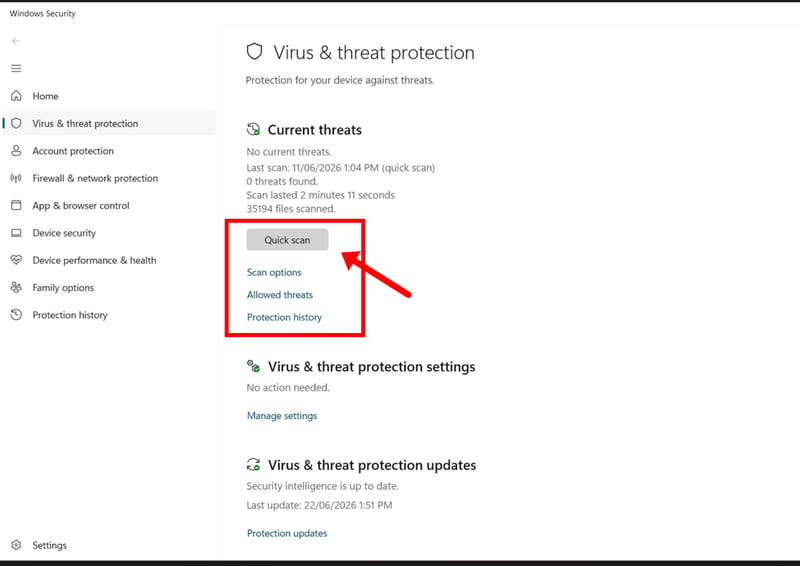
Windows Virus & Threat Protection includes a built-in malware scanner.
Under Scan options, choose either a quick scan or a full system scan. If the tool finds anything, follow the on-screen instructions to remove the infected files.
Because different security tools use different detection methods, a second scan with a dedicated anti-malware tool can provide an additional layer of reassurance.
We’ve tested several anti-malware tools and summarized their pros and cons in this article:
Since your infected device isn’t connected to the internet, download the anti-malware tool on a second, clean PC. Transfer the installer to a USB drive, then use it to install the tool on the infected device.
Remove suspicious apps and extensions
After the malware scan, check your installed apps and browser extensions. Open the app list by clicking Start → Settings → Apps → Installed apps, and pay close attention to recently installed programs.
Remove anything unfamiliar or suspicious. Malware often hides behind apps with names like “Helper,” “Cleaner,” or “Optimizer.”
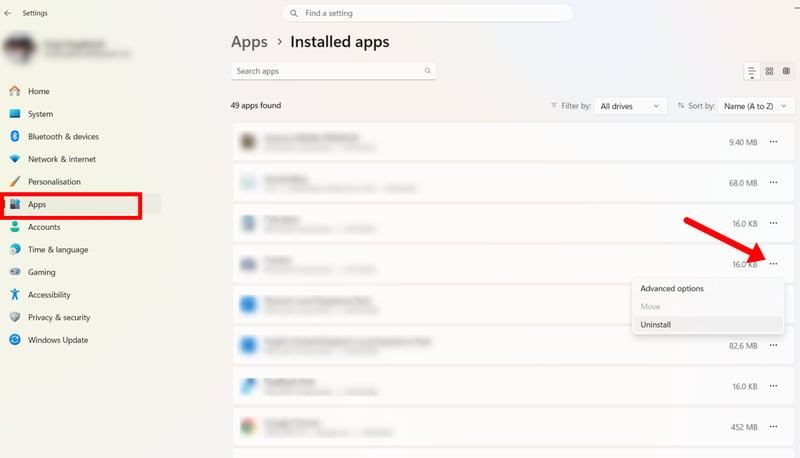
Select the suspicious app and uninstall it by clicking the three-dot menu.
Malware can also hide in browser extensions. Review your installed add-ons and toolbars, and remove anything suspicious.
Open the extensions manager: In Chrome and Microsoft Edge, click the menu icon (three dots) and go to Extensions → Manage extensions. In Firefox, you’ll find this under Add-ons and Themes.

Select the unwanted extension and remove it from your browser.
If malware changed your browser’s homepage or default search engine, reset them in your browser’s settings under Homepage and Default search engine.
If nothing else works, reset your system
If a malware scan and manual cleanup don't fully remove the malware, or if your device still acts up, it's best to reset your system completely.
This removes installed programs and, depending on the option you choose, your personal files as well. It can also remove malware that wasn’t eliminated during manual cleanup.
On Windows, you'll find this option under “Start” → “Settings” → “System” → “Recovery,” then under “Recovery options.”

When you reset your PC through recovery, you can choose whether to keep your files.
Select “Keep my files” to remove apps and settings while preserving your personal files, or “Remove everything” to delete your personal files and installed apps.
That depends on your situation:
“Keep my files” is the less disruptive option and may be sufficient for a minor infection.
“Remove everything” is the more thorough option if you suspect a serious infection, especially if files have already been altered or encrypted. In that case, be sure to back up your data to an external drive first!
How to Remove Malware From Your Smartphone
Mobile devices like smartphones and tablets are popular malware targets too, especially Android devices. Android devices are particularly exposed because apps can be installed outside the Google Play Store through sideloading. This broader installation model gives attackers more opportunities to distribute malicious apps.
If your smartphone or tablet is infected with malware, follow these steps to safely remove it:
Step 1: Disconnect from Wi-Fi and mobile data to stop any further data transfers. For extra safety, turn off Bluetooth too. This prevents malware from spreading to other devices.
Step 2: Restart your device in safe mode. On most phones, press and hold the power button, then long-press “Power off.” Alternatively, turn off the device, then press and hold the volume-down button when the “Powered by Android” logo appears during boot.

Starting an Android device in safe mode.
Step 3: In safe mode, scan your device with a security app (like Malwarebytes, Avast, or Bitdefender from the Google Play Store). These tools can detect malware that may be hidden or disguised as legitimate apps or system components.

Step 4: After the scan, review your installed apps and their permissions. Go to “Settings” → “Apps” or “Apps & notifications” to open the app manager.
Step 5: Tap an app in the list to view its permissions. Check whether they (like access to location, contacts, or camera) make sense for what the app does. If not, disable them. When in doubt, uninstall the app entirely.

In the app info, you can check the permissions for each app on your phone.
Step 6: If the malware mainly shows up while browsing the internet, such as intrusive ads or push notifications, the problem is likely in your browser.
Open your browser’s settings and search for options like “Privacy and security” or “Clear browsing data.” Delete your cache, cookies, and history.

Clear browser data on your smartphone.
Step 7: Finally, check your settings to see whether your homepage or default search engine changed without your permission. If they did, reset them.
If your device still acts strangely, the safest option is a factory reset. Go to Settings → General Management → Reset. Just be sure to back up your personal data first!
How to Prevent Malware and Keep Your System Clean
The best way to deal with malware is to keep it off your device in the first place. Follow these basic security rules to lower your risk:
Final Thoughts: How to Remove Malware and Prevent Future Infections
Malware can be serious, but many infections can be removed with the right steps. The key is to act fast: disconnect the infected device from the internet, run a thorough malware scan, and remove any suspicious programs or apps. If that doesn’t work, resetting the system may be the next step.
Of course, the best approach is to avoid infections altogether. Only download software and apps from trusted sources, keep your operating system and apps updated, and stay cautious with links and attachments. These simple steps go a long way toward reducing your risk.
FAQ
Common signs of a malware infection include a computer that suddenly slows down, crashes frequently, or restarts unexpectedly. In your browser, malware typically shows up as a changed homepage or unwanted redirects to unfamiliar sites. Unknown programs you never installed or an antivirus that suddenly turns off are also red flags.
Start your computer in safe mode and run a full scan with an anti-malware tool. Remove any threats it finds, along with unknown programs and browser extensions. Then change your most important passwords from a clean device and keep your system updated to close security gaps.
Yes, smartphones can also be affected by malware. Android devices are especially at risk since apps can be installed from unofficial sources. Malicious apps, shady links, or phishing texts are common ways malware gets in.