Ahrefs vs. Semrush: Which SEO Tool Is Right for You?


Ahrefs and Semrush are two of the most popular SEO tools for professional search engine optimization. While both serve similar purposes, they take different approaches: Semrush positions itself as an all-in-one online marketing suite, while Ahrefs focuses solely on SEO. So which one is the better choice?
We put both platforms to the test to help you decide which tool fits your needs.
Ahrefs vs. Semrush: Comparison in 7 Categories


Our overall winner is Semrush, with a score of 1.3 compared to Ahrefs’ 1.6.
Semrush wins our comparison, but that doesn’t automatically make it the better choice for everyone. Ahrefs outperforms Semrush in some areas. Let’s take a closer look at the key differences.
Interface and Ease of Use
The differences between the two tools become clear right from the start. Ahrefs is built entirely around SEO, so its interface is clean and focused. Semrush, on the other hand, combines features for multiple marketing areas (content marketing, social media, and PPC) in a single dashboard.
Semrush offers more features, while Ahrefs stays laser-focused. That’s why Ahrefs scores 8.5 out of 10 in this category, and Semrush 7.5.
 Semrush |  Ahrefs |
|---|
| Semrush | Ahrefs | |
|---|---|---|
Interface and Usability10% | ||
6/8 | 7/8 | |
1.5/2 | 1.5/2 | |
| 7.5 / 10 Points | 8.5 / 10 Points | |
Ahrefs: Focused and fast
Ahrefs has a clean, modern design that makes data easy to understand. Once you log in, you land on a straightforward dashboard with quick access to all the key tools. Charts and graphs turn even complex data into clear insights.
The navigation is simple and well-organized. Tooltips, question mark icons, and built-in tutorial videos explain the more advanced features. Performance is another advantage: reports load quickly, and even in-depth domain analyses appear without noticeable delays.
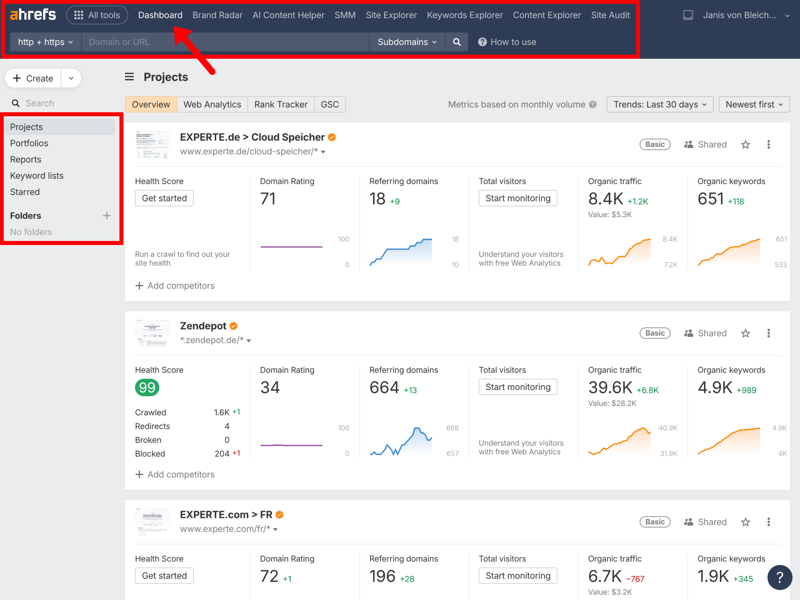
In the Ahrefs dashboard, you can set up projects and track all key developments at a glance.
The interface isn’t perfect, though. Some features appear in more than one place, which can be confusing at first. Backlink data, for example, shows up in both the Site Explorer and the separate Backlinks module. Even so, Ahrefs stays easy and intuitive to use.
Semrush: Powerful but complex
In Semrush, the SEO tools are part of a larger marketing suite that also covers content marketing, social media, and PPC.
For agencies and larger teams that need all these tools, this is a big plus. But if you only use Semrush for SEO, you’ll have to navigate through a lot of irrelevant menu items.
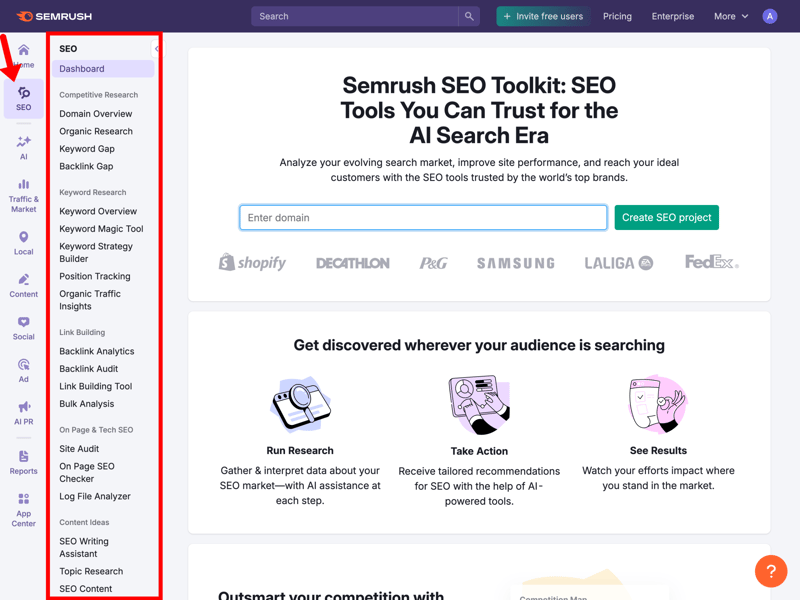
Semrush’s SEO dashboard: start a project or dive straight into one of the many modules.
Overall performance is strong, though we ran into slow loading times during the backlink audit. The localizations in other languages also have gaps, with English terms popping up in the middle of an international interface.

Both tools are well-organized but take some time to learn. Ahrefs is easier to pick up thanks to its clear focus on SEO, making it the better choice for beginners or anyone who only needs SEO features.
If you already use the same tool for content marketing, social media, or PPC, Semrush’s extra complexity isn’t a drawback. It’s the price you pay for more features.
Competitor Analysis
Both tools are nearly identical when it comes to keyword rankings, top pages, gap analysis, and analyzing organic competitors. Semrush stands out with a longer data history and slightly more accurate traffic estimates.
Overall, Semrush edges out Ahrefs with 16.5 out of 20 points, compared to Ahrefs’ 16.
Semrush | Ahrefs |
|---|
| Semrush | Ahrefs | |
|---|---|---|
Competitor Analysis20% | ||
2/2 | 2/2 | |
6/6 | 5/6 | |
3/6 | 3/6 | |
4/4 | 4/4 | |
1.5/2 | 2/2 | |
| 16.5 / 20 Points | 16 / 20 Points | |
Ahrefs: deep insights into content and links
The Site Explorer is the core competitor analysis tool in Ahrefs. Enter a domain, and you’ll get detailed insights into organic traffic, rankings, and top-performing content.
The “Content Gap” feature lets you compare up to ten competitors and shows which keywords they rank for while you don’t.
 Ahrefs |  Semrush | |
|---|---|---|
Number of keywords (history) | ✓ | ✓ |
Number of URLs (history) | ✓ | ✓ |
Top pages | ✓ | ✓ |
Ranking history per keyword | ✓ | ✓ |
Ranking changes | ✓ | ✓ |
Ranking distribution | ✓ | ✓ |
Organic competitors | ✓ | ✓ |
Keyword gap analysis | ✓ | ✓ |
Total | 8 | 8 |
Ahrefs analyzes competitors at all four levels (domain, subdomain, directory, and URL) for a highly detailed breakdown.
One particularly useful feature is its analysis of referring IP addresses: this reveals whether a competitor's backlinks come from natural sources or potentially manipulated link networks.
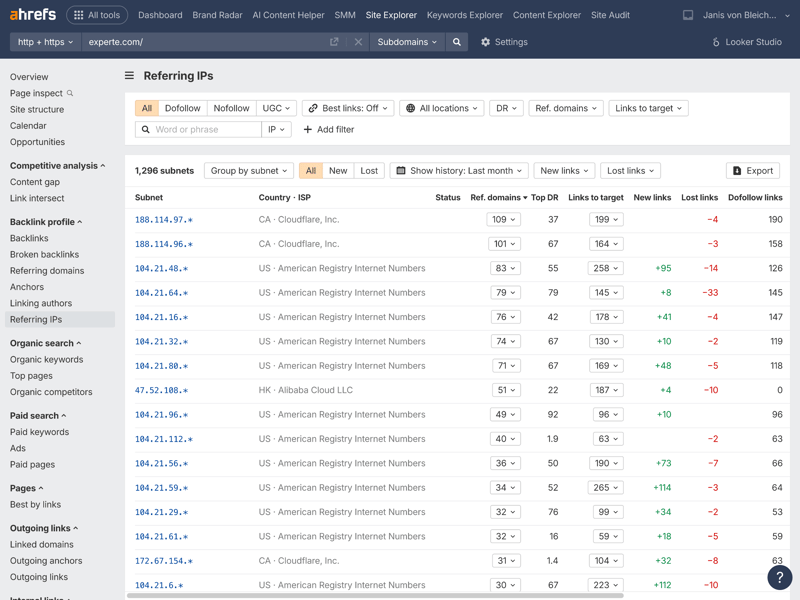
The analysis of referring IP addresses shows whether a backlink profile grew organically or was artificially created.
Ahrefs clearly displays all key traffic metrics, including organic traffic, paid traffic, traffic value, and geographic distribution. Ahrefs stores five years of historical data, while Semrush keeps up to fourteen years.
In our test, Ahrefs’ traffic estimates were less accurate. With a 45.4% accuracy rate, it ranked in the bottom third of the comparison.
| Traffic estimation accuracy | |
|---|---|
 | 53.6 % |
 | 51 % |
 | 50.1 % |
| 49.1 % |
 | 46.1 % |
 | 45.9 % |
| 45.4 % |
 | 18.9 % |
 | 0 % |
How we tested: To check the accuracy of these estimates, we compared each tool’s predictions with real data from the Google Search Console of 30 stable test domains.
Semrush: broader data coverage and more accurate traffic estimates
Ahrefs and Semrush offer similar features, but Semrush has the edge in two key areas. First, its historical data goes back 14 years, more than double Ahrefs’ five-year range. That makes it easier to analyze long-term trends across multiple Google updates.
Ahrefs | Semrush | |
|---|---|---|
Organic traffic | ✓ | ✓ |
Paid traffic | ✓ | ✓ |
Trafic value | ✓ | ✓ |
Traffic by country | ✓ | ✓ |
Traffic history | 5 years | 14 years |
Semrush also analyzes your competitors’ paid search ads and social media activity. Its automatic competitor detection surfaces relevant rivals so you don’t have to search for them.
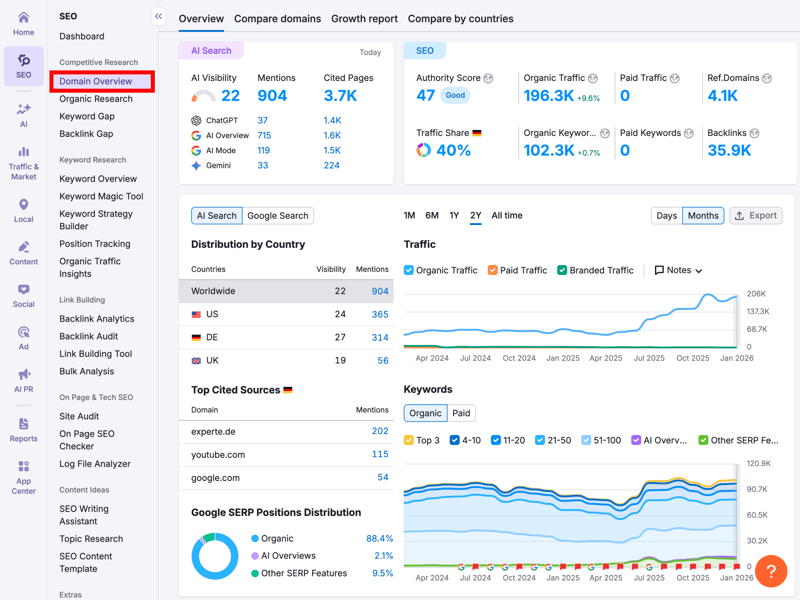
Semrush automatically identifies top competitors and shows which keywords they rank for.
Ahrefs offers a more detailed site structure analysis since Semrush doesn’t provide data on internal links. In our test, Semrush’s traffic estimates were 49.1% accurate, slightly better than Ahrefs, though both still performed around the middle of our comparison.
Both tools cover all the core features you need for competitor analysis. Semrush takes the lead thanks to its longer data history and more precise traffic estimates, including paid search and social media data.
Ahrefs stands out with its deeper site structure analysis, including internal links, and its ability to analyze referring IP addresses. If you frequently examine link profiles, Ahrefs might be the better choice.
If competitor analysis and comprehensive traffic data are your priority, go with Semrush. But if you need to dive deep into link profiles, Ahrefs is the stronger option.
Backlink Analysis
Backlinks are one of Google’s most important ranking factors, so reliable backlink analysis is a must.
Both tools cover all the key aspects of backlink analysis: backlink history, referring domains and IP addresses, broken links, anchor text analysis, and backlink gap analysis.
Semrush | Ahrefs |
|---|
| Semrush | Ahrefs | |
|---|---|---|
Backlink Analysis15% | ||
5/5 | 5/5 | |
3/4 | 2/4 | |
3.5/4 | 4/4 | |
2/2 | 2/2 | |
| 13.5 / 15 Points | 13 / 15 Points | |
Ahrefs: More up-to-date index, smaller database
In the SEO industry, Ahrefs is best known for its backlink index. The company claims to run the most active web crawler after Google, updating its index every 15 to 30 minutes. As a result, deleted links disappear from the index faster than with many competitors, keeping backlink data more current.
Ahrefs | Semrush | |
|---|---|---|
Backlink history | ✓ | ✓ |
Referring domains | ✓ | ✓ |
Referring IPs | ✓ | ✓ |
Lost links | ✓ | ✓ |
Toxic links | ✓ | ✓ |
Broken links | ✓ | ✓ |
Link quality metrics | ✓ | ✓ |
Anchor text analysis | ✓ | ✓ |
Top pages by links | ✓ | ✓ |
Backlink gap analysis | ✓ | ✓ |
Total | 10 | 10 |
Ahrefs performed well in our backlink source comparison, identifying an average of 5,627 referring domains. That’s fewer than Semrush, but for a good reason: while other tools count outdated or inactive links, Ahrefs removes them to keep its index clean.
| Referring domains (on average) | |
|---|---|
| 12,100 |
| 12,100 |
| 8,927 |
| 5,627 |
| 5,200 |
| 3,505 |
| 2,305 |
| 1,172 |
| 224 |
How we tested: To compare the tools fairly, we measured how many referring domains each one identified on average. More domains usually mean a more complete picture of a site's link profile.
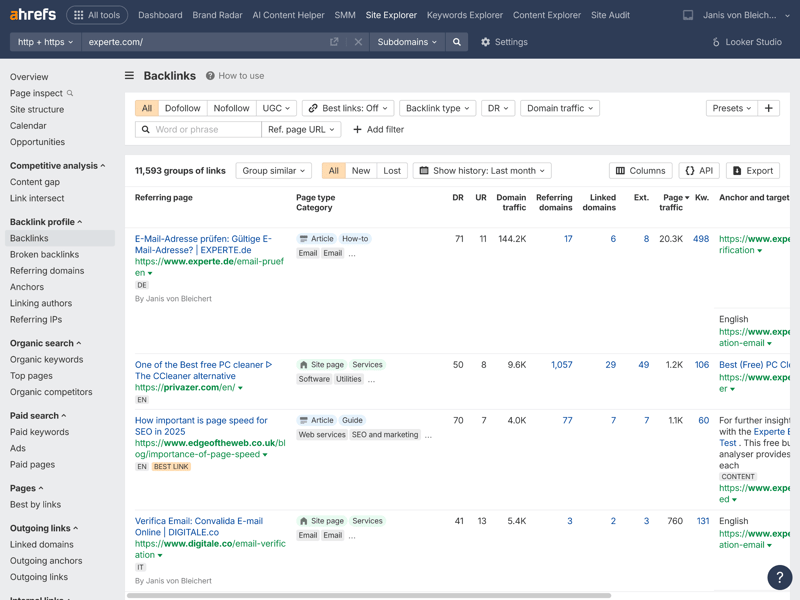
Ahrefs’ Backlink Explorer shows key metrics at a glance.
Ahrefs’ Backlink Explorer gives you all the key metrics at a glance: referring domains, anchor texts, and link profile history. But it doesn’t include an automatic toxicity score, so you’ll have to evaluate problematic backlinks manually. That can be time-consuming for larger link profiles.
Semrush: larger database and automatic toxicity score
In our test, Semrush identified an average of 8,927 referring domains, putting it well ahead of Ahrefs. Its backlink database is one of the largest on the market, updates daily, and reliably detects redirects and JavaScript links.
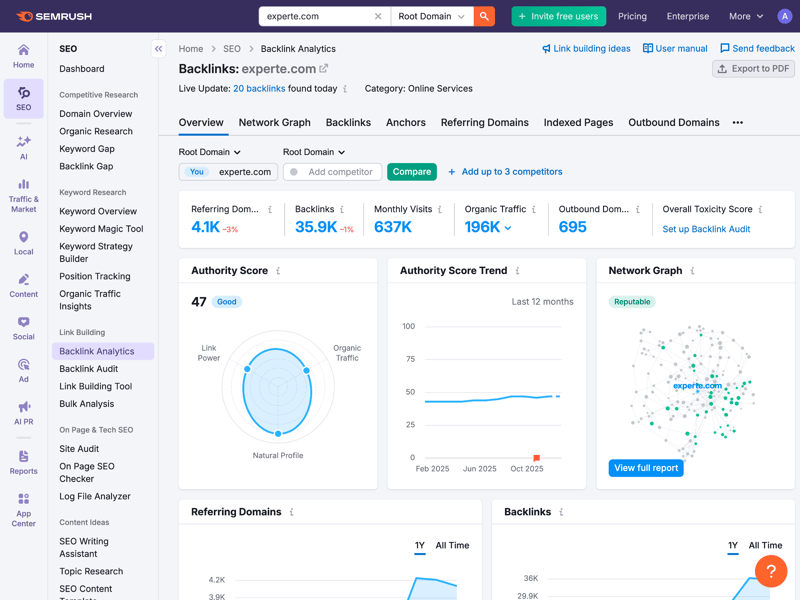
Semrush presents backlink data in a clear, organized way.
The filtering options are nearly identical. Both tools let you filter by link age, link type, anchor text, traffic of the linking page, nofollow or dofollow links, link position, language, and link authority.
Ahrefs | Semrush | |
|---|---|---|
Nofollow/Dofollow | ✓ | ✓ |
Link authority | ✓ | ✓ |
Anchor text | ✓ | ✓ |
Link type (text, image, …) | ✓ | ✓ |
Link position (content, footer, …) | ✓ | ✓ |
Link age | ✓ | ✓ |
Traffic of referring page | ✓ | ✓ |
Language of referring page | ✓ | ✓ |
Total | 8 | 8 |
Semrush’s biggest advantage over Ahrefs is its automatic Toxicity Score, which flags backlinks as toxic, potentially toxic, or safe. This makes it much easier to evaluate large link profiles. The built-in link-building tool also suggests relevant sources for new backlinks to help you grow your profile.
Both tools cover all the key aspects of backlink analysis, but Semrush outperforms Ahrefs thanks to its larger database. In our test, it found an average of 3,000 more referring domains per URL than Ahrefs. The automatic Toxicity Score also makes it easier to spot potentially harmful backlinks.
Ahrefs keeps its index especially current by aggressively removing outdated links. So while it finds fewer domains, that doesn’t necessarily mean it’s less effective. If you prioritize the most up-to-date backlink data and prefer to evaluate problematic links yourself, Ahrefs is still a solid choice.
Keyword Research
Keyword research is the foundation of any content strategy, and here too, Semrush and Ahrefs offer nearly identical features. Both provide monthly and country-specific search volume, keyword difficulty, CPC, search intent, current and historical SERPs, SERP comparisons, SERP overlap, and keyword clustering. The main differences come down to database size and the accuracy of search volume data.
Semrush | Ahrefs |
|---|
| Semrush | Ahrefs | |
|---|---|---|
Keyword Research15% | ||
5/5 | 5/5 | |
1/1 | 1/1 | |
2/3 | 1/3 | |
4/5 | 4/5 | |
2/2 | 2/2 | |
| 14 / 15 Points | 13 / 15 Points | |
Ahrefs: Topic clusters and a smaller database
Ahrefs’ Keywords Explorer includes all the essential metrics and covers 170 countries. One notable feature is its “Parent Topics,” which group keywords into broader topic clusters and make it easier to plan content around related themes. It also offers extensive filtering options.
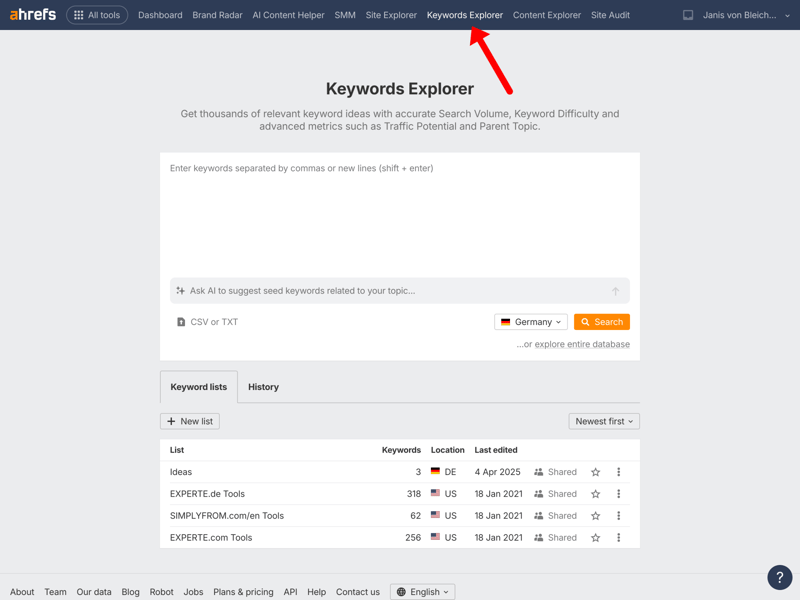
Ahrefs automatically groups keywords into broader Parent Topics.
For the number of keyword suggestions, Ahrefs landed in the lower middle of the pack in our test, finding an average of 1,801 keyword variations per seed keyword.
| Number of keywords (on average) | |
|---|---|
| 5,325 |
| 3,831 |
| 3,504 |
| 3,331 |
| 3,032 |
| 1,801 |
| 410 |
| 106 |
| - |
How we tested: We defined 20 identical seed keywords and measured how many keyword variations each tool provided.
Search volume accuracy was stronger. Ahrefs scored 73.4%, landing in third place overall, solid enough for strategic planning.
| Search volume accuracy | |
|---|---|
| 83 % |
| 75.3 % |
| 73.4 % |
| 72.4 % |
| 65.5 % |
| 55.7 % |
| 54.9 % |
| 52.8 % |
| 29.9 % |
How we tested: To check search volume accuracy, we compared tool estimates with actual monthly impressions from the Google Search Console for 30 stable-ranking keywords.
Semrush: bigger database, slightly more precise
Semrush takes a two-pronged approach to keyword research. You can analyze search terms on their own or evaluate them in the context of your own domain. The “Keyword Magic Tool” generates a wide range of keyword ideas from a single seed keyword, while the “Strategy Builder” automatically groups them into thematic clusters.
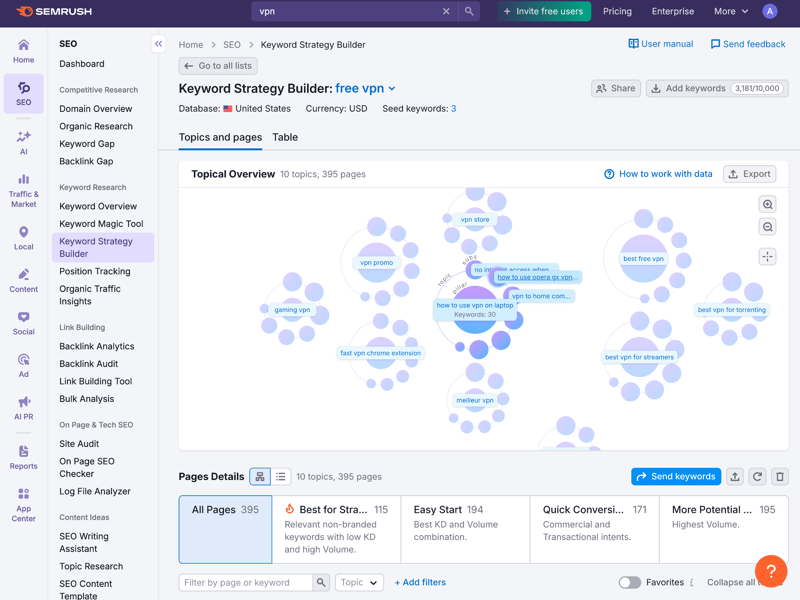
Semrush’s Strategy Builder visually groups keywords into thematic clusters.
The filtering options here are also extensive. Semrush lets you filter by search volume, keyword difficulty, CPC, search intent, SERP features, and word count, among others.
In our test, Semrush scored 75.3% for search volume accuracy, placing it second overall. It also pulls ahead on the number of keyword suggestions, delivering an average of 3,331 per seed keyword, almost twice as many as Ahrefs.
| Number of keywords (on average) | |
|---|---|
| 3,331 |
| 1,801 |
Both tools offer nearly the same range of features. Semrush takes the lead with slightly more accurate search volume data and a much larger keyword database. In our test, it delivered almost twice as many suggestions per seed keyword.
Ahrefs, however, has one feature Semrush doesn’t: Parent Topics. It automatically groups keywords into broader topics, making it easier to plan content that covers a subject comprehensively.
Other Features
Rank tracking, site audits, AI tools, and extra features: this is where the two tools differ the most. Semrush is a full online marketing suite, so it comes with far more features.
Semrush | Ahrefs |
|---|
| Semrush | Ahrefs | |
|---|---|---|
Other Features20% | ||
5/5 | 4/5 | |
3/5 | 4.5/5 | |
5/5 | 4.5/5 | |
5/5 | 3.5/5 | |
| 18 / 20 Points | 16.5 / 20 Points | |
Ahrefs: Strong audits, innovative AI features
Ahrefs’ Site Audit is a cloud-based crawler that detects over 170 predefined SEO issues and automatically sorts them into errors, warnings, or notices. For each issue, Ahrefs provides a clear description and actionable solutions.
Ahrefs tracks keyword sets at the city level within projects, but daily updates are only available as a paid add-on. Semrush includes them in every plan.
Ahrefs is currently ahead on AI features. It doesn’t just track AI Overviews in Google search results; its “Brand Radar” feature also monitors your brand’s presence in AI chatbots like ChatGPT, Gemini, and Perplexity. It also offers an AI-powered text editor.
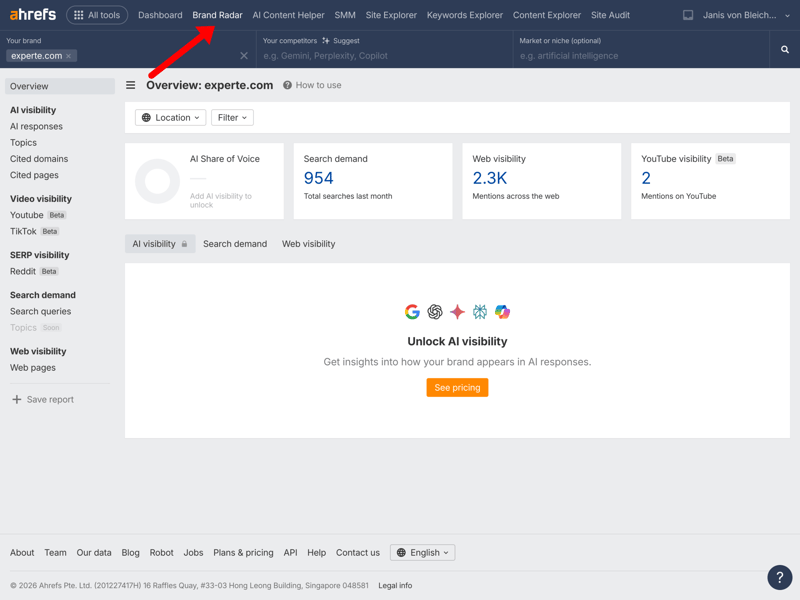
Ahrefs’ Brand Radar shows how visible a brand is in external AI chatbots.
Every plan includes Google Search Console imports, API access, and email reporting. Batch analysis, however, is only available starting with the Standard plan. Ahrefs also stands out with its Content Explorer and well-known metrics like Domain Rating and Keyword Difficulty.
Ahrefs doesn’t offer white-label reporting, which is a downside for agencies.
Semrush: the more complete marketing suite
Semrush includes daily rank-tracking updates in every plan. Its local tracking goes even further, breaking down results by device (desktop or mobile) and adding metrics like SERP features and competitive comparisons.
Semrush also scores high on site audits. The tool scans for technical issues, automatically prioritizes fixes, and provides detailed explanations with links to helpful articles. It also checks Core Web Vitals and HTTPS.
Semrush falls behind Ahrefs in AI tracking. It does track AI Overviews in Google search results and offers an “AI Visibility Toolkit” for monitoring external AI chatbots. But overall, Semrush leans more on AI for content creation than for tracking.
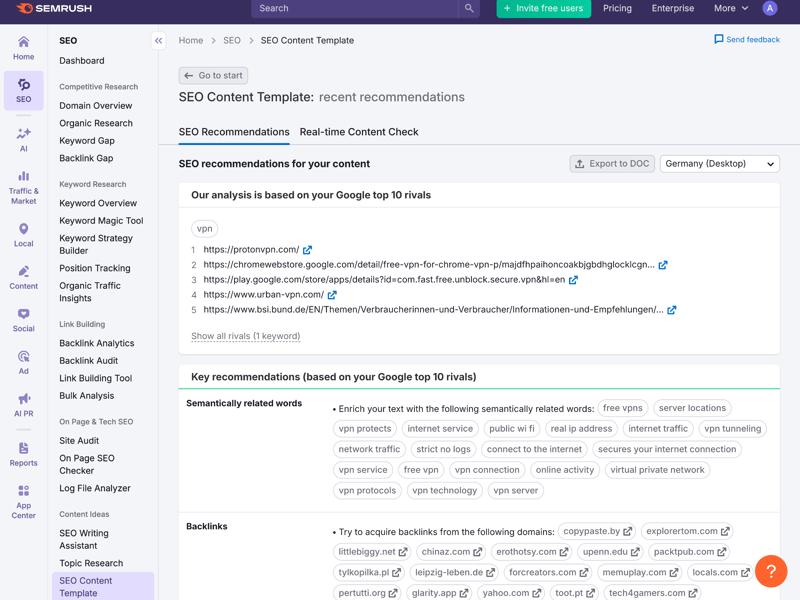
Semrush uses AI mostly for content creation.
Semrush offers a much broader feature set than Ahrefs, largely because of its complete marketing suite. On top of a robust content marketing package (including an SEO Writing Assistant and Content Audit), Semrush offers social media management, local SEO, PPC analysis, white-label reporting starting at the Business plan, and bulk backlink analysis for up to 200 domains.
Semrush wins this category by a clear margin. It delivers daily ranking updates on all plans, white-label reporting for agencies, and a full marketing toolkit with features for content, social media, and PPC. Ahrefs simply can’t match that breadth of features.
If you don’t need those extra marketing tools, Ahrefs still gives you a powerful, focused SEO tool. In some areas, like AI tracking, it even outperforms Semrush.
Support
Both tools deliver above-average support: Semrush scores 9.5 out of 10, while Ahrefs earns 9 out of 10.
Semrush | Ahrefs |
|---|
| Semrush | Ahrefs | |
|---|---|---|
Support10% | ||
3/3 | 2.5/3 | |
2/2 | 1.5/2 | |
1.5/2 | 2/2 | |
3/3 | 3/3 | |
| 9.5 / 10 Points | 9 / 10 Points | |
Ahrefs: fast support, industry-leading resources
The Ahrefs blog and help center are go-to resources in the SEO industry. The content is well-researched, data-driven, and practical, backed by high-quality YouTube tutorials and the Ahrefs Academy, which offers free courses on every module.

The Ahrefs Academy offers free English courses on every tool module.
The AI chatbot Fin delivered accurate, high-quality answers in our tests. But Ahrefs doesn’t offer phone support, which costs it half a point in our rating.
Semrush: more learning resources
The Semrush Academy offers dozens of free courses for beginners and pros. Its help center is massive, covering nearly every feature in detail, and an active blog and YouTube channel round out the learning resources.

The Semrush Academy offers free courses with industry-recognized certifications.
Semrush also gives you more ways to get help. You can reach support by email, live chat, or, depending on your region and plan, phone. In our tests, the chatbot provided quick and accurate answers. The only downside is email support, which is mostly limited to logged-in customers.
Both tools offer strong support. Semrush wins this round because it gives you more ways to get help, more learning resources, and an academy with industry-recognized certifications.
Costs
Both tools rank among the most expensive SEO solutions out there. In most pricing scenarios, Ahrefs costs more than Semrush and offers less flexibility for getting started.
Semrush | Ahrefs |
|---|
| Semrush | Ahrefs | |
|---|---|---|
Pricing10% | ||
2/2 | 0.5/2 | |
1/2 | 0/2 | |
0/2 | 0/2 | |
1/2 | 0/2 | |
0/2 | 0/2 | |
| 4 / 10 Points | 0.5 / 10 Points | |
Ahrefs: the most expensive tool in the comparison
Ahrefs currently offers three plans: Lite starting at $99, Standard at $191, and Advanced at $349 (all monthly when billed annually). In three of four test scenarios, Ahrefs was the most expensive tool in our comparison. It also doesn’t offer a free trial or money-back guarantee, so you can’t test it risk-free.
| Beginner | Advanced | Team | Rank tracking | |
|---|---|---|---|---|
| $117.33 | $416.66 | $297.33 | $208.33 |
| $208.00 | $374.00 | $448.00 | $208.00 |
Semrush: more expensive, but more flexible
Semrush also offers three plans: Pro starting at $108, Guru at $190, and Business at $386 per month. That makes it cheaper than Ahrefs for beginners and teams. Only advanced users end up paying more with Semrush.
And unlike Ahrefs, Semrush offers both a free trial and a refund policy.
If price is your main concern, neither tool is ideal, since both rank among the most expensive SEO solutions on the market. But Semrush is often the more affordable option, and it adds a free trial and a 30-day refund guarantee.
Final Verdict: SEO Specialist or Marketing Suite?
In our overall ranking of the best SEO platforms, Semrush and Ahrefs finish neck and neck, both among the top providers. But they focus on different things:
Semrush is the better pick if SEO is just one part of your online marketing strategy. Beyond core SEO tools, the platform covers content marketing, social media, PPC, and competitive analysis. It’s ideal for businesses, agencies, and marketing teams.
Ahrefs is also a strong choice, as long as your primary focus is SEO. It stands out with its up-to-date backlink index, powerful technical site audit, and a clean, SEO-focused interface.
Both tools are among the most expensive on the market. If you’re not ready to pay for Ahrefs or Semrush, consider more affordable alternatives like SE Ranking, Ubersuggest, Serpstat, Mangools, or SpyFu. These tools are often more than enough for many use cases. We’ve rounded up the best alternatives to Semrush and Ahrefs here: