Best SEO Tools 2026: 9 Providers Tested and Ranked

Is your website getting buried in search results? It’s time to change that. Then it’s time to take a closer look. You need to optimize your content, resolve technical issues, and analyze what your competitors are doing better. That’s where SEO tools come in. But with so many options, which one is the best?

We tested nine providers in depth to help you make the right choice.

Ad disclaimer: For links on this page, EXPERTE.com may earn a commission from the provider. This supports our work and has no influence on our editorial rating.
Filter
Sort by
Semrush
Semrush
(6,955 )
Semrush impresses as a powerful all-in-one solution with almost all common features. It's the ideal choice for agencies and professionals looking for a complete marketing system.
daily ranking updates
powerful site audit
best support & documentation
many features beyond SEO
high data accuracy
9.4
excellent
Projects
5 - 40
Keywords
500 - 5,000
Reports per day
3,000 - 10,000
Historical data
0 - 13 Years
Semrush Pro
from $117.33
monthly price
Sistrix
Sistrix
(364 )
Sistrix is the standard in the German-speaking region. Its range of features makes it the top choice for professionals and agencies who value precision and strategy.
Visibility index as industry standard
above-average data quality
clear and user-friendly interface
strong site audit & reporting
excellent support
9.0
excellent
Projects
3 - 100
Keywords
2,500 - 100,000
Reports per day
142 - 14,285
Historical data
0.25 - 13 Years
Sistrix Start
from $138.04
monthly price
Ahrefs
Ahrefs
(581 )
Ahrefs is an all-in-one solution for experienced SEO experts who need deep insights into backlinks, content, and technical SEO, and want to benefit from continuous data updates.
largest backlink index in the industry
excellent performance
detailed site audit
advanced keyword research
outstanding support
8.8
good
Projects
5 - 50
Keywords
750 - 5,000
Reports per day
16 - ∞
Historical data
0.5 - 5 Years
Ahrefs Lite
from $108.00
monthly price
SE Ranking
SE Ranking
(297 )
SE Ranking bridges the gap between beginner tools and expensive professional suites. It impresses with a vast range of features at a fair price, especially for agencies and freelancers.
comprehensive all-in-one suite
all features for keyword & ranking
fair prices for agencies & SMBs
flexible and scalable solution
partly mixed data quality
8.6
good
Projects
5 - ∞
Keywords
500 - 15,000
Reports per day
1,000 - 10,000
Historical data
0 - 5 Years
SE Ranking Essential
from $52.00
monthly price
Ubersuggest
Ubersuggest
(800 )
Ubersuggest offers the best value for money and impresses with high data quality. It's the perfect choice for beginners and small to medium-sized businesses focusing on content rather than technical depth.
best costs in comparison
surprisingly high data quality
very beginner-friendly
strong keyword research
Support needs improvement
8.5
good
Projects
1 - 15
Keywords
125 - 4,500
Reports per day
150 - 900
Historical data
1 Year
Ubersuggest Individual
from $29.00
monthly price
Serpstat
Serpstat
(490 )
Serpstat scores as an affordable all-rounder with strong audits and good visualizations. Ideal for technically oriented SEOs. However, it lacks essential features and the interface is only in English.
solid value-for-money winner
strong technical site audit
good visualizations & graphics
essential features are missing
data analysis is partly not possible
7.9
good
Projects
5 - ∞
Keywords
2,500 - 125,000
Reports per day
100 - 5,000
Historical data
10 Years
Serpstat Individual
 $50.00
monthly price
Mangools
Mangools
(339 )
Mangools stands out with the best user interface in the review, making SEO extremely accessible. However, due to the lack of a site audit and module separation, it is more suitable for beginners and content teams.
top marks in ease of use and setup
excellent traffic estimation
good rank tracking
no technical site audit
workflow disrupted by separation
7.8
good
Projects
null Projects
Keywords
200 - 1,500
Reports per day
100 - 1,200
Historical data
8 Years
Mangools Basic
 $37.70
monthly price
show all

9 SEO Tools Tested: Here Are the Results

SEO shouldn’t be a guessing game. High-impact strategies are built on reliable, actionable data. If you want to understand how competitors operate, where your website has technical weaknesses, and which keywords actually have potential, you’ll need specialized SEO tools.

The market is crowded with SEO platforms, ranging from all-in-one suites to specialized point solutions. They differ not only in features, ease of use, and support, but also in the depth of their global databases and the accuracy of their local search insights.

To help you decide, we put nine leading tools to the test, evaluating them across seven key categories. Here’s how they stack up. Here’s our ranking:

1.

Semrush: A Versatile Marketing Suite for Professionals

Semrush
Semrush
(6,955 )
Semrush impresses as a powerful all-in-one solution with almost all common features. It's the ideal choice for agencies and professionals looking for a complete marketing system.
daily ranking updates
powerful site audit
best support & documentation
many features beyond SEO
high data accuracy
9.4
excellent
Projects
5 - 40
Keywords
500 - 5,000
Reports per day
3,000 - 10,000
Historical data
0 - 13 Years
Semrush Pro
from $117.33
monthly price

Since its debut in 2008, Semrush has evolved from a niche SEO utility into a comprehensive digital marketing powerhouse. Its massive feature set makes it a go-to solution for many agencies—though all those premium capabilities don’t come cheap.

What do we like about Semrush?

The platform stands out for its data depth and analysis precision. The site audit feature deserves special mention: it provides a deep dive into technical issues, prioritizing them by their potential impact on your rankings. Data freshness is also top-notch.

Another plus is the Semrush Academy, which offers extensive, high-quality learning resources, including free certifications.
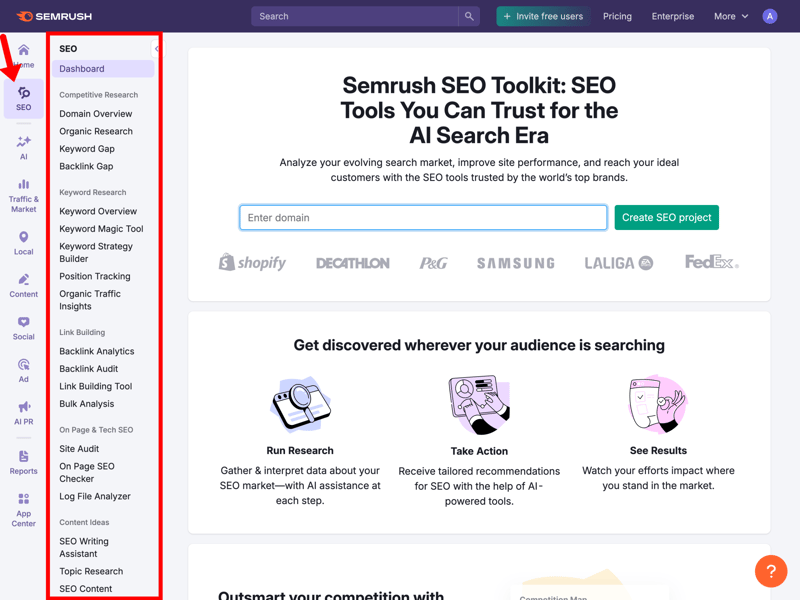
Semrush offers one of the most comprehensive SEO dashboards on the market.

What sets Semrush apart from other tools?

Many SEO tools take an all-in-one approach, but Semrush goes a step further than most competitors. It’s not just an SEO tool; it’s a comprehensive digital marketing suite. Beyond classic SEO modules, it includes tools for PPC competitor analysis and social media management.

For keyword research, Semrush combines standard metrics like search volume with domain-specific data. This allows you to gauge at a glance how difficult it will be to crack the top rankings for a specific term.

Another standout feature is the integrated toxicity score in the backlink analysis, which helps identify potentially harmful links.

Who is Semrush best suited for?

Semrush is a solid choice for marketing agencies and larger companies looking for a central platform that covers all digital channels. If precision is your top priority—especially regarding daily rank tracking and traffic forecasting—this is one of the most robust tools available.

What are Semrush’s weaknesses?

Beginners can easily feel overwhelmed by the sheer number of menus and dashboards. Another downside is the fragmented user experience: because the platform has grown so much through acquisitions, some modules feel disjointed and lack a consistent interface design. Semrush is also one of the most expensive options in our comparison.

Semrush pros and cons

  • Massive feature set
    Semrush offers one of the most comprehensive SEO and marketing dashboards available, covering far more than just search engine optimization.

  • Industry-leading data depth
    The platform excels at providing granular insights and massive keyword databases that outperform most competitors.

  • Reliable site audit with clear recommendations
    The built-in crawler thoroughly analyzes websites, identifies technical issues, and prioritizes them in a way that’s easy to understand.

  • Excellent learning resources
    The Semrush Academy offers high-quality, free courses along with recognized certifications.

  • Strong results across nearly all test categories
    In our comparison, Semrush consistently scored high across the board, except for value for money.

  • Relatively high costs
    Semrush is one of the priciest options in our comparison, especially when you need advanced features or multiple user accounts.

  • Steep learning curve
    The wide range of features and complex menu structure can be overwhelming for beginners at first.

  • Inconsistent UI across modules
    With so many integrated features, the interface can feel fragmented, making it harder to maintain a seamless workflow across different tools.

Review
9.4
excellent
Check Review
Backlink Analysis (15%)
10 / 10
Keyword Research (15%)
10 / 10
Other Features (20%)
10 / 10
Support (10%)
10 / 10
Competitor Analysis (20%)
9.3 / 10
Interface and Usability (10%)
8.7 / 10
Pricing (10%)
5.6 / 10
2.

Sistrix: Precision Analytics with a Gold-Standard Visibility Index

Sistrix
Sistrix
(364 )
Sistrix is the standard in the German-speaking region. Its range of features makes it the top choice for professionals and agencies who value precision and strategy.
Visibility index as industry standard
above-average data quality
clear and user-friendly interface
strong site audit & reporting
excellent support
9.0
excellent
Projects
3 - 100
Keywords
2,500 - 100,000
Reports per day
142 - 14,285
Historical data
0.25 - 13 Years
Sistrix Start
from $138.04
monthly price

Sistrix is a pioneer in SEO analytics and a dominant force in European market data. The Bonn-based provider gained recognition primarily through its Visibility Index, introduced in 2008, which remains a key metric for measuring SEO performance to this day.

What do we like about Sistrix?

The tool impresses with fast processing speeds and a clean design free of visual clutter. The platform offers expert-level technical support and an extensive Learning Hub, which breaks down even complex SEO topics in an accessible way.
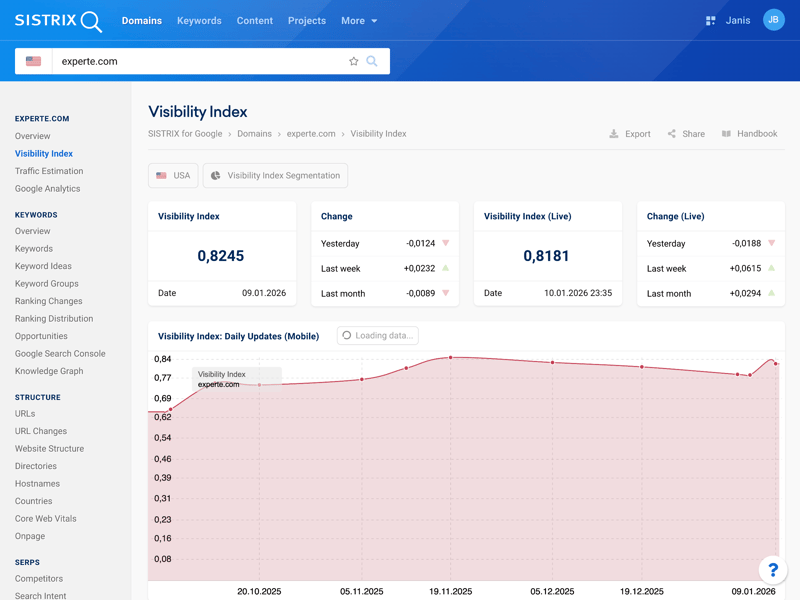
Sistrix puts the Visibility Index at the center of its domain analysis.

What sets Sistrix apart from other tools?

While many international tools try to cover everything, Sistrix’s competitive edge lies in its unparalleled historical data and its deep-dive insights into European search landscapes.

Sistrix also uses innovative visualization formats. For example, the SERP layout feature shows a schematic view of search result pages. This makes it immediately clear how SERP features like featured snippets or ads impact organic real estate.

Keyword grouping by topic works especially well in Sistrix: semantic relationships are detected automatically, which makes working with content clusters much easier. For competitor analysis, Sistrix also provides detailed insights into the directory structure of rival websites.

Who is Sistrix best suited for?

Sistrix is geared toward data-driven SEO professionals, agencies, and businesses with a clear focus on international growth and European markets. If you require precise competitive benchmarks and value reliable, long-term data histories, this is a professional-grade tool worth considering.

What are Sistrix’s weaknesses?

Sistrix is also relatively expensive. When it comes to backlink analysis, the tool falls short compared to specialized systems like Ahrefs: its own crawler indexes significantly fewer referring domains. The specialized focus on high-end data means the interface can be less intuitive for beginners compared to more mainstream platforms.

Pros and cons of Sistrix

  • Pioneering visibility index
    With its Visibility Index, Sistrix has created a widely recognized metric that allows for quick and reliable assessment of SEO visibility.

  • Versatile and well-structured keyword research
    The extensive keyword database offers granular filters, a focus on search intent, and practical features like question lists and keyword groups.

  • Unmatched European Data Depth
    Sistrix is the premier choice for businesses targeting European markets, offering historical data and regional insights that competitors often lack.

  • Expert-led resources
    Access to high-level SEO expertise through deep-dive tutorials, workshops, and a highly responsive support team.

  • High costs, especially for teams
    Sistrix is relatively expensive, and the modular pay-per-feature pricing can lead to significant costs as your needs scale.

  • Comparatively small backlink database
    For detailed off-page analysis, Sistrix is less suited than specialized backlink tools.

  • Learning curve due to modular structure
    The interface is well organized, but the density of information and the distribution of features still require some getting used to.

Review
9.0
excellent
Keyword Research (15%)
10 / 10
Other Features (20%)
10 / 10
Support (10%)
9.6 / 10
Interface and Usability (10%)
9.1 / 10
Competitor Analysis (20%)
8.9 / 10
Backlink Analysis (15%)
8.2 / 10
Pricing (10%)
6.4 / 10
3.

Ahrefs: Pro-Level Tool for Technical Precision and Backlinks

Ahrefs
Ahrefs
(581 )
Ahrefs is an all-in-one solution for experienced SEO experts who need deep insights into backlinks, content, and technical SEO, and want to benefit from continuous data updates.
largest backlink index in the industry
excellent performance
detailed site audit
advanced keyword research
outstanding support
8.8
good
Projects
5 - 50
Keywords
750 - 5,000
Reports per day
16 - ∞
Historical data
0.5 - 5 Years
Ahrefs Lite
from $108.00
monthly price

Ahrefs has earned a stellar reputation within the SEO community, particularly for its link analysis capabilities. Since launching in 2010, the tool has evolved from a specialized backlink checker into a comprehensive SEO and marketing suite. Today, the platform includes features for technical website audits, keyword research, rank tracking, and content analysis.

What do we like about Ahrefs?

The Ahrefs backlink index is nearly unmatched in freshness. Its proprietary crawler works very fast and updates data at short intervals.

Performance is another strong point—tables and charts load instantly, even for large domain queries. The site audit delivers a thorough technical analysis with clearly structured recommendations.

What sets Ahrefs apart from other tools?

A standout feature is the detailed analysis of referring IP addresses. This allows users to identify private blog networks (PBNs), which is essential for maintaining a link-building strategy.

In the Keyword Explorer, the “Parent Topics” feature helps you assign individual search terms to broader topic clusters and strategically organize your content.
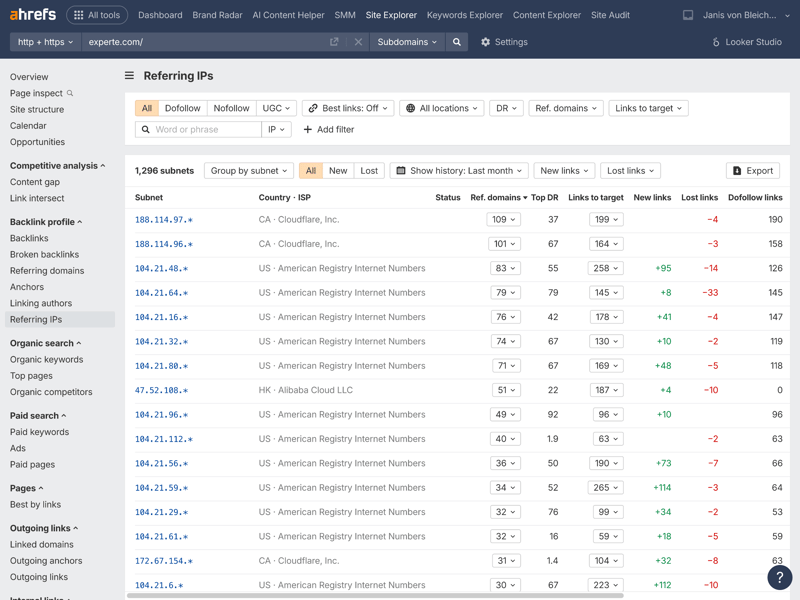
Ahrefs stands out with innovative and specialized features like “referring IPs.”

Ahrefs also offers modern features like “Brand Radar,” which lets you monitor your brand’s visibility across AI-driven search experiences (SGE) and large language model chatbots. The internal link analysis is also very detailed and helps you optimize how link equity is distributed across your website.

Who is Ahrefs best suited for?

Ahrefs is primarily aimed at experienced SEO professionals, data-driven inbound marketers, and larger agencies. If you need deep insights into backlink structures, technical details, and extensive data histories, this remains one of the most robust platforms in our lineup.

What are the potential weaknesses of Ahrefs?

Once again, price is the biggest drawback: Ahrefs is one of the most expensive SEO tools on the market. There’s no free trial and no money-back guarantee. The lack of localized training resources can be a hurdle for global teams. While the interface supports multiple languages, the advanced documentation and Academy courses are primarily English-centric.


Pros and cons of Ahrefs

  • Industry-leading backlink index
    Ahrefs offers one of the largest and most up-to-date link indexes on the market.

  • High data quality and fast performance
    Even with large datasets, the tool responds quickly and allows for deep analysis without waiting.

  • Comprehensive all-in-one suite for professionals
    Beyond backlink analysis, Ahrefs includes modules for keyword research, rank tracking, site audits, content analysis, AI features, and API integrations.

  • Innovative AI features
    Many SEO tools treat AI as a gimmick. Ahrefs has built practical AI features that actually add value.

  • High costs
    Ahrefs is the most expensive SEO tool in our comparison. The entry barrier is steep, especially for smaller businesses or solo projects.

  • Dense and non-intuitive UI
    The vast amount of data and the way features are nested can make for a steep learning curve, even for seasoned pros.

  • Limited multilingual documentation
    While the UI is localized, the deep-dive tutorials and support resources are mostly limited to English, which may pose challenges for international teams.

Review
8.8
good
Support (10%)
10 / 10
Backlink Analysis (15%)
9.7 / 10
Keyword Research (15%)
9.7 / 10
Interface and Usability (10%)
9.6 / 10
Other Features (20%)
9.3 / 10
Competitor Analysis (20%)
9.1 / 10
Pricing (10%)
2.4 / 10
4.

SE Ranking: Flexible All-in-One Tool for Budget-Conscious Users

SE Ranking
SE Ranking
(297 )
SE Ranking bridges the gap between beginner tools and expensive professional suites. It impresses with a vast range of features at a fair price, especially for agencies and freelancers.
comprehensive all-in-one suite
all features for keyword & ranking
fair prices for agencies & SMBs
flexible and scalable solution
partly mixed data quality
8.6
good
Projects
5 - ∞
Keywords
500 - 15,000
Reports per day
1,000 - 10,000
Historical data
0 - 5 Years
SE Ranking Essential
from $52.00
monthly price

SE Ranking launched in 2013 as a specialized keyword tracking tool but has since matured into a comprehensive SEO platform. With over 30 integrated features, the software covers all the core areas of search engine optimization.

The platform is a powerful yet more affordable alternative to the big industry players. It appeals to freelancers and agencies alike.

What do we like about SE Ranking?

The platform’s price-to-performance ratio is its strongest selling point. Compared to many established suites, users get a broad range of features at significantly lower costs.

SE Ranking’s core module remains its rank tracker. In our testing, the ranking data remained consistent and accurate (even during periods of high volatility). The interface is clean and refreshingly uncluttered. Even with larger projects, there’s hardly any noticeable lag.
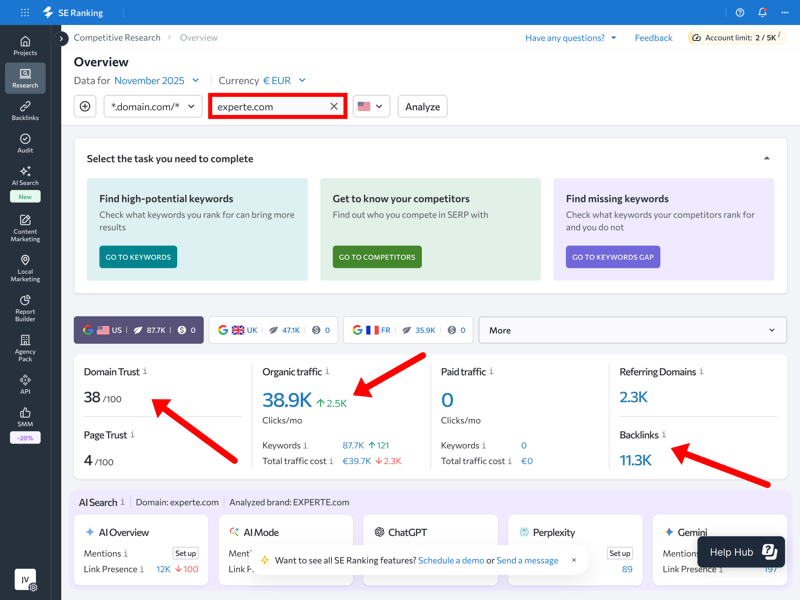
SE Ranking’s dashboard brings all key SEO metrics together in one clear view.

What sets SE Ranking apart from other tools?

A key differentiator is the granular pricing model, which allows users to tailor plans based on project size, keyword count, and crawling frequency. This allows for precise budget planning. Agencies also get white-label options in mid-tier plans, so reports can be branded with their design.

SE Ranking’s on-page checker goes a step further than many standard website audits. Instead of just analyzing the entire domain, the module evaluates individual URLs for specific keywords and compares them directly with top-performing competitors. The integration of AI tracking also shows that the platform is quick to adopt current trends.

Who is SE Ranking best suited for?

SE Ranking is an excellent choice for solo practitioners, in-house teams, and scaling agencies that need a professional SEO suite but don’t want to pay premium prices. For data-driven projects with clear budget constraints, it’s a solid alternative to the market leaders.

What are SE Ranking’s potential weaknesses?

When it comes to backlink analysis, the database is noticeably smaller than specialized competitors. In our testing, the crawler identified far fewer referring domains. This can lead to data gaps for large or heavily linked websites.

Furthermore, certain features—like the AI content editor or specialized local SEO modules—aren’t included in the base plan and have to be purchased separately.

Pros and cons of SE Ranking

  • Competitive pricing and flexibility
    SE Ranking provides a robust feature set at a discounted cost compared to major competitors, with plans that scale alongside your business.

  • Reliable rank tracker
    SE Ranking delivers accurate and consistent ranking data, making it well-suited for long-term SEO projects.

  • Granular on-page insights
    The audit module evaluates individual URLs against top-ranking competitors, offering actionable data for specific optimizations.

  • Strong reporting features
    SE Ranking offers flexible report templates and white-label options, letting you create professional reports with your branding.

  • Smaller backlink database
    Compared to specialized backlink tools, the link index is noticeably smaller.

  • Extra costs for certain modules
    Some features, like the AI content editor or specialized local SEO tools, aren’t included in the base plan and require an additional purchase.

  • Lack of localized support
    The absence of dedicated support in other major languages could be a hurdle for international agencies and global clients.

Review
8.6
good
Check Review
Pricing (10%)
10 / 10
Support (10%)
9.6 / 10
Competitor Analysis (20%)
8.7 / 10
Keyword Research (15%)
8.5 / 10
Other Features (20%)
8.2 / 10
Backlink Analysis (15%)
7.9 / 10
Interface and Usability (10%)
7.8 / 10
5.

Ubersuggest: Budget-Friendly Keyword Finder for SEO Beginners

Ubersuggest
Ubersuggest
(800 )
Ubersuggest offers the best value for money and impresses with high data quality. It's the perfect choice for beginners and small to medium-sized businesses focusing on content rather than technical depth.
best costs in comparison
surprisingly high data quality
very beginner-friendly
strong keyword research
Support needs improvement
8.5
good
Projects
1 - 15
Keywords
125 - 4,500
Reports per day
150 - 900
Historical data
1 Year
Ubersuggest Individual
from $29.00
monthly price

Under the guidance of digital marketer Neil Patel, Ubersuggest has evolved from a simple keyword generator into a versatile SEO platform. The platform caters not only to professionals but is specifically designed to make SEO accessible to beginners and small businesses. It combines basic analysis features with an extensive keyword database at relatively low costs.

What do we like about Ubersuggest?

Ubersuggest excelled in keyword research during our evaluation, delivering a surprisingly high volume of search term suggestions (sometimes outperforming significantly pricier competitors). The search volume data also proved accurate and up-to-date.

The interface is clean and avoids cluttered data views. Integrated tooltips explain technical terms directly within the dashboard, which lowers the barrier to entry for newcomers. The visual presentation of data is another plus, helping users quickly grasp connections and trends.
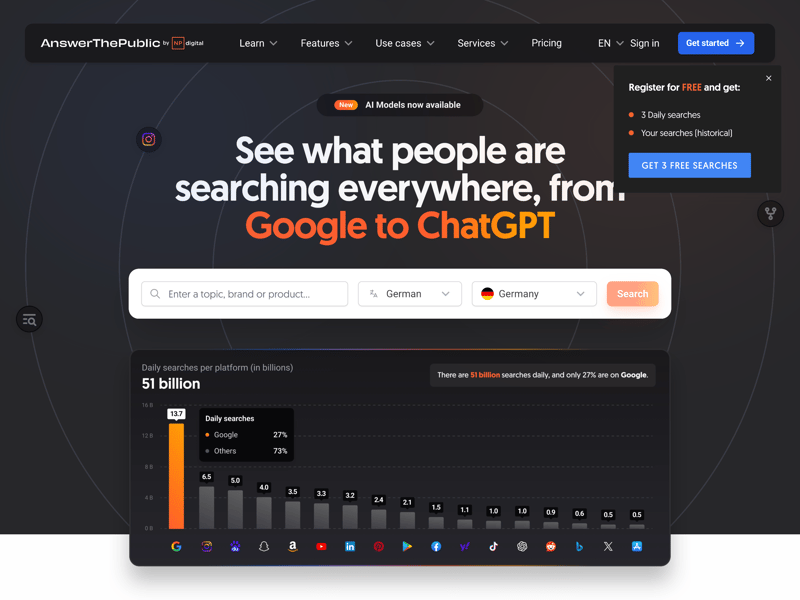
Ubersuggest presents keyword data in a clear, visual format.

What sets Ubersuggest apart from other tools?

The platform prioritizes visual data, such as its topical keyword clustering tool, which helps streamline content planning. The Chrome extension included with the subscription shows key SEO metrics directly in search results, allowing for quick competitor analysis without switching tools.

Who is Ubersuggest best suited for?

Ubersuggest is an excellent fit for bloggers, small business owners, and content teams seeking reliable data on a budget. For SEO beginners, it offers a solid foundation without overwhelming complexity.

What are Ubersuggest’s potential weaknesses?

When it comes to in-depth technical analysis or comprehensive off-page strategies, Ubersuggest quickly hits its limits. The backlink analysis lacks important filter options, such as filtering by IP address or traffic source.

On top of that, key enterprise features like an API or extensive white-label reporting options are missing, which limits scalability for larger agencies.

While the core interface is user-friendly, the lack of localized support resources for non-English-speaking markets can be a drawback for international teams or agencies with global clients.

Pros and cons of Ubersuggest

  • Extensive keyword database
    Ubersuggest provides a surprisingly deep pool of keyword ideas and accurate search volume data (holding its own against premium suites).

  • Beginner-friendly interface
    The user interface is clearly organized, and many technical terms are explained directly, making it easier to get started with search engine optimization.

  • Highly competitive pricing
    As one of the most accessible tools in our comparison, Ubersuggest offers excellent value for small-scale projects.

  • Visual data presentation and browser extension
    Graphical displays like the tree diagram and the integrated Chrome extension make day-to-day analysis easier.

  • Missing enterprise features
    Larger agencies will miss key integrations like APIs or comprehensive reporting options, which limits scalability.

  • Restrictive backlink filtering
    Despite the large keyword database, the backlink analysis offers only limited filtering options, making detailed off-page analysis more difficult.

  • Limited multilingual support
    The absence of localized documentation and support in other major languages may pose challenges for international users.

Review
8.5
good
Interface and Usability (10%)
10 / 10
Pricing (10%)
10 / 10
Keyword Research (15%)
9.4 / 10
Backlink Analysis (15%)
8.4 / 10
Competitor Analysis (20%)
8.0 / 10
Other Features (20%)
7.3 / 10
Support (10%)
6.4 / 10
6.

Serpstat: Budget-Friendly All-Rounder with a Data Focus

Serpstat
Serpstat
(490 )
Serpstat scores as an affordable all-rounder with strong audits and good visualizations. Ideal for technically oriented SEOs. However, it lacks essential features and the interface is only in English.
solid value-for-money winner
strong technical site audit
good visualizations & graphics
essential features are missing
data analysis is partly not possible
7.9
good
Projects
5 - ∞
Keywords
2,500 - 125,000
Reports per day
100 - 5,000
Historical data
10 Years
Serpstat Individual
 $50.00
monthly price

Ukrainian agency Netpeak originally developed Serpstat in 2013 as an internal utility for automating keyword research. It has since matured into a standalone. Since then, it has grown into a standalone all-in-one suite that covers the entire SEO workflow, from technical analysis to backlink management.

Like SE Ranking, Serpstat positions itself as a cost-conscious alternative to larger competitors.

What do we like about Serpstat?

Serpstat is particularly compelling due to its competitive price-to-performance ratio. Despite relatively low costs, the platform offers a broad feature set that covers nearly all core SEO disciplines.

The technical site audit was a highlight in our testing. Technical issues are presented in a structured format and prioritized by impact, allowing users to tackle optimizations efficiently. The platform also runs fast and stable, even with larger queries.
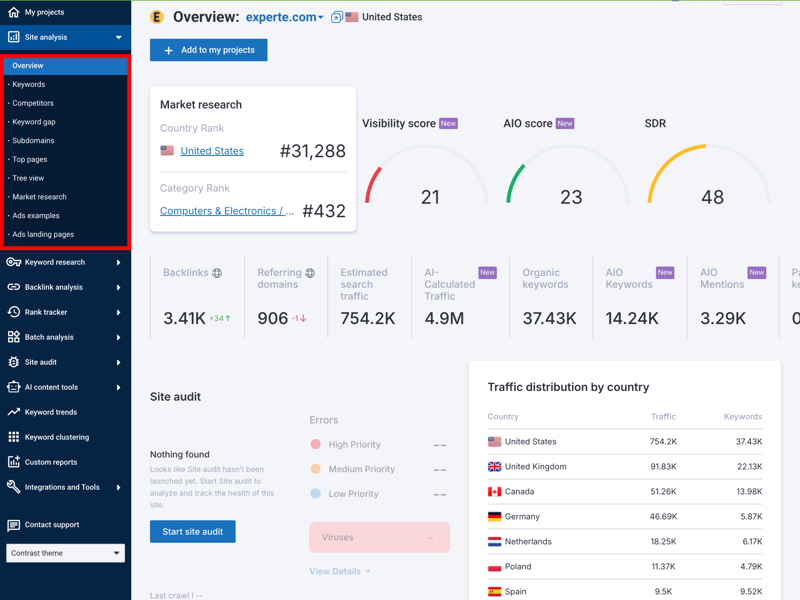
Serpstat bundles the most important domain metrics into a compact overview.

What sets Serpstat apart from other tools?

One especially handy feature is Serpstat’s Tree View. It displays a domain hierarchically by subpages and assigns keywords directly to the corresponding URLs. This makes it easy to analyze site structures and identify on-page opportunities.

Serpstat also offers detailed trend analysis for local SEO. Search trends can be filtered down to the city level, a feature that is especially useful for managing hyper-local campaigns. For backlinks, Serpstat uses its own crawler, so it doesn’t rely on external data sources.

Who is Serpstat best suited for?

Serpstat is a great fit for startups, small teams, and agencies with limited budgets who still want access to a wide range of features. Because the modules aren’t fully integrated, you’ll often find yourself jumping between tabs and moving data manually.

What are Serpstat’s potential weaknesses?

The biggest drawback is the inconsistent accuracy of its traffic estimates. In our testing, the projected visitor numbers sometimes differed significantly from actual measurements, so they’re better used as a rough trend indicator. The pricing structure isn’t always immediately transparent either, so it’s worth checking exactly which features are included in each plan before signing up.

Pros and cons of Serpstat

  • Exceptional price-to-performance ratio
    Serpstat provides an expansive feature set (covering nearly all SEO disciplines) at a significantly lower price point than premium competitors.

  • Structured “tree view” for content analysis
    The tree view displays which keywords are assigned to which subpages in a clear hierarchy. This makes it easier to analyze site structures and optimize individual pieces of content.

  • Site audit with clear prioritization
    The technical audit ranks errors by urgency, so you can focus on the most important fixes first.

  • Inconsistent traffic estimates
    The accuracy of projected visitor numbers isn’t always convincing. The data works better as a trend indicator than as a precise metric.

  • Limited international data precision
    The platform’s data accuracy and depth can vary across different global markets, making it less reliable for broad international campaigns.

  • Opaque tiered pricing
    The distinctions between subscription levels are not always transparent, requiring users to carefully vet feature lists before committing.

Review
7.9
good
Support (10%)
10 / 10
Pricing (10%)
10 / 10
Other Features (20%)
7.6 / 10
Backlink Analysis (15%)
7.5 / 10
Interface and Usability (10%)
7.3 / 10
Keyword Research (15%)
7.3 / 10
Competitor Analysis (20%)
6.9 / 10
7.

Mangools: User-Friendly 5-in-1 SEO Platform

Mangools
Mangools
(339 )
Mangools stands out with the best user interface in the review, making SEO extremely accessible. However, due to the lack of a site audit and module separation, it is more suitable for beginners and content teams.
top marks in ease of use and setup
excellent traffic estimation
good rank tracking
no technical site audit
workflow disrupted by separation
7.8
good
Projects
null Projects
Keywords
200 - 1,500
Reports per day
100 - 1,200
Historical data
8 Years
Mangools Basic
 $37.70
monthly price

Mangools has taken a somewhat unconventional approach since its founding in 2014. Instead of a single central platform, the suite consists of five standalone applications. KWFinder handles keyword research, SERPChecker analyzes search results, SERPWatcher tracks rankings, LinkMiner examines backlinks, and SiteProfiler provides domain metrics.

What do we like about Mangools?

Mangools has one of the best user interfaces on the market. The design is modern and intuitive, making complex SEO data digestible even for beginners.

In our evaluation of traffic accuracy, Mangools ranked second for organic traffic predictions, providing surprisingly reliable data. The estimates turned out to be surprisingly reliable.

Another highlight is the backlink preview in LinkMiner: linking pages are displayed directly, anchor text is highlighted, and you can quickly grasp the context.
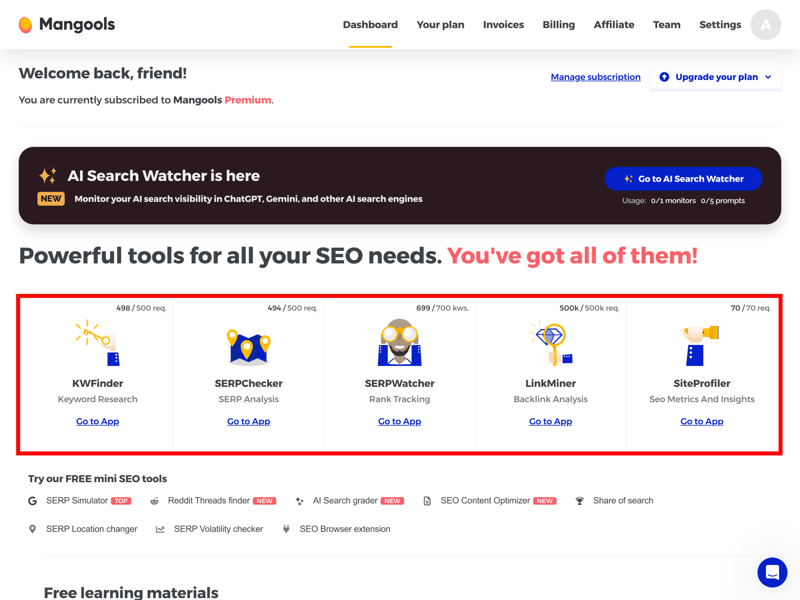
Mangools splits its features into five standalone applications.

What sets Mangools apart from other tools?

The primary differentiator is its modularity, with each application focusing exclusively on a specific task to keep the workspace uncluttered.

KWFinder combines an intuitive interface with reliable data on search volume and ranking difficulty. This makes it especially well-suited for structured content planning.

Who is Mangools for?

Mangools is aimed primarily at SEO beginners, bloggers, and smaller marketing teams. If your focus is on keyword research, competitor analysis, and rank tracking, and you don’t require advanced technical configurations, this is a highly accessible option.

What are potential weaknesses of Mangools?

Because the individual modules aren’t seamlessly integrated, you’ll often find yourself switching between browser tabs and transferring data manually. A notable gap is the absence of a technical site audit module.

Additionally, Mangools lacks deep localization (both in terms of multilingual support and regional data nuances), which may limit its appeal for global agencies.

Pros and cons of Mangools

  • Exceptional ease of use
    Mangools features a modern, clean design that allows even absolute beginners to navigate SEO metrics with confidence.

  • Accurate traffic estimates
    In our testing, the algorithms delivered reliable estimates for organic visitor numbers, making it easier to realistically assess competitors.

  • Useful backlink preview
    Linking pages are displayed directly in the tool, and anchor text is automatically highlighted. This makes evaluating backlinks quick and easy.

  • Fragmented workflow due to modular structure
    The split into five separate apps means you’re constantly switching between browser tabs, which can disrupt your workflow.

  • Lack of technical audit features
    The platform does not include a comprehensive on-page crawler, requiring users to rely on a separate tool for technical SEO audits.

  • Limited global localization
    The lack of multilingual support and localized data insights can be a hurdle for teams managing international campaigns in markets other than English-speaking ones.

Review
7.8
good
Check Review
Interface and Usability (10%)
10 / 10
Pricing (10%)
10 / 10
Support (10%)
8.7 / 10
Backlink Analysis (15%)
8.5 / 10
Keyword Research (15%)
7.6 / 10
Competitor Analysis (20%)
7.3 / 10
Other Features (20%)
4.9 / 10
8.

SpyFu: The Specialist for Competition and PPC

SpyFu
SpyFu
(814 )
SpyFu is the specialist for competitor analysis and PPC with the most accurate traffic data in the review. It's great as an affordable addition, but unsuitable as a standalone SEO tool due to the lack of technical features.
specialized competitor analysis
very affordable pricing model
helpful support
no technical site audit
weak data (backlinks, search volume)
7.6
good
Projects
1 - ∞
Keywords
5,000 - 50,000
Reports per day
10,000 - ∞
Historical data
0 - 10 Years
SpyFu Basic
from $29.00
monthly price

SpyFu stands out from typical all-in-one SEO suites by focusing almost entirely on competitive intelligence. The name says it all: the tool reveals organic strategies and paid campaigns from your competitors that would otherwise be difficult to uncover.

What do we like about SpyFu?

The accuracy of the traffic data is particularly impressive. In our evaluation, SpyFu’s traffic projections most closely aligned with actual visitor numbers, providing the most reliable estimates among the tools we tested.

On top of that, the tool stands out for its low entry costs and clear side-by-side comparison of organic and paid traffic. SEO and PPC data are displayed together, making competitor analysis fast and straightforward.
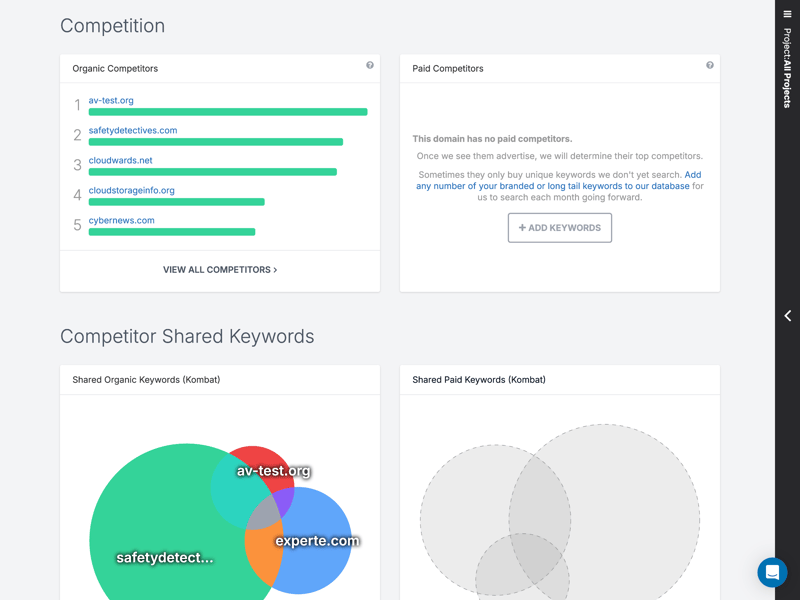
SpyFu displays organic and paid competitor traffic side by side.

What sets SpyFu apart from other tools?

SpyFu combines organic rankings with paid advertising data. Users get insights not just into ranking positions, but also into ad budgets, click-through rates, and actual ad copy from competitors (often including historical data spanning several years).

Another unique feature is the built-in lead module, which provides business contact information for potential customers. This takes SpyFu beyond standard SEO analysis and opens up additional opportunities for sales and outreach.

Who is SpyFu best suited for?

SpyFu is ideal for marketing teams, PPC managers, and sales departments looking to analyze competitor strategies or identify new market opportunities. The platform provides a specialized solution for those prioritizing data-driven competitor monitoring across both organic and paid search.

What are SpyFu’s potential weaknesses?

SpyFu isn’t well suited for technical site optimization. It lacks a comprehensive site audit, and its backlink index leaves a lot to be desired.

A significant drawback is its narrow geographical focus. While SpyFu excels in the US and UK markets, its data depth for other international regions is severely limited. That can lead to major inaccuracies (such as reporting near-zero search volume for high-traffic global terms).

Pros and cons of SpyFu

  • Deep competitor insights
    SpyFu excels at uncovering competitor strategies, highlighting both their tactical strengths and their underlying weaknesses.

  • Unique PPC data
    The tool makes competitors’ Google Ads campaigns transparent, offering insights into budgets, ad copy, and historical performance data.

  • Low entry costs
    SpyFu is significantly cheaper than comprehensive SEO suites.

  • Lack of technical auditing
    The platform does not provide tools for technical website analysis, such as crawlers or site health audits.

  • Limited global database
    Due to its heavy focus on English-speaking markets, the tool’s data quality significantly decreases when analyzing international or non-US search trends.

  • Tiny backlink index
    SpyFu isn’t well-suited for in-depth link analysis, as its backlink database is significantly smaller than other SEO tools.

9.

Moz Pro: A Long-Standing Classic with a Focus on Authority

Moz Pro
Moz Pro
(870 )
Moz Pro is a classic with strong backlink metrics and a solid crawler. However, the tool feels outdated: it lacks traffic estimates and is heavily focused on the USA.
comprehensive backlink analysis
established metrics (Domain Authority)
no traffic estimate possible
below average quality
little focus on the DACH market
7.2
good
Projects
1 - 25
Keywords
50 - 3,000
Reports per day
2 - 500
Historical data
null Years
25 % Rabatt
Moz Starter
from $39.00
monthly price

As an industry pioneer, Moz Pro has been a cornerstone of the SEO market since 2004. What started as a blog and consulting agency evolved into a software provider with a classic all-in-one suite. With Moz Pro, the company focuses less on trendy features and more on established metrics for evaluating link authority.

What do we like about Moz Pro?

The integrated Page Grader is a practical utility for content optimization, providing specific recommendations to improve a URL’s relevance for a target keyword.

The technical site audit also impresses with its clear structure and logical prioritization of issues. On top of that, Moz Pro benefits from an extensive historical data archive, making it easy to track long-term domain trends.
The Moz Pro dashboard provides quick access to the main analysis modules.

What sets Moz Pro apart from other tools?

Moz Pro is best known for developing Domain Authority (DA) and Page Authority (PA), metrics that have become industry-standard benchmarks for evaluating a website’s competitive strength. Another standout feature is the sheer size of its backlink index.

The “MozBar” browser extension also offers a convenient way to view SEO metrics directly while browsing Google search results or visiting websites.

Who is Moz Pro best suited for?

Moz Pro is primarily aimed at marketing teams and agencies targeting core English-speaking markets where historical data depth is a priority. If you value internationally recognized authority metrics and a solid technical foundation, this is a proven tool.

What are potential weaknesses of Moz Pro?

Moz Pro lacks the global versatility found in newer suites. While it excels in the US, its data depth and localization in non-English-speaking markets remain limited, which can be a significant hurdle for global agencies managing international campaigns.

Traffic estimates for competitors are completely missing, which limits competitive analysis. Moz Pro also lags more modern all-in-one suites when it comes to keyword research and offers a relatively limited feature set overall.

Pros and cons of Moz Pro

  • Standardized authority metrics
    Domain Authority (DA) and Page Authority (PA) offer recognized benchmarks that allow for consistent competitive analysis across the industry.

  • Large historical data archive
    Thanks to its long market presence, Moz Pro provides extensive historical link data, allowing you to track domain developments over many years.

  • Solid on-page optimization
    The Page Grader delivers specific recommendations for keyword optimization of individual URLs and helps prioritize actions.

  • Limited keyword database
    Compared to more modern SEO suites, Moz Pro delivers fewer keyword suggestions and offers a more limited feature set overall.

  • Lack of competitive traffic insights
    Unlike many modern competitors, Moz Pro does not provide visitor projections, which limits its utility for comprehensive strategic analysis.

  • Limited international localization
    The platform is heavily optimized for the US market, lacking the linguistic support and regional data depth required for complex international SEO projects.

Review
7.2
good
Check Review
Backlink Analysis (15%)
9.4 / 10
Interface and Usability (10%)
8.2 / 10
Pricing (10%)
7.3 / 10
Other Features (20%)
7.1 / 10
Support (10%)
6.9 / 10
Keyword Research (15%)
6.4 / 10
Competitor Analysis (20%)
5.6 / 10

Rating Criteria: Our Testing Methodology

To compare SEO tools as fairly and transparently as possible, we evaluated all software across seven categories. Each category has clearly defined criteria and a consistent scoring system. The categories are:

  • 1.

    Layout and Usability (10%)

  • 2.

    Competitor Analysis (20%)

  • 3.

    Backlink Analysis (15%)

  • 4.

    Keyword Research (15%)

  • 5.

    Additional Features (20%)

  • 6.

    Support (10%)

  • 7.

    Costs (10%)

Each platform’s overall score is derived from 32 distinct evaluation criteria, combining hands-on impressions with objective, data-driven analysis. Below, we briefly explain our seven categories and rating criteria. First, here’s the complete comparison table:

Semrush
Sistrix
Ahrefs
SE Ranking
Ubersuggest
Serpstat
Mangools
SpyFu
Moz
Interface and Usability (10%)
User interface ?
6/8
  • Design & Layout: Functional, data-rich, professional.
  • Navigation: An extensive left sidebar leads to the features.
  • Operation: Experienced SEO users find the operation logical and easy to use. Newcomers need some training due to the many options and data.
  • Data visualization: Dashboards and charts present information.
6.5/8
  • Design & Layout: Clear, organized, focused on data. Few distracting elements.
  • Navigation: Modules clearly structure the navigation.
  • Operation: Professional users find the interface intuitive. It requires some time to get familiar at the beginning.
  • Data visualization: Tables and graphs display information with high data density.
7/8
  • Design & Layout: Modern, clean, and appealing. Visualizations make data understandable.
  • Navigation: A central dashboard provides a good overview.
  • Operation: The operation is largely intuitive. Tooltips and question mark icons aid understanding. The abundance of data and reports can overwhelm beginners.
  • Data visualization: Graphs and charts visualize data effectively.
5.5/8
  • Design & Layout: Modern and tidy.
  • Navigation: The site navigation organizes the features clearly.
  • Operation: The tool is mostly intuitive and understandable. The amount of data can initially be a challenge.
  • Data visualization: The arrangement of the data appears sporadically inconsistent.
8/8
  • Design & Layout: Clean, modern, and clear appearance.
  • Navigation: The left side navigation is clearly structured; main areas are logically organized.
  • Operation: The tool is extremely intuitive and designed for ease of use. Tooltips and explanations are prominently placed everywhere.
  • Data Visualization: Graphics often present data appealingly. The interface rarely feels cluttered.
5/8
  • Design & Layout: Functional and data-oriented.
  • Navigation: Despite a lot of information, navigation remains clear.
  • Operation: Experienced users find the logic after a short familiarization period. Beginners might initially feel overwhelmed.
  • Data Visualization: The data visualization is functional but not always immediately self-explanatory.
8/8
  • Design & Layout: Simple, modern, and colorful.
  • Navigation: Five separate but interconnected dashboards structure the application.
  • Ease of use: The tool is self-explanatory, especially for SEO beginners. Switching between the five features works seamlessly.
  • Data visualization: Visual presentations of the data are easy to understand.
6/8
  • Design & Layout: Very clear and tidy.
  • Navigation: The navigation is structured simply.
  • Operation: The tool is largely intuitive. For advanced users, the interface may seem too simplified.
  • Data Visualization: Visual data presentations enable understandable comparisons. Very data-rich tables are partially cut off.
5.5/8
  • Design & Layout: Functional and simple.
  • Navigation: A left sidebar clearly organizes the features.
  • Usability: The tool is largely intuitive as its structure resembles common SEO platforms. The abundance of data can be overwhelming at first.
  • Data Visualization: Information is sometimes nested, requiring multiple clicks.
Performance ?
1.5/2
  • Speed: The platform operates remarkably fast and stable.
  • Report delivery: Reports based on the database load quickly with the tool.
  • Specific waiting times: Active crawling requires an initial waiting time.
1.5/2
  • Speed: The tool operates quickly and responsively.
  • Report provision: All analyses are based on a large, weekly updated database.
  • Specific waiting times: Only the on-page crawl in the "Optimizer" module requires some waiting time.
1.5/2
  • Speed: The platform operates remarkably fast and stable.
  • Report provision: Reports, based on the database, load quickly with the tool.
  • Special waiting times: Active crawling requires an initial waiting time.
1/2
  • Speed: The tool shows hardly any loading times.
  • Report provision: Data is sometimes incomplete or only available via plug-in.
  • Special waiting times: Audits take a bit longer.
1.5/2
  • Backlink Index: The tool provides a good overview, but the database is smaller.
  • Redirects & Canonicals: Redirects & Canonicals are part of the site audits for your own site.
  • JavaScript: The detection of JavaScript links is limited.
  • Index Update: The link index updates regularly.
  • Spam Detection: The tool does not offer explicit spam filtering or a "Toxicity Score."
1/2
  • Speed: The tool generally works stably; with enormous data queries, short loading times are possible.
  • Report Provision: Most reports for competitor or keyword analysis are immediately available.
  • Specific Waiting Times: The first site audit took some time.
2/2
  • Speed: The tool is fast and responsive, showing no loading times.
  • Report availability: All analyses and reports are available immediately.
2/2
  • Speed: The tool is fast with no noticeable loading times.
  • Report Provision: Analyses for domains or keywords are available immediately after input.
  • Special Waiting Times: There is no on-demand crawling for technical audits, so no waiting time for this feature.
1.5/2
  • Speed: The tool operates smoothly without significant delays.
  • Report Generation: The tool usually generates reports immediately.
  • Specific Wait Times: The initial site crawl of a new domain can take some time; subsequent crawls are faster.
Competitor Analysis (20%)
Analysis level ?
2/2
All four levels offered
2/2
All four levels are available.
2/2
All four levels available
1.5/2
All levels except URL available
1.5/2
All levels except path available
1.5/2
All levels except path available
1.5/2
All levels except path possible
1.5/2
All levels except path available
1.5/2
All levels except path available
Scope of traffic estimation ?
6/6
  • Paid traffic
  • Trafic value
  • Organic traffic
  • Traffic by country
  • 14 years data history
5/6
  • Paid traffic
  • Trafic value
  • Organic traffic
  • Traffic by country
  • 5 years data history
5/6
  • Paid traffic
  • Trafic value
  • Organic traffic
  • Traffic by country
  • 5 years data history
5/6
  • Paid traffic
  • Trafic value
  • Organic traffic
  • Traffic by country
  • 8 years data history
4/6
  • Paid traffic
  • Trafic value
  • Organic traffic
  • Traffic by country
  • 3 years data history
5/6
  • Paid traffic
  • Trafic value
  • Organic traffic
  • Traffic by country
  • 9 years data history
2/6
  • Organic traffic
  • Traffic by country
  • 1 year data history
6/6
  • Paid traffic
  • Trafic value
  • Organic traffic
  • Traffic by country
  • 16 years data history
1/6
  • Traffic by country
  • 1 year data history
Accuracy of traffic estimation ?
3/6
49.1 %
3/6
45.9 %
3/6
45.4 %
3/6
46.1 %
4/6
50.1 %
0/6
18.9 %
4/6
51.0 %
4/6
53.6 %
0/6
0.0 %
Keyword rankings ?
4/4
  • Top pages
  • Keyword gap analysis
  • Number of URLs (history)
  • Ranking history per keyword
  • Ranking changes
  • Number of keywords (history)
  • Organic competitors
  • Ranking distribution
4/4
  • Top pages
  • Keyword gap analysis
  • Number of URLs (history)
  • Ranking history per keyword
  • Ranking changes
  • Number of keywords (history)
  • Organic competitors
  • Ranking distribution
4/4
  • Top pages
  • Keyword gap analysis
  • Number of URLs (history)
  • Ranking history per keyword
  • Ranking changes
  • Number of keywords (history)
  • Organic competitors
  • Ranking distribution
4/4
  • Top pages
  • Keyword gap analysis
  • Number of URLs (history)
  • Ranking history per keyword
  • Ranking changes
  • Number of keywords (history)
  • Organic competitors
  • Ranking distribution
3.5/4
  • Top pages
  • Keyword gap analysis
  • Number of URLs (history)
  • Ranking history per keyword
  • Ranking changes
  • Number of keywords (history)
  • Organic competitors
3/4
  • Top pages
  • Keyword gap analysis
  • Ranking history per keyword
  • Ranking changes
  • Number of keywords (history)
  • Organic competitors
3.5/4
  • Top pages
  • Keyword gap analysis
  • Number of URLs (history)
  • Ranking history per keyword
  • Ranking changes
  • Number of keywords (history)
  • Ranking distribution
3.5/4
  • Top pages
  • Keyword gap analysis
  • Ranking history per keyword
  • Ranking changes
  • Number of keywords (history)
  • Organic competitors
  • Ranking distribution
4/4
  • Top pages
  • Keyword gap analysis
  • Number of URLs (history)
  • Ranking history per keyword
  • Ranking changes
  • Number of keywords (history)
  • Organic competitors
  • Ranking distribution
Page structure ?
1.5/2
Hostnames, directories, and outgoing links available, internal links not
1.5/2
Hostnames, directories, and outgoing links are possible, internal links are not.
2/2
All four available
1.5/2
All except directories available (however, divided into backlink analysis and audit)
0.5/2
Hostnames are available, directories, internal and outgoing links are not
1.5/2
All except directories present
1/2
Hostnames and outgoing links available, directories and internal links not
0.5/2
Only hostnames available, directories, internal and outgoing links are not present.
1.5/2
All except directories accessible via the Link Explorer
Backlink Analysis (15%)
Feature set ?
5/5
  • Top pages by links
  • Lost links
  • Toxic links
  • Anchor text analysis
  • Broken links
  • Backlink gap analysis
  • Referring IPs
  • Link quality metrics
  • Backlink history
  • Referring domains
4.5/5
  • Top pages by links
  • Lost links
  • Anchor text analysis
  • Broken links
  • Backlink gap analysis
  • Referring IPs
  • Link quality metrics
  • Backlink history
  • Referring domains
5/5
  • Top pages by links
  • Lost links
  • Toxic links
  • Anchor text analysis
  • Broken links
  • Backlink gap analysis
  • Referring IPs
  • Link quality metrics
  • Backlink history
  • Referring domains
5/5
  • Top pages by links
  • Lost links
  • Toxic links
  • Anchor text analysis
  • Broken links
  • Backlink gap analysis
  • Referring IPs
  • Link quality metrics
  • Backlink history
  • Referring domains
3.5/5
  • Top pages by links
  • Lost links
  • Anchor text analysis
  • Backlink gap analysis
  • Link quality metrics
  • Backlink history
  • Referring domains
4/5
  • Top pages by links
  • Lost links
  • Anchor text analysis
  • Backlink gap analysis
  • Referring IPs
  • Link quality metrics
  • Backlink history
  • Referring domains
5/5
  • Top pages by links
  • Lost links
  • Toxic links
  • Anchor text analysis
  • Broken links
  • Backlink gap analysis
  • Referring IPs
  • Link quality metrics
  • Backlink history
  • Referring domains
3.5/5
  • Top pages by links
  • Lost links
  • Anchor text analysis
  • Backlink gap analysis
  • Link quality metrics
  • Backlink history
  • Referring domains
4.5/5
  • Top pages by links
  • Lost links
  • Toxic links
  • Anchor text analysis
  • Broken links
  • Backlink gap analysis
  • Link quality metrics
  • Backlink history
  • Referring domains
Number of backlinks ?
3/4
8,927 referring domains
1/4
2,305 referring domains
2/4
5,627 referring domains
1/4
1,172 referring domains
4/4
12,100 referring domains
1/4
3,505 referring domains
2/4
5,200 referring domains
0/4
224 referring domains
4/4
12,100 referring domains
Data quality ?
3.5/4
  • Backlink index: The backlink database is among the largest and fastest on the market.
  • Redirects & canonicals: The site audit crawler reliably detects them.
  • JavaScript: The tool renders JavaScript.
  • Index update: The backlink index updates constantly.
  • Spam detection: The "Toxicity Score" identifies spam links.
  • Analysis features: The tool analyzes link profiles, assesses harmfulness, and creates disavow files.
3.5/4
  • Backlink index: Sistrix operates its own, very extensive backlink crawler, independent of third parties.
  • Data quality: The data quality is considered very high and reliable.
  • Redirects & Canonicals: The on-page crawler in the Optimizer detects redirects & canonicals.
  • JavaScript: The tool renders JavaScript.
  • Index update: Sistrix crawls and updates the index continuously.
  • Spam detection: There is no explicit spam or toxicity score.
4/4
  • Backlink index: Ahrefs operates the most active web crawler after Google and has the largest and most up-to-date backlink index in the industry.
  • Redirects & Canonicals: The crawler reliably detects redirects & canonicals.
  • JavaScript: Ahrefs can render JavaScript.
  • Index update: The index updates frequently; according to Ahrefs, every 15–30 minutes.
  • Spam detection: There is no explicit "Toxicity Score"; link quality is assessed manually.
  • Analysis features: Exporting link lists for disavow tools is possible.
2.5/4
  • Backlink index: Backlink data from the backlink analysis is very helpful.
  • Redirects & Canonicals: The tool distinguishes chains and faulty redirects.
  • JavaScript: JavaScripts are displayed in the site audit as "4XX or 5XX files."
  • Index update: The crawler continuously provides results.
  • Spam detection: The tool shows spam links as potentially harmful (Toxicity).
2/4
  • Keyword Organization: Provides a large amount of keyword ideas, questions, comparisons, and prepositions for a seed keyword.
  • Filter & Sorting: Extensive filters and sorting: search volume, SEO difficulty, paid difficulty, CPC, as well as including and excluding words.
3/4
  • Backlink Index: The index is extensive and provides a solid foundation for analysis; the tool uses its own crawler and an updated index.
  • Redirects & Canonicals: The tool detects redirects and flags them as errors or warnings.
  • JavaScript: Detecting JavaScript links is challenging.
  • Index Update: The backlink index updates continuously.
  • Spam Detection: The tool identifies potentially harmful links ("Toxicity Score").
2.5/4
  • Backlink index: The tool uses Majestic's API for its backlink data.
  • Redirects & Canonicals: The tool considers redirects & canonicals in the analysis.
  • JavaScript: The detection of JavaScript links depends on the Majestic database.
  • Index update: The update occurs daily.
  • Spam detection: The tool does not offer explicit spam filtering or a "Toxicity Score."
1.5/4
  • Backlink Index: The tool discovers link sources but does not offer an in-depth audit.
  • Redirects & Canonicals: Redirects & canonicals are not the tool's strength.
  • JavaScript: The tool can only partially recognize JavaScript-generated links.
  • Index Update: Keywords with high search volume are updated several times a month, most others about once a month (also implies backlink data).
  • Spam Detection: There is no explicit spam score.
3/4
  • Backlink Index: The data is high-quality and solid.
  • Redirects & Canonicals: The crawler detects redirects (301/302) and canonicals.
  • JavaScript: Detection of JavaScript-generated links is limited.
  • Index Update: The link index is always up-to-date.
  • Spam Detection: The "Spam Score" identifies harmful links.
Backlink filters ?
2/2
  • Link age
  • Link type (text, image, …)
  • Anchor text
  • Traffic of referring page
  • Nofollow/Dofollow
  • Link position (content, footer, …)
  • Language of referring page
  • Link authority
1.5/2
  • Link age
  • Link type (text, image, …)
  • Anchor text
  • Nofollow/Dofollow
  • Language of referring page
  • Link authority
2/2
  • Link age
  • Link type (text, image, …)
  • Anchor text
  • Traffic of referring page
  • Nofollow/Dofollow
  • Link position (content, footer, …)
  • Language of referring page
  • Link authority
1.5/2
  • Link age
  • Link type (text, image, …)
  • Anchor text
  • Traffic of referring page
  • Nofollow/Dofollow
  • Link authority
1.25/2
  • Link age
  • Link type (text, image, …)
  • Anchor text
  • Nofollow/Dofollow
  • Link authority
1.25/2
  • Link age
  • Link type (text, image, …)
  • Anchor text
  • Nofollow/Dofollow
  • Link authority
1.5/2
  • Link type (text, image, …)
  • Anchor text
  • Nofollow/Dofollow
  • Link position (content, footer, …)
  • Language of referring page
  • Link authority
1.25/2
  • Link type (text, image, …)
  • Anchor text
  • Traffic of referring page
  • Nofollow/Dofollow
  • Link authority
1/2
  • Link age
  • Anchor text
  • Nofollow/Dofollow
  • Link authority
Keyword Research (15%)
Features ?
5/5
  • Cost per click (CPC)
  • Search volume by month
  • SERP overlap
  • Search volume by country
  • Search intent
  • Current SERPs
  • SERP comparison
  • Historical SERPs
  • Keyword difficulty
  • Keyword clustering
5/5
  • Cost per click (CPC)
  • Search volume by month
  • SERP overlap
  • Search volume by country
  • Search intent
  • Current SERPs
  • SERP comparison
  • Historical SERPs
  • Keyword difficulty
  • Keyword clustering
5/5
  • Cost per click (CPC)
  • Search volume by month
  • SERP overlap
  • Search volume by country
  • Search intent
  • Current SERPs
  • SERP comparison
  • Historical SERPs
  • Keyword difficulty
  • Keyword clustering
5/5
  • Cost per click (CPC)
  • Search volume by month
  • SERP overlap
  • Search volume by country
  • Search intent
  • Current SERPs
  • SERP comparison
  • Historical SERPs
  • Keyword difficulty
  • Keyword clustering
3/5
  • Cost per click (CPC)
  • Search volume by month
  • Search volume by country
  • Current SERPs
  • Keyword difficulty
  • Keyword clustering
4.5/5
  • Cost per click (CPC)
  • Search volume by month
  • SERP overlap
  • Search volume by country
  • Current SERPs
  • SERP comparison
  • Historical SERPs
  • Keyword difficulty
  • Keyword clustering
4.5/5
  • Cost per click (CPC)
  • Search volume by month
  • SERP overlap
  • Search volume by country
  • Search intent
  • Current SERPs
  • SERP comparison
  • Keyword difficulty
  • Keyword clustering
4.5/5
  • Cost per click (CPC)
  • Search volume by month
  • SERP overlap
  • Search volume by country
  • Current SERPs
  • SERP comparison
  • Historical SERPs
  • Keyword difficulty
  • Keyword clustering
3.5/5
  • Search volume by month
  • SERP overlap
  • Search volume by country
  • Search intent
  • Current SERPs
  • SERP comparison
  • Keyword difficulty
Number of countries ?
1/1
190 countries
0.5/1
50 countries
1/1
170 countries
1/1
190 countries
1/1
230 countries
1/1
200 countries
1/1
120 countries
0/1
15 countries
1/1
200 countries
Number of keywords ?
2/3
3,331 keywords
2/3
3,504 keywords
1/3
1,801 keywords
2/3
3,831 keywords
2/3
5,325 keywords
/3
null keywords
0/3
410 keywords
2/3
3,032 keywords
0/3
106 keywords
Accuracy of search volume ?
4/5
75.3 %
4/5
72.4 %
4/5
73.4 %
2/5
52.8 %
5/5
83.0 %
2/5
54.9 %
3/5
65.5 %
0/5
29.9 %
2/5
55.7 %
Filters ?
2/2
  • Keyword organization: Displays millions of keywords in thematic clusters and subgroups.
  • Filter & sorting: Extensive filter and sorting options: search volume, keyword difficulty, CPC, search intent, SERP features, word count, as well as including and excluding terms.
2/2
  • Keyword organization: Has an extensive keyword database.
  • Filter & sorting: Offers powerful and granular filters and sorting: search volume, competition intensity, cost per click (CPC), SERP features (Maps, Images, News, etc.), and search intent.
2/2
  • Keyword organization: Shows thematic "Parent Topics" and clusters.
  • Filters & sorting: Extensive filter and sorting options: Keyword Difficulty, search volume, click potential (clicks), CPC, SERP features, word count, as well as including and excluding terms.
1/2
  • Keyword organization: The overview shows the number and search volume of the cluster.
  • Filter & sorting: Filters by inclusion, exclusion, word count, and characters. Sorts by search volume and difficulty.
1.5/2
  • Keyword Organization: Provides a large amount of keyword ideas, questions, comparisons, and prepositions for a seed keyword.
  • Filter & Sorting: Extensive filters and sorting: search volume, SEO difficulty, paid difficulty, CPC, as well as including and excluding words.
1.5/2
  • Keyword Organization: Groups keyword suggestions into semantic clusters.
  • Filter & Sorting: Filters by search volume, keyword difficulty, CPC, number of words, inclusion or exclusion of certain terms, and special filters for questions. Sorts by all common metrics.
1/2
  • Keyword organization: Provides keywords.
  • Filter & sorting: Filters and sorts by search volume, keyword difficulty, CPC, number of words, as well as including and excluding terms.
1.5/2
  • Keyword Organization: Displays keywords as groups or clusters.
  • Filter & Sorting: Filters and sorts by including and excluding words, word count, search volume, keyword difficulty, click rate, and cost-per-click (CPC).
1/2
  • Keyword Organization: Offers "Keyword Suggestions."
  • Filtering & Sorting: Filters by search volume, keyword difficulty, and organic click-through rate (CTR). A question filter shows only keyword suggestions as questions.
Other Features (20%)
Rank tracking ?
5/5
  • The tool tracks the presence of "AI Overviews" (Google's AI answers) in search results.
  • Position tracking shows which keywords trigger an AI result and if your own page appears there.
  • A feature for measuring visibility in external chatbots (like ChatGPT) is offered by the "AI Visibility Toolkit".
  • AI support in content creation via "SEO Content Template" and "SEO Writing Assistant".
4/5
  • Keyword set monitoring: Yes, the "Optimizer" module monitors projects with their own keyword sets.
  • Update frequency: Updates occur daily or weekly, depending on the plan.
  • Local tracking: Yes, detailed local rank tracking is possible at the country, city, and even device level (Desktop/Mobile).
4/5
  • Keyword set monitoring: Yes, the "Rank Tracker" monitors keyword sets in projects.
  • Update frequency: The update frequency depends on the chosen plan and ranges from weekly to daily.
  • Local tracking: Yes, detailed local rank tracking is possible at the country, state, or city level.
4/5
  • Keyword set monitoring: Yes, the rank tracker (position tracking) monitors up to 5 projects.
  • Update frequency: The frequency is chosen according to the plan (daily, weekly, manually).
  • Local tracking: Yes, local SEO is possible at country, region, and ZIP code level.
4.5/5
  • Keyword Set Monitoring: Yes, you can create projects with keyword lists for rank tracking.
  • Update Frequency: The rankings are updated daily in all paid plans.
  • Local Tracking: Yes, optimally developed local rank tracking is possible at country, city, or ZIP code level.
4/5
  • Keyword Set Monitoring: Yes, the "Rank Tracking" module works with projects and keyword sets.
  • Update Frequency: The ranking updates can be daily depending on the plan.
  • Local Tracking: Yes, local rank tracking is available at country, region, and city levels.
5/5
  • Keyword set monitoring: Yes, "SERPWatcher" acts as a dedicated rank tracker.
  • Update frequency: The ranking updates occur daily for all plans.
  • Local tracking: Yes, local rank tracking is possible at the country, state, county, or city level.
3/5
  • Keyword Set Monitoring: Yes, the "Tracking" section allows projects with keyword sets.
  • Update Frequency: Rankings are updated weekly by default.
  • Local Tracking: Yes, local SEO tracking is possible, focusing on national and city levels.
3/5
  • Keyword Set Monitoring: Yes, "Campaigns" use keyword sets for projects.
  • Update Frequency: Weekly by default, daily tracking is available in more expensive plans.
  • Local Tracking: Yes, local rank tracking is available at national, regional, and ZIP code levels.
AI-Tracking ?
3/5
  • Tracking the presence of "AI Overviews" (Google's SGE) in the SERPs
  • In position tracking: Which keywords show an AI result and feature your own page?
  • No features for tracking visibility in external chatbots
  • Semrush integrates AI features in many areas, e.g., the "ContentShake AI" for content creation
5/5
  • The tool tracks the integration of "AI Overviews" in the SERPs.
  • A separate module for AI bots is available as an external website.
  • Sistrix offers the "Content Assistant AI," which supports as a text editor with ChatGPT (OpenAI).
4.5/5
  • The tool tracks "AI Overviews" (Google's AI answers).
  • The Rank Tracker shows if your page appears for a keyword in such a feature.
  • The "Brand Radar" module allows direct tracking of visibility in external AI chatbots.
  • Ahrefs offers an AI-powered text editor.
1/5
  • The new AI tracking promises to map visibility and mentions in AI search engines like Perplexity, Gemini, or ChatGPT.
  • The data currently appears incomplete and sometimes contextless.
  • Some metrics only appear with a paid add-on, which limits the usefulness in the standard dashboard.
  • The feature requires some prior knowledge (e.g., decision for LLM-based search engine directly at first use).
  • The tool offers an AI-supported editor as an add-on for content marketing.
2/5
  • The tool integrates artificial intelligence to simplify tasks (e.g., "AI Writer" for content creation).
  • Dedicated tracking of rankings in AI chatbots like Gemini or Perplexity is missing.
  • The tool provides insight into visibility on ChatGPT (brand mentions in the past 30 days).
1.5/5
  • The tool detects if so-called "AI Overviews" appear in Google search results for keywords.
  • A feature to track brands in chatbots like ChatGPT does not exist.
0.5/5
  • The tool does not offer an explicit tracking module for AI visibility in chatbots or AI overviews.
  • An online test for AI visibility is available to determine how often the company name appears in AI search engines.
1/5
  • The AI tracking is still expandable.
  • It is currently primarily limited to brand mentions in tools like ChatGPT.
  • RivalFlow provides specific improvement suggestions based on URLs or keywords (AI-supported).
  • The evaluations are still relatively new and not as in-depth as the tool's core features.
2.5/5
  • Moz does not offer a true "AI Search."
  • The tool detects in the Domain Explorer if Google provides AI Overviews for a keyword.
  • There is AI-assisted text generation for marketing purposes.
Site audit ?
5/5
  • Technical error analysis: Yes, the "Site Audit" tool thoroughly scans the website for technical errors.
  • Error prioritization: Yes, it automatically prioritizes issues into "errors," "warnings," and "notices."
  • Error description: Detailed explanations show why an error exists and how to fix it, often with links to further articles. It also checks Core Web Vitals and HTTPS.
4.5/5
  • Technical error analysis: Yes, the "Optimizer" module serves as a comprehensive site audit tool for the on-demand crawl of your own website.
  • Error prioritization: Yes, Sistrix automatically prioritizes found errors into "Errors," "Warnings," and "Notices."
  • Error description: For each error, Sistrix provides an explanation; relevance and concrete solutions are practical and understandable. It also analyzes page structure and Core Web Vitals.
4.5/5
  • Technical error analysis: Yes, the "Site Audit" tool is a cloud-based crawler for comprehensive technical analysis of the website (checks over 140 predefined SEO issues).
  • Error prioritization: Yes, it automatically prioritizes issues as "Errors," "Warnings," and "Notices."
  • Error description: Each error has a clear description and specific instructions for resolution. The Site Audit is currently only available in English.
5/5
  • Technical error analysis: Yes, the website audit crawls the website and checks more than 115 technical and on-page factors (indexability, content quality, security, Core Web Vitals, backlink signals).
  • Error prioritization: Yes, a health score assesses the overall condition, and a traffic light system (errors, warnings, notices) indicates the need for action.
  • Error description: Each error has a detailed explanation, a list of affected URLs, and instructions for resolution. You can determine the scan frequency yourself.
3.5/5
  • Technical Error Analysis: Yes, the site audit crawls the website and assesses the technical condition.
  • Error Prioritization: Yes, it automatically prioritizes found issues into "critical errors" and "warnings."
  • Error Description: Simple explanations show what is wrong and why it matters to Google. An interactive to-do list shows optimization potentials.
4/5
  • Technical Error Analysis: Yes, the "Site Audit" conducts a comprehensive technical crawl of the website.
  • Error Prioritization: Yes, it categorizes errors by priority (high, medium, low) and summarizes the health status in the SDO score.
  • Error Description: Detailed descriptions of the problem and guidance for resolution are available for each error.
0/5
Mangools does not offer its own site audit tool.
0/5
SpyFu does not offer a comprehensive technical site audit tool.
3.5/5
  • Technical Error Analysis: Yes, the "Site Crawl" provides a technical audit.
  • Error Prioritization: Yes, it provides warnings and detailed explanations of errors. Categories like "Critical Crawler Issues" and "Crawler Warnings" help with classification. The tool indicates urgency with colors.
  • Error Description: Detailed explanations offer context and urgency assessment. It checks crawling errors, redirect issues, metadata errors, and content problems.
Additional features ?
5/5
  • API: Yes, a comprehensive API is available (separate plan or higher rates).
  • GSC import: Yes, the tool deeply integrates data from Google Search Console, as well as Google Analytics and Google Business Profile.
  • Email reporting: Yes, you can create regular reports and send them via email.
  • White-label reporting: Yes, white-label and branded reports are available from the "Guru" plan.
  • Batch analysis: Yes, the "Bulk Backlink Analysis" allows batch analysis of up to 200 domains simultaneously.
  • Special features: A complete content marketing toolkit (topic research, SEO Writing Assistant, Content Audit), a social media toolkit, a local SEO toolkit (Listing Management), and comprehensive PPC analysis tools.
4.5/5
  • API: Yes, an API is available.
  • GSC import: Yes, a connection to Google Search Console and Google Analytics is possible in the Optimizer module.
  • Email reporting: Yes, flexible reports can be automated and sent via email.
  • White-label reporting: Yes, white-label reports are available.
  • Batch analysis: Yes, batch analysis is available.
  • Special features: The SISTRIX visibility index as an industry standard in the German-speaking area. Other features include content analysis ("Content Discovery"), comprehensive analysis of SERP features, and an influencer search.
3.5/5
  • API: Yes, an API is available in the higher plans.
  • GSC import: Yes, integration with Google Search Console is always possible.
  • Email reporting: Yes, regular email reports for rank tracking and site audits can be set up.
  • White-label reporting: No, white-label reports are not a standard feature.
  • Batch analysis: Yes, batch analysis (up to 200 URLs or domains in one run) is possible.
  • Special features: The "Content Explorer" for analyzing the most successful content on the web. The metrics "Domain Rating (DR)" and "Keyword Difficulty (KD)" are industry standards. Free tools are available as Ahrefs Webmaster Tools.
4/5
  • API: Yes, an API is available from the business plan (for integrations & automations).
  • GSC import: Yes, the tool integrates Google Search Console, Google Analytics, and Matomo.
  • Email reporting: Yes, a flexible reporting module allows the creation and sending of reports with templates.
  • White-label reporting: Yes, a white-label solution with your own logo is available from the pro plan.
  • Batch analysis: Yes, it allows the analysis of 200 domain backlinks, 20 direct competitors, and 1,000 keywords in batch.
  • Special features: A content marketing platform, an on-page checker, and a local SEO module.
2/5
  • API: No, an API integration is missing.
  • GSC Import: Yes, integration with Google Search Console and Google Analytics is available and recommended.
  • Email Reporting: Yes, regular reports for rank tracking and site audits can be set up.
  • White-Label Reporting: No, a white-label solution is missing.
  • Batch Analysis: No, batch analysis is missing.
  • Special Features: A very useful Chrome extension that displays SEO data directly in Google search results. The "Labs" feature offers new, experimental AI tools.
3/5
  • API: Yes, an API is available in higher plans.
  • GSC Import: Yes, a GSC integration is possible.
  • Email Reporting: Yes, regular reports can be automated via email.
  • White-Label Reporting: Yes, white-label reports with custom branding are only available in more expensive plans.
  • Batch Analysis: Yes, batch analyses for keywords and domains are supported.
  • Special Features: The "Text Analytics" feature for content optimization based on top competitors.
1/5
  • API: Yes, an API is available in the higher plans.
  • GSC import: No, direct integration of GSC is not available (Google Analytics is also missing).
  • Email reporting: Yes, weekly or monthly reports via email for rank tracking are possible.
  • White-label reporting: No, a white-label solution is not available.
  • Batch analysis: Yes, batch analysis for keywords and domains is limitedly possible.
  • Special features: Browser extension (for Chrome and Firefox) for analyzing SEO metrics directly on any visited website. The "Keyword Difficulty" metric is considered one of the most accurate on the market.
3.5/5
  • API: Yes, an API is available in the higher plans.
  • GSC Import: Yes, direct integration of Google Search Console is possible.
  • Email Reporting: Yes, regular reports, including automated ones, are possible.
  • White-Label Reporting: Yes, white-label reports are available in the more expensive plans.
  • Batch Analysis: Yes, batch analysis for keywords (bulk upload) is available for up to 1,000 keywords at once.
  • Special Features: Extremely detailed PPC competitor analysis, including historical ad texts and estimated budgets. Another strong feature is the "Leads Section" for business contacts.
2.5/5
  • API: Yes, an API is available, but separately or in the most expensive plans.
  • GSC Import: Yes, GSC and Analytics data can be imported directly.
  • Email Reporting: Yes, custom reports can be sent as automatic emails.
  • White-Label Reporting: Yes, white-label reports with your own logo are available in higher plans.
  • Batch Analysis: Yes, batch analysis in the Link Explorer for up to ten URLs at once is possible.
  • Special Features: The Moz Local add-on offers tools for local SEO management. The MozBar browser extension displays SEO metrics directly.
Support (10%)
Documentation and tutorials ?
3/3
  • Scope of the help center: The help center ("Knowledge Base") is extremely extensive and detailed.
  • Article quality: The articles are of high quality and go into great detail. They offer structured guides for almost every tool in the suite.
  • Video tutorials/courses: The "Semrush Academy" offers dozens of free courses and certifications. An active blog and a YouTube channel constantly provide new content and tutorials.
2.5/3
  • Scope of the help center: The knowledge base ("Ask SISTRIX") is extremely extensive.
  • Article quality: The articles are of exceptionally high quality and offer detailed SEO knowledge, especially for the German-speaking area.
  • Video tutorials/courses: Sistrix regularly offers free and paid seminars, workshops, and webinars.
2.5/3
  • Scope of the help center: The help center and the Ahrefs blog are considered leaders in the SEO industry. The FAQ page is well-organized.
  • Article quality: Articles are in-depth, data-driven, and very practical.
  • Video tutorials/courses: The YouTube channel offers high-quality video tutorials. The "Ahrefs Academy" provides free, comprehensive courses on the tool's individual features. All supporting content exists exclusively in English.
2.5/3
  • Scope of the help center: The knowledge base (help center) is extensive and well integrated into the dashboard.
  • Article quality: The articles are very high quality, clearly understandable, and practical.
  • Video tutorials/courses: The tool offers YouTube channels, online seminars, and entire courses.
2/3
  • Scope of the Help Center: The help center bundles answers to the most common questions. The support area includes countless blog articles, YouTube videos, and webinars.
  • Article Quality: Many high-quality, practical contents help understand the features and SEO expertise. The technical documentation is almost exclusively in English.
  • Video Tutorials/Courses: There are countless YouTube videos and webinars by Neil Patel.
2.5/3
  • Scope of the Help Center: The extensive knowledge base offers guides on a variety of features.
  • Article Quality: The articles are detailed and helpful.
  • Video Tutorials/Courses: An active YouTube channel provides tutorials and webinars. The "Serpstat Academy" offers free SEO courses. An SEO blog complements the package.
1/3
  • Scope of the help center: The help center is well-maintained and covers the technical aspects of the tools. There is an active blog and SEO guides.
  • Article quality: The guides are high quality.
  • Video tutorials/courses: There is no dedicated "Academy" or certified video courses/training programs.
1.5/3
  • Scope of the Help Center: A versatile library of help materials includes a knowledge base, a blog, and various courses and feature guides.
  • Article Quality: The quality of the content is convincing. The visual presentation seems somewhat inconsistent (blog simple, knowledge base hardly matches the tool look).
  • Video Tutorials/Courses: There are various tutorials.
1.5/3
  • Scope of the Help Center: The SEO resources are spread across various areas (Academy, Webinars, Help Center, Learning Center, Guides). The naming seems somewhat arbitrary.
  • Article Quality: The Moz Academy is comprehensive and offers in-depth knowledge. The famous Beginner’s Guide to SEO is lengthy. The resources are only available in English.
  • Video Tutorials/Courses: The Moz Academy offers free and paid video courses. There are webinars and the "Whiteboard Friday" videos.
Support channels ?
2/2
Support is available via email, live chat, and phone (depending on region and plan).
1.5/2
Support is available via email and phone hotline, no live chat available.
1.5/2
Support is available via live chat and email, there is no phone hotline.
1.5/2
Email and live chat (service hours) available, hotline not provided
1.5/2
Support is primarily available via email, but also accessible via live chat, hotline not possible
2/2
Support is available via email (ticket system) and live chat, no phone hotline set up
1.5/2
Support available via email and live chat, no hotline
2/2
Support available via email, live chat, and even phone
1.5/2
  • Support is available via email (ticket system) or live chat, there is no hotline.
Quality of support ?
1.5/2
  • Chatbot responds in seconds, reliably, expertly.
  • Email receives a generic response, requires registration.
1.5/2
  • Responses in chat and via email within twelve hours.
  • Responses are helpful, friendly, competent, transparent.
Staff member provides name and shows picture (personal touch).
2/2
  • Chatbot Fin responds in seconds.
  • Email in less than a minute with a detailed response from Fin.
  • Responses are factually correct, understandable, tested in German.
1.5/2
  • Live chatbot quickly directs to a human colleague.
  • Responses in chat and via email: satisfactory, helpful, nice.
  • Communication always in English.
0.5/2
  • No constantly available live chat.
  • Email inquiries sometimes show slow response times.
  • Personal support does not quite keep up with marketing speed.
1.5/2
  • Chatbot Lonni responds in chat and via email within a minute.
  • Responses are satisfactory and competent.
2/2
  • Live chat responds within minutes.
  • Direct human contact (no bot levels).
  • Communication is standard in English.
1.5/2
  • All channels available 24/7.
  • Team responds within a day, competently and friendly.
0.5/2
  • Live chat bot quickly redirects, but contradictory/unclear statements, disconnections, chat goes offline.
  • Email response after six hours is competent.
  • Question to chatbot receives a response days later.
Reviews on review platforms ?
3/3
  • Numerous industry awards for service
  • First-class technical help in live chat
  • High professionalism with complex questions
3/3
  • Gold standard in the DACH region
  • Excellent personal contacts
  • Highest professional competence ratings
3/3
  • Professionally precise help for professionals
  • Very fast response times in chat
  • High satisfaction despite language barrier
3/3
  • Consistently fast chat support
  • Hardly any noteworthy negative criticism
1/3
  • Frequent criticism of slow response times
  • Negative reports on refunds
3/3
  • Short wait times in the chat system
  • Willingness to help with beginner questions
3/3
  • Praise for "human" support tone
  • High leniency on subscription questions
3/3
  • Rare hotline option highly appreciated
  • Reliable problem solutions
2/3
  • World-class learning content, but support is sometimes slow
  • Criticism of cumbersome chatbot pre-screening
Pricing (10%)
Trial version ?
2/2
  • Free trial (usually 7 or 14 days) for full feature access
  • Seven-day money-back guarantee for new subscriptions
2/2
  • Free 14-day trial for the advanced packages
  • No money-back guarantee needed, as contracts can be canceled monthly.
0.5/2
  • There is no classic free trial version.
  • Ahrefs Webmaster Tools, a free version with limited but very useful features
  • Also no money-back guarantee.
2/2
  • Free 14-day trial
  • No money-back guarantee
2/2
  • Seven-day free trial for paid plans
  • 30-day money-back guarantee offered for all plans
  • Generous free version with daily limits
2/2
  • Free plan with heavily restricted limits
  • A classic, time-limited trial of the full scope only on request, no explicit money-back guarantee
2/2
Ten-day free trial and a 48-hour money-back guarantee
1.5/2
  • No classic free trial, but a permanently free plan with limited data.
  • All plans include a 30-day money-back guarantee.
2/2
  • Free trial version from 7 to 30 days.
  • No explicit money-back guarantee.
Starter plan ?
1/2
$117.33
1/2
$138.04
0/2
$208.00
2/2
$52.00
2/2
$29.00
2/2
$50.00
2/2
$37.70
2/2
$29.00
1/2
$143.25
Advanced plan ?
0/2
$416.66
1/2
$277.24
0/2
$374.00
2/2
$95.20
2/2
$99.00
2/2
$100.00
2/2
$52.70
2/2
$89.00
1/2
$239.00
Team plan ?
1/2
$297.33
0/2
$392.78
0/2
$448.00
2/2
$132.00
2/2
$29.83
2/2
$169.00
2/2
$145.70
2/2
$149.00
1/2
$235.00
Rank tracking ?
0/2
$208.33
1/2
$138.04
0/2
$208.00
1/2
$95.20
2/2
$49.00
2/2
$50.00
1/2
$97.70
2/2
$29.00
1/2
$143.25
1.

Interface and Usability (10%)

SEO is data-heavy. A tool can offer all the metrics in the world, but if essential metrics are buried under multiple clicks, it creates unnecessary friction in your daily workflow.

To earn a top score, a platform must offer an intuitive interface where complex data is visualized to provide immediate, actionable insights. Complex data needs to be visualized so that actionable insights are immediately clear. We also test performance: reports must load quickly, and noticeable delays result in point deductions.
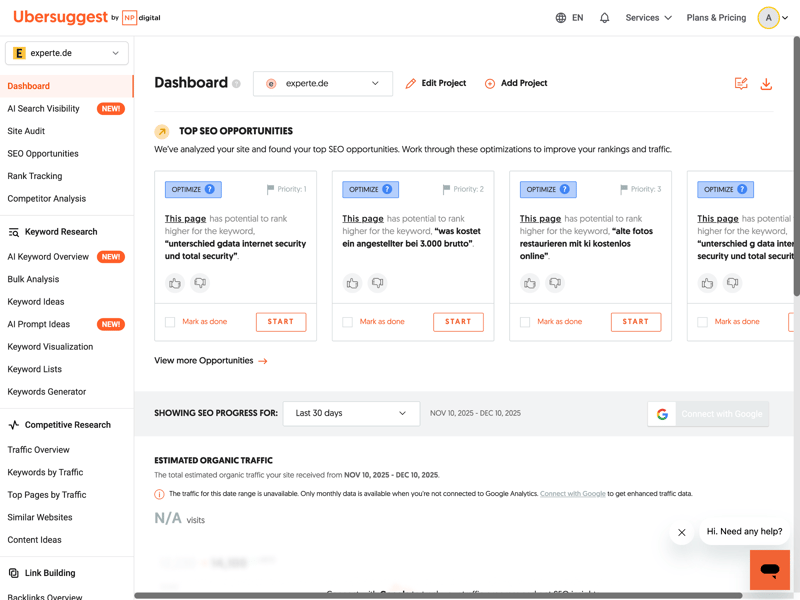
Ubersuggest manages to stay clean and visually appealing despite handling a lot of data.

Tools like Ubersuggest and Mangools score particularly well here because they’re easy to use, even for SEO beginners. Serpstat and Moz Pro underwhelmed in this category, as their interfaces often felt cluttered and less efficient.
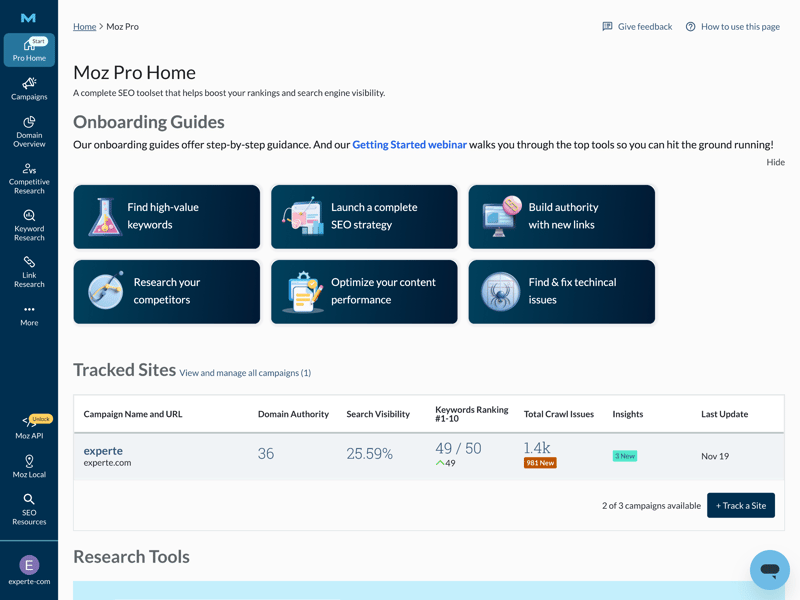
With Moz Pro, you have to dig around a lot despite the visual aids.

2.

Competitor Analysis (20%)

One of the most critical questions in SEO is why your competitors are outranking you. Without granular insights into their strategies, you are essentially operating with a massive blind spot. In this category, we take a closer look at competitor analysis features and evaluate the accuracy of traffic estimates.

Evaluating feature depth and scope

First, it’s important to know which features are actually offered. We defined the key functions and systematically compared which analysis levels and evaluation options each tool covers:

Sistrix
SE Ranking
Semrush
Moz
Ahrefs
Ubersuggest
SpyFu
Mangools
Serpstat
Number of keywords (history)
Number of URLs (history)
Top pages
Ranking history per keyword
Ranking changes
Ranking distribution
Organic competitors
Keyword gap analysis

How comprehensive and reliable Is the traffic data?

We also assess the quality of traffic data. This includes which metrics are available and how detailed the analysis options are. Data history matters too: the longer the lookback period, the more meaningful trend analyses become.

Ubersuggest
SpyFu
Sistrix
Serpstat
SE Ranking
Semrush
Ahrefs
Mangools
Moz
Organic traffic
Paid traffic
Trafic value
Traffic by country
Traffic history
3 Years
16 Years
5 Years
9 Years
8 Years
14 Years
5 Years
1 Years
1 Years

Of course, the accuracy of traffic estimates matters just as much. To test this, we compared each tool’s projections against real analytics data (Google Search Console) from 30 test domains. Scores were awarded based on how closely a tool’s projections aligned with real-world data.

Traffic Estimation Accuracy
SpyFu
53.6 %
Mangools
51 %
Ubersuggest
50.1 %
Semrush
49.1 %
SE Ranking
46.1 %
Sistrix
45.9 %
Ahrefs
45.4 %
Serpstat
18.9 %
Moz
-

Semrush took the top spot in this category with a score of 1.3, closely followed by Ahrefs. Moz Pro and Serpstat landed at the bottom again: they struggled with data depth and historical coverage, making professional analysis more difficult.
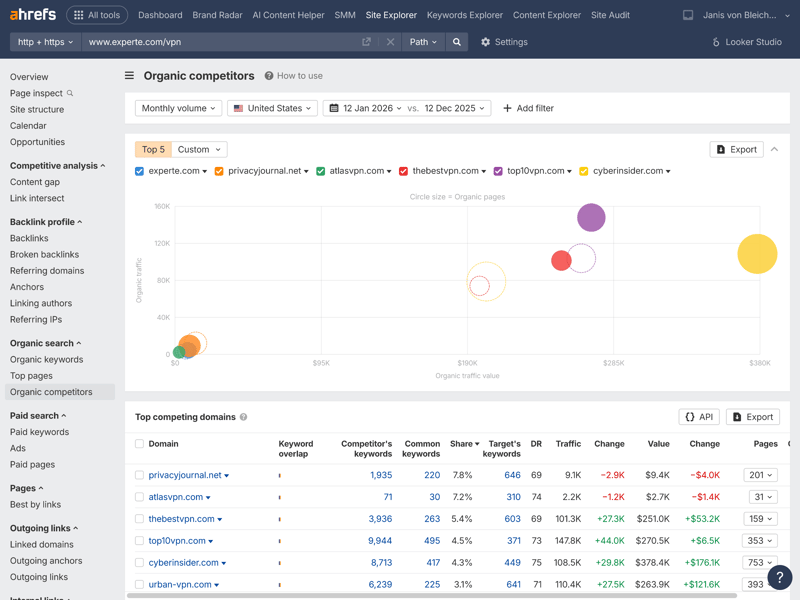
Ahrefs (like Semrush) visualizes your competitors and delivers detailed data.

3.

Backlink Analysis (15%)

Backlinks remain a primary ranking signal. To identify toxic links and build quality backlinks, you require a link index with a crawling speed and frequency that rivals Google’s own bots.

What backlink features and filters are supported?

We evaluated both the quantity and quality of backlink data. A capable tool needs to offer different criteria for assessing links, such as distinguishing between new, lost, or potentially harmful links. We also checked whether redirects and JavaScript links are reliably detected.

SE Ranking
Semrush
Mangools
Ahrefs
Sistrix
Moz
Serpstat
Ubersuggest
SpyFu
Backlink history
Referring domains
Referring IPs
Lost links
Toxic links
Broken links
Link quality metrics
Anchor text analysis
Top pages by links
Backlink gap analysis

We also compared filtering options. Ideally, users should be able to filter anchor texts by language, traffic metrics, and specific keywords. Backlinks themselves should be sortable by type (dofollow/nofollow), position on the page, link attributes, or referring domain.

Semrush
Ahrefs
Sistrix
SE Ranking
Mangools
Ubersuggest
SpyFu
Serpstat
Moz
Nofollow/Dofollow
Link authority
Anchor text
Link type (text, image, …)
Link position (content, footer, …)
Link age
Traffic of referring page
Language of referring page

The more granular the filters, the more precisely you can analyze and evaluate link profiles. That’s why the variety and depth of filter options directly influenced our scoring.

How many backlink sources are found?

The value of a backlink analysis depends heavily on the size of the underlying link index. The more referring domains a tool identifies, the more complete your picture of a site’s link profile.

To make this comparable, we analyzed how many referring domains each tool found on average per test URL. Higher coverage generally means a better foundation for strategic off-page decisions.

Referring Domains (on Average)
Ubersuggest
12,100
Moz
12,100
Semrush
8,927
Ahrefs
5,627
Mangools
5,200
Serpstat
3,505
Sistrix
2,305
SE Ranking
1,172
SpyFu
224

While Ubersuggest, Moz Pro, and Semrush impressed with sizable databases, SpyFu’s backlink index turned out to be insufficient for professional requirements.

4.

Keyword Research (15%)

Keyword research is the foundation of any effective content strategy. If you’re working with inaccurate search volumes or incomplete keyword data, you risk wasting resources on keywords that won’t drive meaningful traffic or ROI. That’s why this module evaluates both the range of features and the quality and reliability of the data.

Which keyword features are supported?

Here, we also assess which analysis features each tool actually provides. A tool only earns top marks if it moves beyond the basics, offering advanced capabilities such as topic clustering or transparent keyword difficulty scores.

Sistrix
SE Ranking
Semrush
Ahrefs
SpyFu
Serpstat
Mangools
Moz
Ubersuggest
Search volume by month
Search volume by country
Keyword difficulty
Cost per click (CPC)
Search intent
Current SERPs
Historical SERPs
SERP comparison
SERP overlap
Keyword clustering

Features like SERP overlap analysis or automatic keyword grouping are essential for professional content planning and are weighted accordingly in our scoring.

How large is the keyword database?

To compare the actual size of each tool’s keyword database, we ran a standardized test.

We defined 20 identical seed keywords (e.g., “vpn”) and had each tool generate related keyword suggestions. Then we calculated the average number of suggestions returned per tool.

Our test revealed significant differences. Some tools returned far more keyword variations than others. Ubersuggest stood out with a surprisingly large database, holding its own against, and even outperforming, significantly more expensive suites.

Number of Keywords (on Average)
Ubersuggest
5,325
SE Ranking
3,831
Sistrix
3,504
Semrush
3,331
SpyFu
3,032
Ahrefs
1,801
Mangools
410
Moz
106
Serpstat
-

How reliable is the search volume data?

A large database alone isn’t enough. What really matters is how accurate the reported search volumes actually are.

To test accuracy, we selected 30 keywords where we or our partner websites consistently rank in the top 3 positions on Google.

For these keywords, we can see the actual monthly impressions in Google Search Console, meaning how often they were really shown. We then compared these real impressions to the search volumes reported by each SEO tool. The closer a tool’s estimate matched the actual impressions, the higher it scored.

While this method doesn’t measure absolute search volume, it provides a reliable benchmark to gauge the accuracy of each tool’s projections.

Search Volume Accuracy
Ubersuggest
83 %
Semrush
75.3 %
Ahrefs
73.4 %
Sistrix
72.4 %
Mangools
65.5 %
Moz
55.7 %
Serpstat
54.9 %
SE Ranking
52.8 %
SpyFu
29.9 %
5.

Other Features (20%)

Modern SEO has expanded beyond simple keywords and backlinks. Modern tools increasingly cover adjacent areas like technical SEO, content optimization, AI-powered search visibility, and automated reporting. The scope and quality of these “other features” also factored into our evaluation.

Here's what we looked at:

  • Rank tracking
    Can rankings be monitored reliably? Can projects be managed separately? How detailed are the reports?

  • Technical site audit
    Does the tool include a built-in crawler? Are issues prioritized and clearly explained?

  • AI integration and emerging search experiences
    Does the tool track visibility in AI-based search systems or related trends?

  • Additional features
    This includes APIs, data imports, white-label reports, batch analysis, and automation options.

Semrush and Sistrix lead the pack thanks to their wide range of extras and add-on features. Smaller platforms like Mangools and Ubersuggest, as well as the classic Moz Pro, lack the same breadth, remaining focused primarily on their core utility.

6.

Support (10%)

As these platforms are all SaaS (Software-as-a-Service) solutions, consistent customer support is an essential part of the package (more on costs below).

Our evaluation focused on two key areas: the depth of the knowledge base and the responsiveness of the technical support team. We tested support ourselves and also checked independent review platforms to see how satisfied customers are with each provider’s service.

Semrush impressed us with solid support and a comprehensive Academy.

Semrush, Ahrefs, and Serpstat stood out with fast response times and extensive knowledge bases. With Ubersuggest and Moz Pro, we had to wait longer or deal with limited contact options.

7.

Pricing (10%)

Even the most powerful tool is a poor fit if it breaks your budget. For freelancers, small businesses, and agencies, value for money is a key factor. We didn’t just look at pricing tiers. We calculated real-world costs under comparable conditions by comparing four typical use cases:

  • 1.

    Beginner: 1 user, 100 queries per day

  • 2.

    Advanced: 1 user, 500 queries per day, min. 50,000 results per query

  • 3.

    Team: 5 users

  • 4.

    Rank tracking: monitoring 1,000 keywords

Here are the results:

BeginnerAdvancedTeamRank tracking
SpyFu
$29.00
$89.00
$149.00
$29.00
Ubersuggest
$29.00
$99.00
$29.83
$49.00
Mangools
$37.70
$52.70
$145.70
$97.70
Serpstat
$50.00
$100.00
$169.00
$50.00
SE Ranking
$52.00
$95.20
$132.00
$95.20
Semrush
$117.33
$416.66
$297.33
$208.33
Sistrix
$138.04
$277.24
$392.78
$138.04
Moz
$143.25
$239.00
$235.00
$143.25
Ahrefs
$208.00
$374.00
$448.00
$208.00

SE Ranking, Ubersuggest, Serpstat, Mangools, and SpyFu offer the best value for money in our scenarios. Platforms like Ahrefs, Semrush, Sistrix, and Moz Pro sit firmly in the premium category. However, their higher price points are often balanced by superior data depth and extensive feature sets.

Conclusion: Which SEO Tool Is the Best?

One thing became clear during our testing: there’s no such thing as a one-size-fits-all SEO tool. The right choice ultimately comes down to your specific goals, budget, and daily workflow. Semrush claims the top spot with a score of 1.3, offering the most comprehensive package in our lineup by blending deep data insights with a broad range of multi-channel marketing tools.

Sistrix remains a formidable contender, particularly for teams requiring deep European market data. Its Visibility Index serves as a rock-solid benchmark for competitive analysis. Ahrefs maintains its reputation as the industry standard for backlink data and technical SEO, though its premium features come at a significantly higher price point than most other suites.

For those prioritizing value, SE Ranking and Ubersuggest are excellent alternatives. SE Ranking excels with its granular pricing and versatile feature set, while Ubersuggest impressed us with its highly accurate search volume data.

SpyFu and Serpstat are best suited for specialized needs, such as aggressive competitor intelligence or budget-limited projects. Mangools leads the way in user experience, making it a top pick for beginners. While Moz Pro remains a respected classic, it struggled to keep pace with the modern, high-speed features of its competitors.

Marvin has covered the B2B SaaS space for years, focusing on online marketing, SEO, and social media. He lives in Hamburg, Germany and works as a full-time editor at EXPERTE.com.
Fact-Checking: Janis von Bleichert
Janis von Bleichert studied business informatics at the TU Munich and computer science at the TU Berlin, Germany. He has been self-employed since 2006 and is the founder of EXPERTE.com. He writes about hosting, software and IT security.
* Ad disclaimer: For links marked with an asterisk, EXPERTE.com may earn a commission from the provider. The commission has no influence on our editorial rating.
Continue Reading
Other languages