Best Semrush Alternatives 2026: 9 SEO Tools Reviewed


Semrush is probably the most widely used SEO tool in the world and certainly one of the most expensive. If you only use some of its features, this all-in-one marketing platform might be overkill. But if not Semrush, then what?
We compared the top alternatives to Semrush and picked the best options for different needs.
What Are the Possible Downsides of Semrush?

In our review of the best SEO tools, Semrush takes first place with an overall score of 1.3. It ranks near the top in almost every category, from backlink analysis and keyword research to site audits. But it still has its drawbacks:
Relatively high costs
Semrush is one of the priciest tools in our comparison. Costs increase substantially once you reach the “Guru” plan or higher. For small teams, freelancers, or occasional users, that price tag can be challenging to justify.Complex, cluttered interface
With so many features packed in, Semrush can feel overloaded and difficult to navigate. Beginners especially face a much steeper learning curve than with more specialized tools.Too much for simple needs
If you just want to research keywords or track rankings, Semrush may be more than you need. You'd be paying for many features you’ll probably never touch.Data limits on lower plans
On the entry-level plans, you can burn through your daily data queries fast. Heavy users will quickly be pushed toward an upgrade.
The 5 Best Alternatives to Semrush
The right Semrush alternative depends on what you’re after and what concerns you about Semrush. If your main goal is to save money, your needs differ from someone who wants a cleaner interface or only uses a fraction of the features.
We tested the five most promising alternatives, highlighting where they outperform Semrush and where they fall short:
Ahrefs: Deeper SEO Data for Demanding Analysis

Do you find Semrush too complex and cluttered but don’t want to give up data quality? Then Ahrefs* is an alternative with a stronger SEO focus. The tool prioritizes what matters most: excellent SEO data, fast performance, and the industry-leading backlink index. In our overall review, Ahrefs earned the third-best score (1.6).
What does Ahrefs do better than Semrush?
Ahrefs claims to run the most active web crawler of any tool and updates its index every 15 to 30 minutes. New and removed links show up quickly, so the data stays fresh. If you analyze large websites or study complex backlink profiles and link-building campaigns, Ahrefs often gives you more precise results than Semrush here.
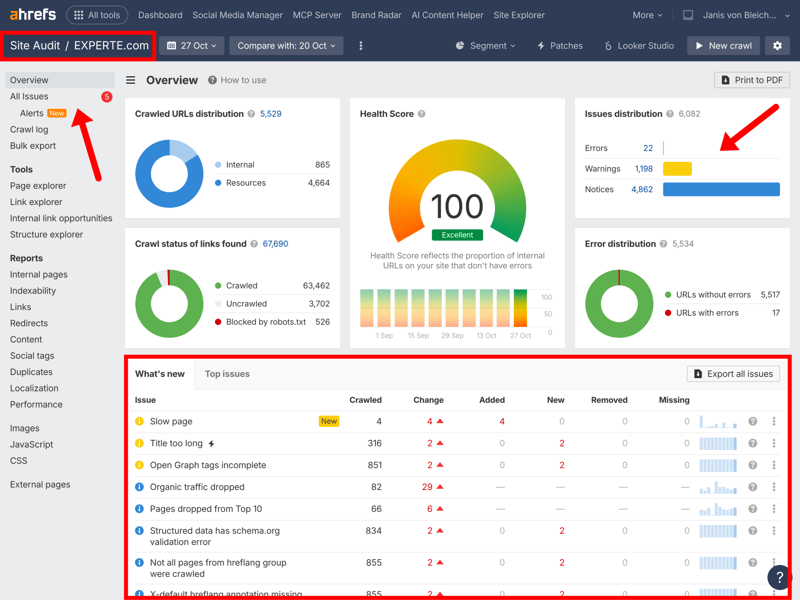
The site audit dashboard for experte.com shows relevant errors, warnings, and notices at a glance.
Semrush brings SEO, content marketing, PPC, social media, and other disciplines under one roof. Ahrefs stays focused mainly on SEO, putting its energy into backlink analysis, keyword research, and technical audits. If you don’t need a full marketing suite, that focus is a clear plus.
Performance is another strength. Even when analyzing large domains, Ahrefs responds quickly with no noticeable loading times.
What are the downsides of Ahrefs compared to Semrush?
If Semrush feels too expensive, Ahrefs won’t solve that problem. Across its tiered plans, Ahrefs is the priciest tool in our comparison. There’s also no free trial and no money-back guarantee, both of which Semrush offers.
Semrush also has an edge in evaluating backlinks. Its Toxicity Score automatically rates links as toxic, potentially toxic, or harmless. With Ahrefs, link quality must be judged manually based on the available data.
Ahrefs pros and cons
Industry-leading backlink index
Ahrefs updates its index several times an hour and clears out deleted links quickly. That makes its data some of the most current on the market.Clear SEO focus
Instead of trying to cover as many marketing disciplines as possible, Ahrefs zeroes in on SEO features like backlink analysis, keyword research, and technical audits.Strong performance
Even when analyzing large domains, Ahrefs responds quickly without noticeable loading times.
High prices
Like Semrush, Ahrefs sits in the upper price range. And there’s no free trial or money-back guarantee.No full toxicity score
No full toxicity score. Unlike Semrush, Ahrefs doesn’t offer an automatic Toxicity Score to flag problematic backlinks; manual evaluation of link quality is required.Inaccurate traffic estimates
In our test, Ahrefs’ traffic estimates were only 45.4% accurate, well below Semrush’s score of over 75%.
Sistrix: A Stronger Focus on SEO

Semrush packs in so many features that it’s easy to lose track. Sistrix* takes a different approach. It has fewer modules overall but focuses more on core SEO tasks like visibility analysis, keyword research, and competitor tracking. In our overall test, the tool earned a score of 1.5.
What Sistrix does better than Semrush?
Compared to Semrush, Sistrix is much leaner and easier to navigate. The interface is lean and clearly structured, which makes it more accessible, especially for beginners. Instead of clicking through countless modules, you get all the data that matters for your daily SEO work at a glance.
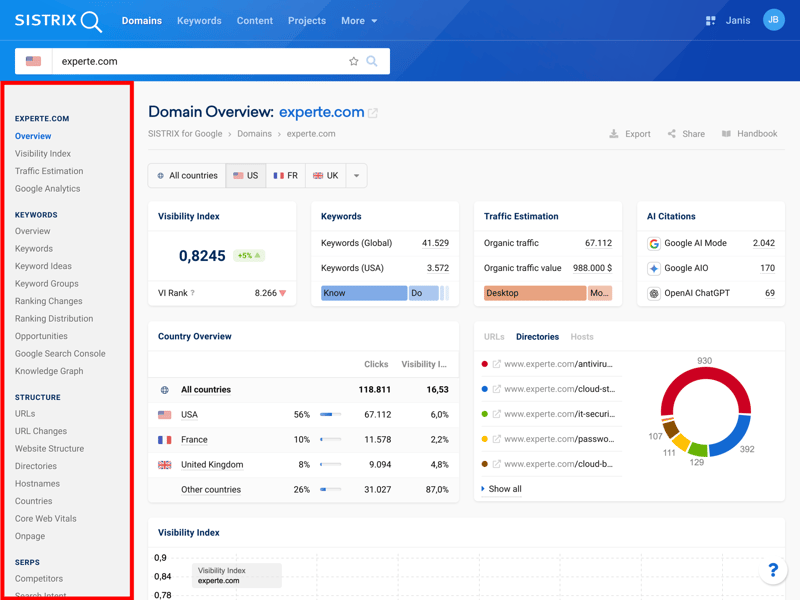
The domain overview for experte.com, with the visibility index as the key metric, is rounded out by traffic, keywords, and directory structure.
At the heart of Sistrix is the Visibility Index, a well-established measure of a website’s organic search visibility. If you want to track how your visibility changes over time, it provides an easy-to-understand benchmark.
Sistrix also excels in support. Customer service is easy to reach and typically responds with a personal reply rather than an automated form letter. It offers more flexible contract terms than Semrush; every plan can be canceled monthly and comes with a free 14-day trial.
What are the downsides of Sistrix compared to Semrush?
Sistrix covers around 50 countries, which makes it a less complete fit for large-scale international SEO projects. For broader global coverage, Semrush is typically the better pick.
Semrush also comes out ahead on backlink analysis. Its database is larger and gives you a broader data foundation, especially for international link analysis.
For some users, the strong SEO focus of Sistrix could be a drawback. If you need an all-in-one tool that handles content marketing, social media, or paid ads alongside your SEO work, Semrush gives you a lot more.
Pros and cons of Sistrix
Unique Visibility Index
The Sistrix Visibility Index offers a clear, standardized way to track organic search presence and benchmark against competitors over time.Cleaner interface
Sistrix focuses on the most important SEO features, which makes it far less cluttered than Semrush. Beginners in particular will find their way around faster.Responsive personal support
When you have questions, you get knowledgeable help from dedicated contacts who respond personally rather than with automated replies.
More limited international coverage
Sistrix supports around 50 countries, compared to Semrush’s roughly 190—a meaningful gap for teams running large-scale international SEO campaigns.Smaller backlink database
For in-depth backlink and competitor analysis, Semrush offers a larger data set.No all-in-one approach
Sistrix doesn’t cover content marketing, social media, or paid search. Teams needing a true all-in-one platform will find Semrush more versatile.
SE Ranking: User-Friendly All-in-One Suite at Affordable Prices

Semrush packs in a considerable range of features, which can quickly overwhelm newcomers. SE Ranking* takes a different approach. It’s also an all-in-one tool, but it feels more approachable and intuitive, and it is significantly more affordable. In our overall review, SE Ranking earned a score of 1.7.
What does SE Ranking do better than Semrush?
SE Ranking is also a full all-in-one suite, but it’s laid out far more clearly and much easier to pick up. The navigation is well organized, key features are quick to find, and new users can become comfortable quickly, minimizing the learning curve. If you find Semrush too complex, you’ll notice the difference right away.
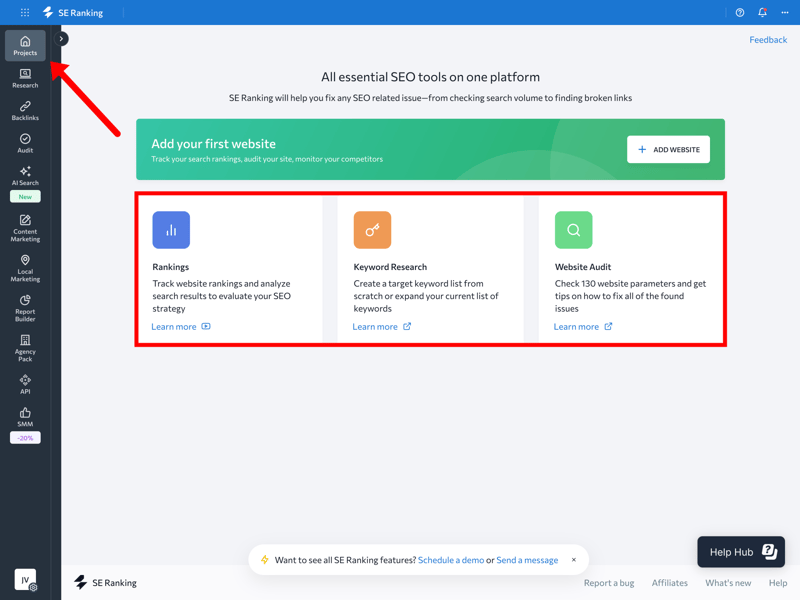
The project view gives you quick access to key features like rankings, keyword research, and website audits.
SE Ranking really shines at keyword tracking. The position data is stable, accurate, and reliable. It’s considerably less expensive than Semrush across all plans. If you don’t need the full feature set of a complete marketing suite, it provides the most important SEO tools at a much lower price.
What are the downsides of SE Ranking compared to Semrush?
SE Ranking is a strong all-in-one tool, but it cannot match Semrush in terms of feature breadth. If you want to manage content marketing, social media, or paid ads alongside SEO in a single platform, Semrush offers significantly more. The data history is also shorter: SE Ranking goes back up to eight years, while Semrush reaches 14.
Some features, like the AI content editor or local SEO packages, aren’t part of SE Ranking’s standard plan. You have to add them as paid extras. If you require them, you’ll pay more than the starting price suggests.
Pros and cons of SE Ranking
Much lower price
SE Ranking offers the most essential SEO features at a fraction of Semrush's cost.Reliable rank tracking
SE Ranking delivers stable, accurate position data, even over long stretches of time.Easier to get started
Beginners will likely find their way around SE Ranking faster than Semrush. The interface is simpler and cleaner than Semrush’s complex layout.
Shorter data history
Semrush offers historical data going back up to 14 years, while SE Ranking maxes out at eight.Extra costs for modern features
Some features, like the AI content editor or local SEO packages, aren’t included in the standard plan and cost extra.Smaller feature set
If you want to manage content marketing, social media, and paid search alongside SEO on a single platform, Semrush is the better fit.
Ubersuggest: A Better Tool for Keyword Research

Semrush is strong in many categories, but keyword research is not its strongest suit. Ubersuggest* took first place in our review for both the number of keywords it found and the accuracy of its search volume estimates.
So if you’re mainly after a keyword research tool, Ubersuggest offers superior data at a much lower price.
What Ubersuggest does better than Semrush?
Ubersuggest performed exceptionally well in our keyword test. It found far more keywords than Semrush (5,325 vs. 3,331) and delivered more accurate search volume data (83% vs. 75.3%). If keyword research is your main focus, Ubersuggest currently gives you the better data foundation.
| Search volume accuracy | |
|---|---|
 | 83 % |
 | 75.3 % |
 | 73.4 % |
 | 72.4 % |
 | 65.5 % |
 | 55.7 % |
 | 54.9 % |
 | 52.8 % |
 | 29.9 % |
The interface is also much more approachable. Ubersuggest is primarily designed for SEO beginners, with a guided setup, tooltips that explain technical terms, and a graphical data view.
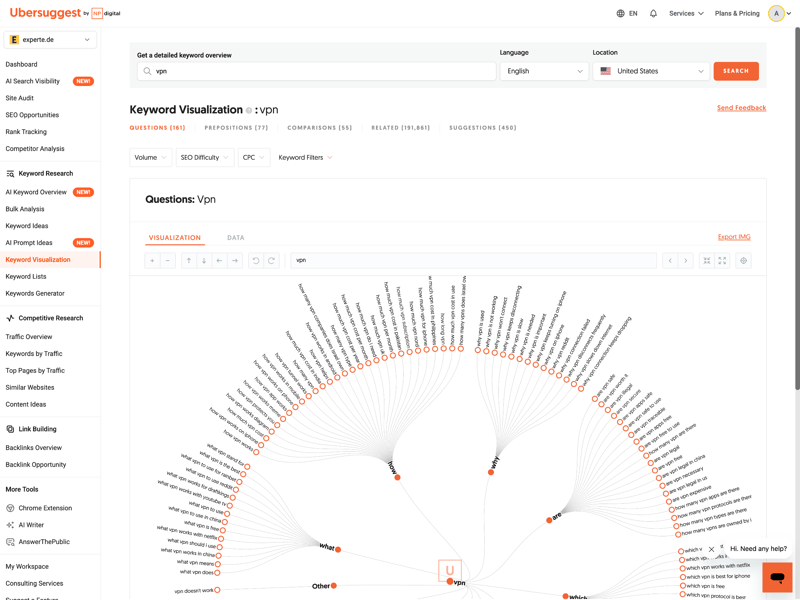
The sunburst chart for “vpn” groups keyword ideas visually at a glance.
On price, Ubersuggest is one of the cheapest tools in our comparison, with a lifetime option and a free basic version.
Where does Ubersuggest fall short compared to Semrush?
Ubersuggest is strong on keywords, but it quickly hits its limits when you need more profound analysis. It lacks historical SERP data, SERP overlap analysis, and an automatic toxicity score. Semrush also handles technical SEO workflows far better: Ubersuggest offers neither an API nor white-label features.
Semrush also offers better support. Ubersuggest provides direct help only through a contact form, and replies often take a while.
Ubersuggest pros and cons
Best keyword data in our comparison
In our testing, Ubersuggest delivered the most keywords and the most accurate search volume data. Semrush can’t keep up here.Beginner-friendly interface
Helpful tooltips, a guided onboarding process, and a clear visual layout make it easy for beginners to get started.Low costs and a free plan
Ubersuggest is one of the most affordable tools in our comparison. It offers attractive team plans, a free basic version, and a unique lifetime option.
Missing pro features
Agencies and experienced SEO teams will miss key pro features like an API or white-label options.No automatic toxicity score
Semrush flags harmful backlinks automatically. With Ubersuggest, you have to do it by hand.Limited support
Ubersuggest offers neither live chat nor a phone hotline; support is available only through a contact form.
Serpstat: An All-in-One Approach With a Unique Structure View

Semrush and Serpstat* share the same basic idea: a complete SEO suite that bundles all the key features into one tool. They differ in how they implement this vision. Serpstat is leaner, more focused, and far cheaper, without skimping on the core analysis features. In our overall test, Serpstat earned a score of 2.0.
What does Serpstat do better than Semrush?
One thing that sets Serpstat apart is its tree-view feature. It lays out, in a clear hierarchy, which subpages of a domain rank for which keywords. This makes it easy to see how a website is organized by topic.
If you want a closer look at your competitors’ keyword strategy or your own site architecture, it provides a unique perspective that many other SEO tools simply don’t offer.
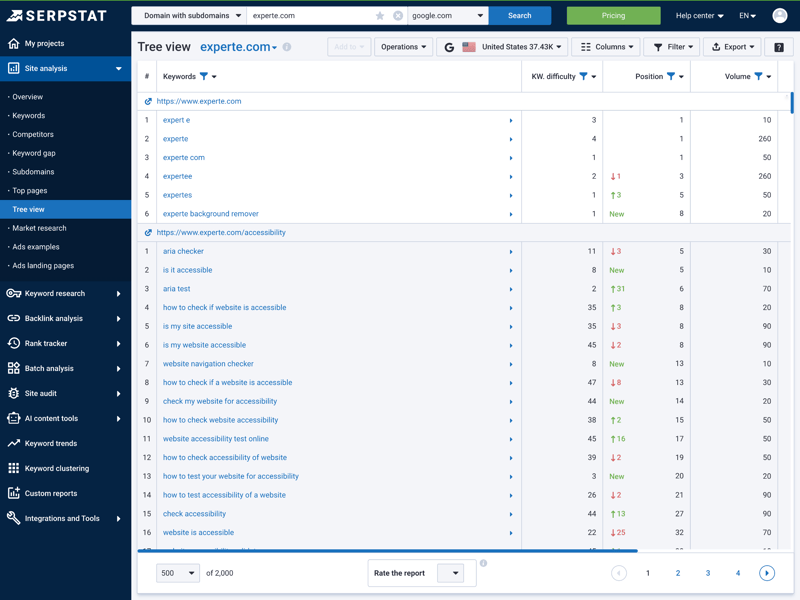
The tree view shows how keywords connect to each other by topic.
The Site Audit also stands out. It groups errors clearly into areas like meta tags, HTTP status codes, and content, which makes it easier to assign tasks across your team.
Serpstat is much cheaper than Semrush at nearly every plan level. It’s one of the most affordable all-in-one tools on the market.
What are the downsides of Serpstat compared to Semrush?
Serpstat delivers a solid all-around package, but it doesn’t match Semrush on data quality. This was especially clear with traffic estimates. In our test, Serpstat achieved just under 19% accuracy, while Semrush topped 75%. If you lean heavily on traffic data for strategic decisions, that’s a big difference.
| Traffic estimation accuracy | |
|---|---|
| 53.6 % |
| 51 % |
| 50.1 % |
| 49.1 % |
| 46.1 % |
| 45.9 % |
| 45.4 % |
| 18.9 % |
| - |
Semrush also offers a much wider range of features overall, especially in areas like content marketing and social media.
Serpstat's interface options are also more limited than Semrush’s, which offers broader localization support.
Pros and cons of Serpstat
Unique tree view feature
This view shows, in a hierarchy, which subpages of a domain rank for which keywords. It’s a perspective on site architecture that Semrush doesn’t offer.Streamlined all-in-one approach
Serpstat brings all the core SEO features together in one interface, without the cluttered marketing modules that make Semrush feel overwhelming to many users.Much lower price
Serpstat costs less than Semrush at nearly every plan level, and it’s one of the cheapest all-in-one tools out there.
Weak traffic accuracy
At just under 19% accuracy on traffic estimates, Serpstat comes in last in our comparison. Semrush hit over 75%.Limited language support
Serpstat is only available in English, Spanish, and Russian, with no additional localization options.Fewer features
For all its all-in-one ambitions, Serpstat can’t match Semrush on features.
More Alternatives
In our big comparison of the best SEO tools, we put nine platforms through their paces. Here’s our overall ranking, with links to detailed reviews:


That said, there are three other tools we’d recommend as Semrush alternatives, though with some reservations:
- 1.
Mangools doesn’t offer a site audit and is too limited for technical SEO.
- 2.
Moz Pro excels at backlink analysis, but it doesn’t provide its own traffic estimates and has a stronger focus on SEO heavily toward English-speaking markets.
- 3.
SpyFu is a strong tool for competitor research, but it can’t replace a full SEO suite. It’s missing too many core features.
Conclusion: Five Alternatives, Five Approaches
Semrush is still one of the strongest and most complete SEO tools around. But all those features come at a price, both in dollars and in usability. Many users end up paying for tools they barely touch or losing time every day in an interface that’s far too complex for their needs.
Which alternative is right for you depends on what bothers you about Semrush:
Ahrefs leans more heavily into SEO and stands out for its backlink data and depth of data.
Sistrix stands out for a more intuitive interface, its Visibility Index, and its strong historical data for European markets.
SE Ranking is a good fit if you want a cheaper, easier-to-understand all-in-one solution.
Ubersuggest delivered the strongest results for keyword research in our review.
Serpstat takes an approach similar to Semrush but offers a much leaner and more affordable alternative.
If you want to pack as many features as possible into a single platform, Semrush is still hard to beat. You’ll find detailed reviews of nine providers in our big SEO comparison.