Best SEO Competitor Analysis Tools in 2026: Our Top 5 Picks


Great SEO starts with a simple question: Why do my competitors outrank me? Competitor analysis reveals which keywords drive traffic, where competitors earn backlinks, and which content performs best.
Instead of guessing what Google wants, you can learn from sites that already rank. We tested nine leading SEO platforms to find the best tools for competitor research.
Top 5 SEO Competitor Analysis Tools
In our comparison of the best SEO platforms, we put nine providers to the test, focusing on their competitor analysis features. We rated each tool on a scale from 1.0 (excellent) to 5.0 (poor). You can find our criteria in more detail later in this article.
For now, here are five tools that stood out:
Semrush: The All-in-One Powerhouse with the Broadest Data

Semrush is one of the most well-known and comprehensive SEO platforms on the market. It takes an all-in-one approach, handling a wide range of marketing tasks (including PPC and social media) in one place. In our test, Semrush didn’t just perform well in competitor analysis (earning a high score of 1.3); it took the top spot overall.
What competitor insights does Semrush provide?
Semrush gives you an in-depth look at your competitors’ strategies. With the “Organic Research” feature, you can see which keywords a competitor’s site ranks for. The tool even separates brand-driven traffic from generic traffic, so you can tell at a glance whether a competitor’s organic success comes from brand recognition or effective SEO.
Keyword and backlink gap analyses are especially useful. They show at a glance which search terms or link sources your competitors rank better for. This helps you to spot content gaps, new keyword opportunities, and potential sources for link building.
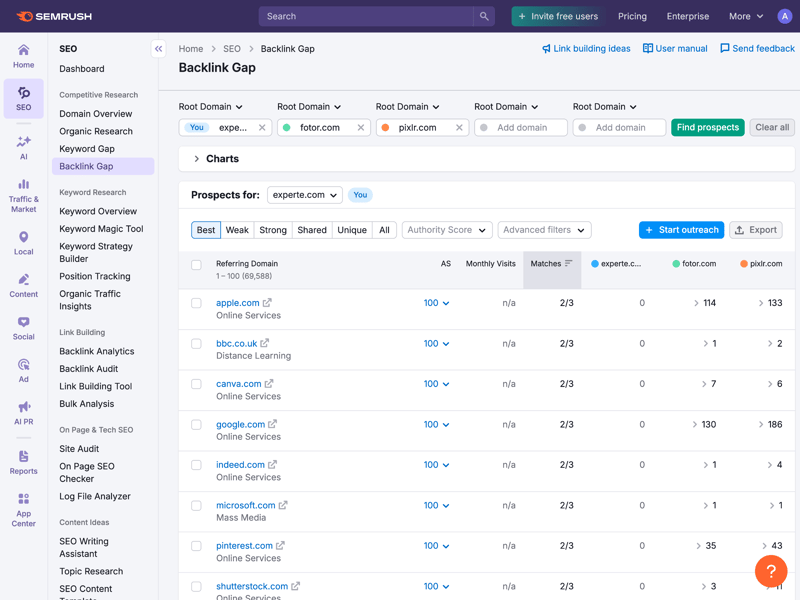
Here, Semrush compares our domain (experte.com) with competitors (computerbild.de, strato.de, and omr.com).
Semrush also gives you a look at paid search. You can see which ads your competitors are running and how much they’re spending on them. That's a big plus if you want to keep an eye on both SEO and paid campaigns.
Who is Semrush best for?
Semrush is a great fit for agencies, larger businesses, and international SEO projects. The platform provides data for multiple countries and lets you analyze trends going back up to 14 years.
What’s the downside?
The biggest hurdle is the complexity. With so many features and reports, the interface can feel overwhelming, and finding the insights that actually matter isn’t always easy, especially for beginners.
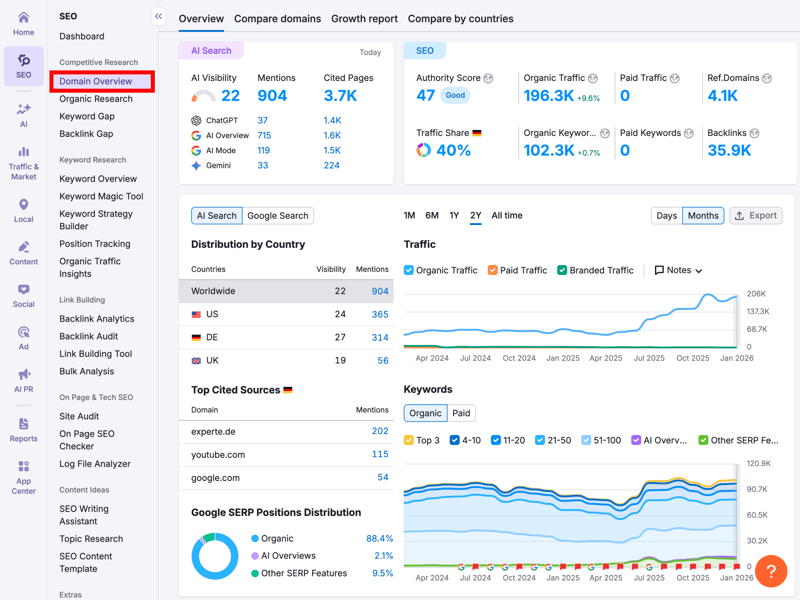
The dashboard is packed with features but can feel cluttered and difficult to navigate.
The other major drawback is cost. Semrush is one of the most expensive tools in our comparison. If you need higher-tier plans or multiple user accounts, the price can quickly become too steep for smaller projects.
Pros and Cons of Semrush
Cross-channel competitor tracking
Semrush combines SEO, Google Ads, and social media in one platform, so you can track and compare competitors across multiple marketing channels.Automatic competitor detection
Semrush suggests relevant competitors for comparison automatically. This saves research time and often surfaces rivals you hadn’t considered.Excellent learning resources
The Semrush Academy offers a wide range of courses, certifications, and practical guides.
High costs
Semrush is the most expensive tool in our test. For smaller projects, higher-tier plans or multiple user accounts can quickly become too pricey.Complex interface
The huge feature set opens up numerous options, but it can also overwhelm you, especially as a beginner.Overwhelming for beginners
With so many features and reports, new users can struggle to find the insights that actually matter, requiring a significant learning curve.
| Analysis level | All four analysis levels are available. | 2/2 |
| Scope of traffic estimation |
| 6/6 |
| Accuracy of traffic estimation | 49.1 % | 3/6 |
| Keyword rankings |
| 4/4 |
| Page structure | Hostnames, directories, and outgoing links are supported; internal links are not. | 1.5/2 |
Ahrefs: Comprehensive Site Audits and a Powerful Backlink Index

Ahrefs is widely regarded as one of the top tools in the SEO industry for backlink analysis. Over time, it has grown into a full SEO suite that goes well beyond its original focus. In our test of the best SEO competitor analysis tools, Ahrefs earned a top score of 1.4.
What competitor insights does Ahrefs offer?
The core of Ahrefs’ competitor tracking is the “Site Explorer.” Enter any domain, and you’ll see its organic traffic, top rankings, and most successful content.
One of the most useful features is “Top pages,” which shows which of a competitor’s pages generate the most traffic and how many search terms they rank for.
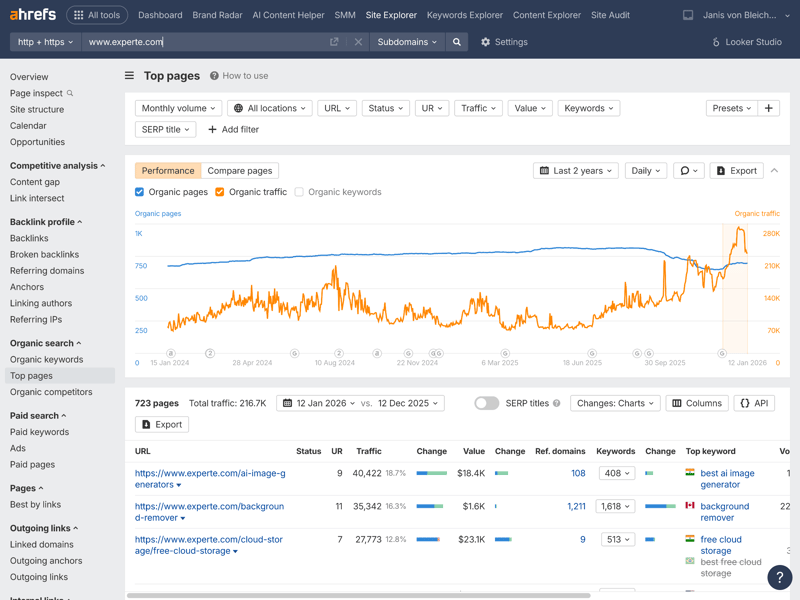
Ahrefs’ Site Explorer shows your top-performing pages (like experte.com/email-check) with all the key data: traffic, URL rating, and keywords.
For strategic planning, Ahrefs offers the “Content gap” feature. It lets you compare up to ten competitors at once to spot keywords they rank for but you don’t. That makes it easy to find content gaps and new topic ideas.
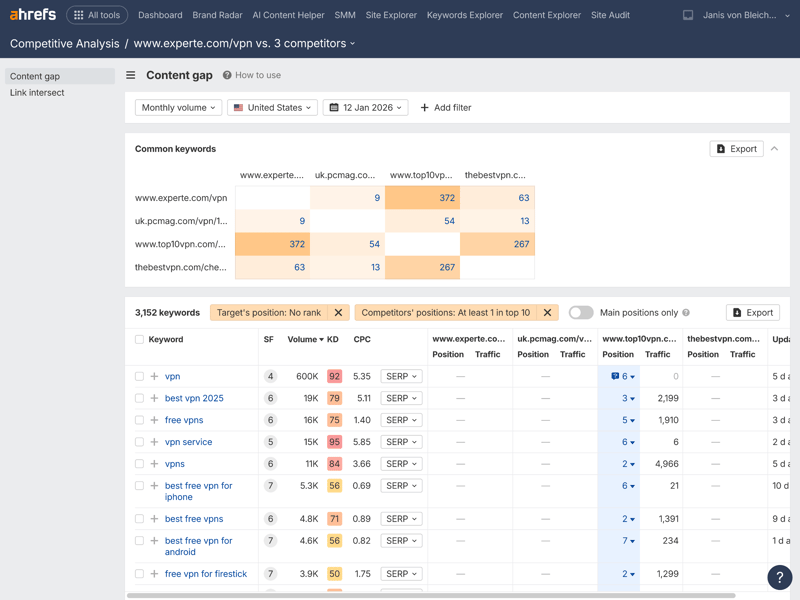
The content gap analysis instantly shows which keyword opportunities you’re missing.
One standout technical feature is the analysis of referring IP addresses. It reveals whether a competitor’s backlinks come from natural sources or artificial link networks (PBNs), giving you a clearer picture of their real authority.
Who is Ahrefs best for as a competitor analysis tool?
Ahrefs is built for experienced SEO professionals who want to base their decisions on solid data. It’s especially strong if you want to go beyond competitors’ keywords and delve into their backlink profiles and link-building strategies.
It’s also great for content planning. Features like topic clustering (“parent topics”) help you organize search topics strategically and create content that targets your competitors’ strengths and weaknesses.
What are the downsides of Ahrefs?
One weak spot is Ahrefs’ traffic estimates. In our tests, they matched real-world data only 45.4% of the time, putting Ahrefs near the bottom of the pack. Other tools estimate actual visitor numbers far better.
Ahrefs is also one of the most expensive tools out there. And unlike many competitors, it doesn’t offer a free trial.

Pros and cons of Ahrefs
Massive backlink index
Ahrefs’ backlink database is one of the largest on the market, with up-to-date data on referring domains and links.Fast performance
Even large-scale website analyses load and process quickly.Constantly evolving
Ahrefs regularly adds new features. One example is “Brand Radar,” which lets you track brand visibility in AI chatbots.
High cost
Ahrefs is one of the most expensive tools on the market. There’s no free trial or money-back guarantee.Less accurate traffic data
Its visitor estimates sometimes stray further from actual numbers than those of some competitors.No free trial
Unlike most competitors, Ahrefs doesn’t offer a free trial or a money-back guarantee, making it challenging to test before committing.
| Analysis level | All four levels are available. | 2/2 |
| Scope of traffic estimation |
| 5/6 |
| Accuracy of traffic estimation | 45.4 % | 3/6 |
| Keyword rankings |
| 4/4 |
| Page structure | All four levels are available. | 2/2 |
SpyFu: The Ad Data Specialist

SpyFu is a long-established SEO and PPC research platform that focuses almost exclusively on competitor intelligence. While other platforms try to cover every SEO angle, SpyFu zeroes in on uncovering competitors’ organic and paid strategies. In our test, it earned a strong score of 1.6 in competitor analysis.
What competitor insights does SpyFu offer?
SpyFu’s biggest strength is its direct comparison of organic search results and paid ads (PPC). For any domain, you can see which keywords drive the most traffic and how much competitors spend on Google Ads. The tool gives you current data plus historical insights going back up to 20 years.
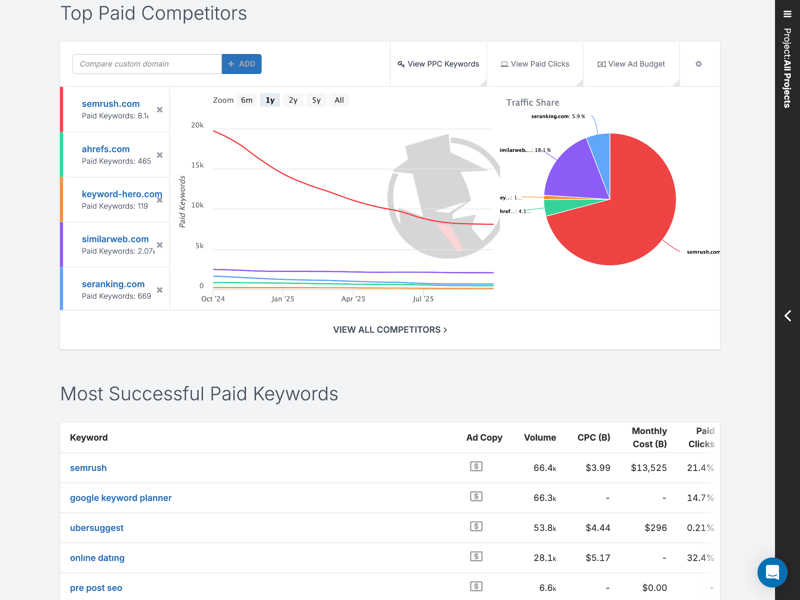
SpyFu also identifies your top competitors in paid search, not just organic.
SpyFu stood out in traffic estimation. With 53.6% accuracy, it delivered the most reliable data in our entire comparison. If you want to know how many visitors a competitor actually gets from search, SpyFu gives you one of the most precise estimates available.
SpyFu also includes a leads module that identifies potential business contacts, making it useful for sales teams too.
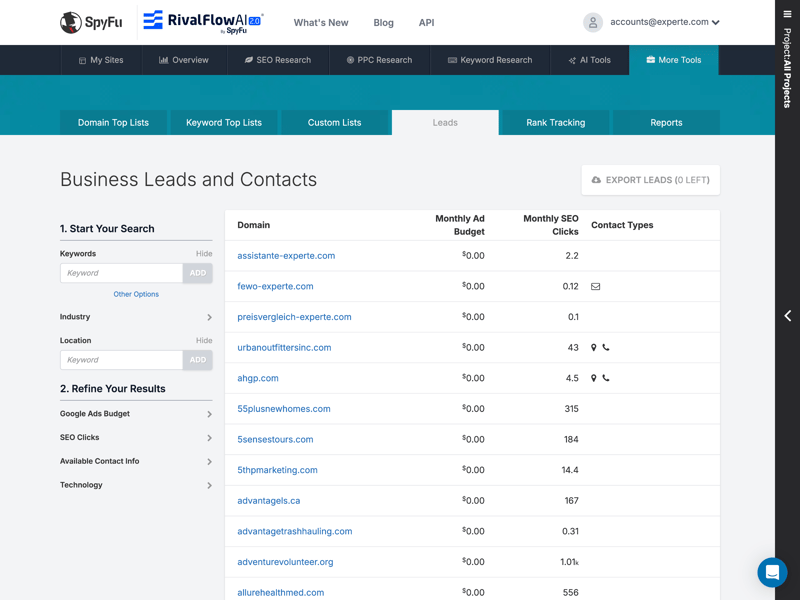
The “Leads” feature finds contacts for your sales team.
Who is SpyFu best for as a competitor analysis tool?
SpyFu is ideal for marketing teams, ad managers, and sales departments. It’s especially useful for uncovering untapped keyword opportunities and market potential.
With its relatively low costs, SpyFu is also a great fit for small businesses and agencies on tight budgets.
What are the downsides of SpyFu?
SpyFu isn’t a full replacement for a technical SEO suite. It lacks key features for analyzing your own website, especially a technical site audit. This means it lacks systematic checks for crawl errors, redirect issues, or on-page weaknesses.
Backlink analysis is another weak spot. SpyFu only finds a few hundred links per domain, a fraction of what competitors uncover. We also noticed occasional data errors in the keyword research tool. Some popular search terms, for example, showed no search volume at all.
SpyFu: Pros and Cons
Accurate traffic data
SpyFu delivered the most precise visitor estimates in our test.Strong focus on ads
SpyFu gives you detailed insights into competitors’ Google Ads budgets and ad copy, making it easy to analyze successful keywords, ads, and ad strategies.Great value for money
SpyFu is one of the most affordable tools in this comparison, with no strict data limits.Built-in sales support
The Leads module identifies potential business contacts, making it useful for sales teams too.
No technical SEO
SpyFu doesn’t offer any technical website audits.Weak backlink database
SpyFu only detects a small portion of the backlinks that other tools find, making in-depth backlink analysis nearly impossible.Inconsistent keyword data
We found occasional discrepancies in search volumes and keyword data during testing.
| Analysis level | Available at all levels except subfolders/paths. | 1.5/2 |
| Scope of traffic estimation |
| 6/6 |
| Accuracy of traffic estimation | 53.6 % | 4/6 |
| Keyword rankings |
| 3.5/4 |
| Page structure | Only hostnames are tracked; support for directories and internal/external links is missing. | 0.5/2 |
Sistrix: The DACH Market’s Go-To SEO Tool

Sistrix is one of the most well-known SEO tools, particularly strong in European markets. The Visibility Index is Sistrix's proprietary metric that measures how visible a website is in Google search results based on thousands of tracked keywords.
In our test of competitor analysis tools, Sistrix earned a good 1.6. Thanks to its deep data coverage for European markets, historical accuracy, and fair pricing, it ranks third overall in our comparison.
What Competitor Insights Does Sistrix Offer?
Sistrix gives you a structured way to analyze competitors. Enter a domain, and you get an overview of key metrics: visibility index, organic traffic, keyword coverage, and how each has changed over time. This shows you how strong a competitor is in search and how their visibility is trending.
One standout feature is the “SERP layout.” It maps out how a search results page is structured for a specific term and which elements appear. You can see which content formats Google favors for a keyword and what has the best chance of ranking well.
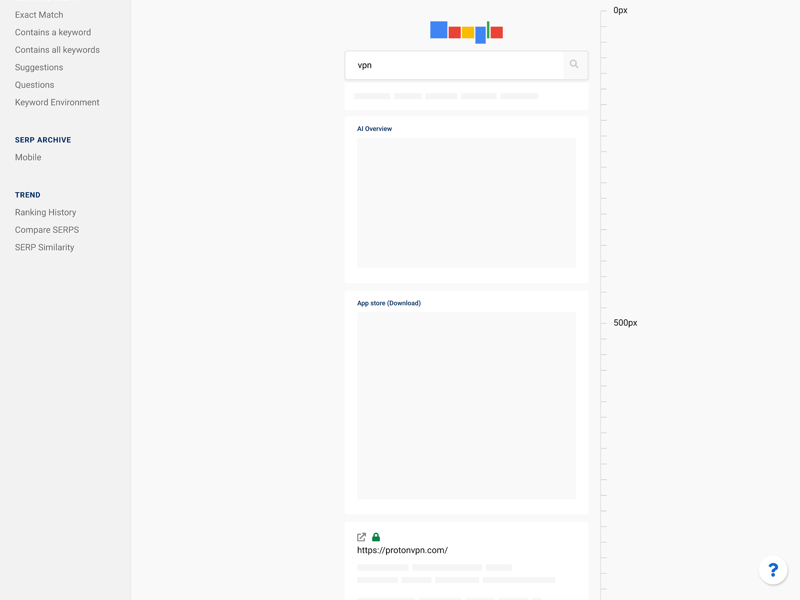
The visual breakdown shows how much real estate is actually left for organic results.
Sistrix also shines with its detailed directory structure breakdown, which shows you which parts of a website drive the most visibility. The “Keyword groups” feature goes further, spotting thematic connections and showing where competitors are strongest.
Who Is Sistrix Best For as a Competitor Analysis Tool?
Sistrix is ideal for businesses, agencies, and international SEO teams that need to analyze competitors across European markets. If you’re expanding into Germany, Austria, Switzerland, or other European countries, Sistrix gives you data depth and historical accuracy that global tools often can’t match for those regions.
What Are the Downsides of Sistrix?
Sistrix falls short in backlink analysis. Its built-in crawler doesn’t uncover nearly as many referring domains as specialized international tools like Ahrefs or Semrush. If you analyze competitors mainly through their backlink profiles, you’ll get a less complete picture here.
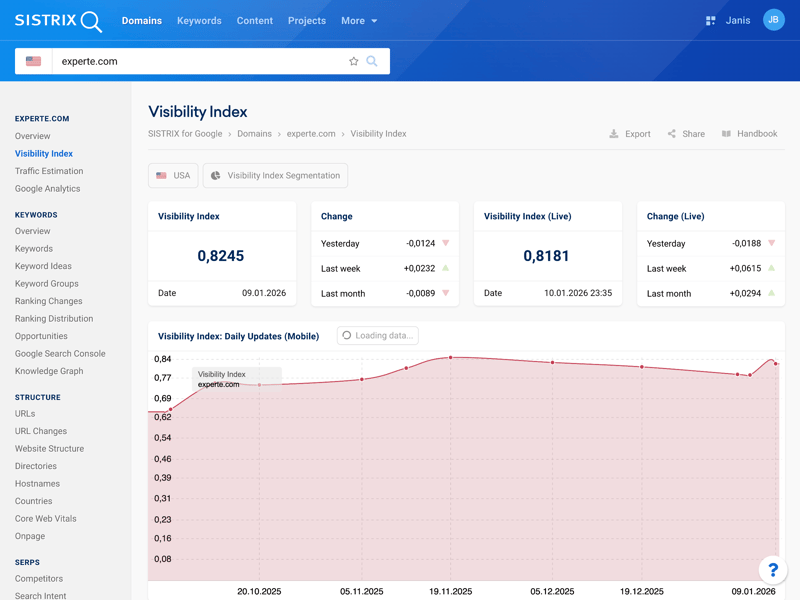
The visibility index for experte.com has remained stable for quite some time.
Sistrix isn’t a leader in traffic estimates. Compared to real-world data, it was only 45.9% accurate, putting it in the middle of our test group.
If you need highly accurate traffic predictions for strategic decisions, other tools do better. And while Sistrix is powerful, its scattered navigation can confuse SEO beginners.
Pros and cons of Sistrix
Visibility Index as a benchmark
Sistrix’s Visibility Index is a widely used benchmark for measuring organic search presence.Strong European data coverage
Sistrix delivers especially precise data for local search terms and historical trends across European markets, making it a reliable choice for international SEO campaigns.Innovative SERP layout
The visual breakdown of search results pages shows which Google features (like featured snippets or shopping ads) dominate a keyword.Responsive support
Personal support and extensive help resources are readily available.
Smaller backlink index
Sistrix tracks fewer backlink sources than global competitors. If you analyze competitors mainly through their backlink profiles, you’ll get a less complete picture.High costs for teams
If you need multiple user accounts or extra modules, costs add up quickly.Scattered navigation
Features are spread across different modules, which can make the tool harder to navigate for beginners.
| Analysis level | All four levels are available. | 2/2 |
| Scope of traffic estimation |
| 5/6 |
| Accuracy of traffic estimation | 45.9 % | 3/6 |
| Keyword rankings |
| 4/4 |
| Page structure | Hostnames, directories, and outgoing links are possible; internal links are not. | 1.5/2 |
SE Ranking: Many Features for a Fair Price

Like Ahrefs, SE Ranking started as a specialized tool focused on rank tracking but has since grown into a full SEO suite. It positions itself as a budget-friendly alternative to the market leaders, without skimping on key analysis features. In our test, SE Ranking earned a nice score of 1.7.
What competitor insights does SE Ranking offer?
SE Ranking’s strength is how it ties keyword research directly to competitor analysis. The tool reveals both the organic and paid strategies of other domains, and you can analyze data at the domain, subdomain, or individual URL level. It also shows how a site’s visibility has changed over the past eight years.
One standout feature is the On-Page Checker. Unlike a traditional website audit, it compares a specific URL on your site directly with the top-ranking competitors for a given keyword. Then it tells you exactly what content or technical tweaks you need to outrank them.
The Backlink Gap Analysis also shows which backlink sources your competitors use that your site is missing.
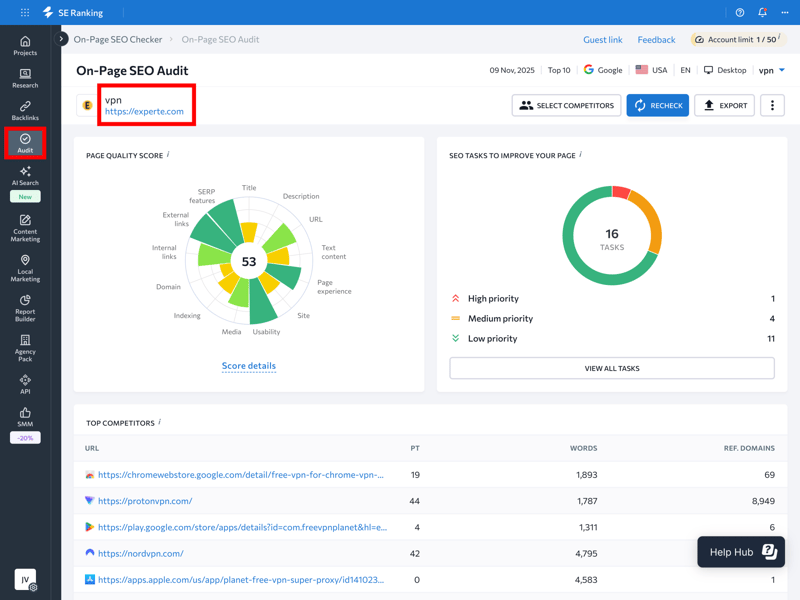
The on-page checker compares a URL with top search results for selected keywords and delivers actionable optimization tips.
Who is SE Ranking best for as a competitor analysis tool?
SE Ranking is a great fit for freelancers, small and midsized businesses, and growing agencies. If you need a professional SEO tool for daily use but also need to avoid high costs, SE Ranking gives you plenty of features at an affordable price.
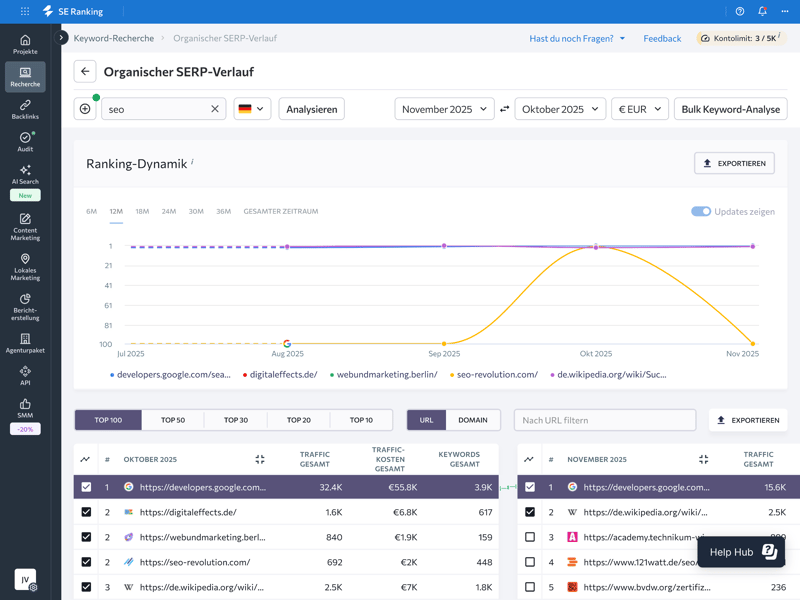
SE Ranking can display ranking changes over time in a clear chart.
What are the downsides of SE Ranking?
For long-term competitor analysis, the limited historical data is a drawback. While some top tools offer over a decade of data, SE Ranking’s lookback period varies by plan and often covers only a few years. That makes it harder to track long-term trends or gauge the impact of past Google updates.
The PPC analysis also isn’t as detailed as specialized tools. If you want an in-depth look at competitors’ ad strategies, you’ll hit limits sooner. For traffic estimates, SE Ranking scores a solid 46.1%: decent, but not the most accurate for predicting real visitor numbers.
Not every feature comes with every plan. SE Ranking’s base price is low, but advanced tools like the AI content editor or local SEO features may cost extra.
Pros and Cons of SE Ranking
Great value for money
SE Ranking packs many pro-level features and offers a more affordable alternative to big all-in-one suites.Accurate rank tracking
Tracking keyword positions is one of the platform’s core strengths, with reliable historical data.Flexible pricing
SE Ranking’s plans let you tailor the number of keywords and crawling frequency to your needs, so you only pay for what you use.
Smaller backlink index
SE Ranking captures fewer backlinks than competitors, which leaves you less data for detailed backlink analysis and link profile comparisons.Extra costs for some features
Some features aren’t in every plan and require paid add-ons.Traffic estimates are decent but not precise
The estimates work better for spotting trends than for making exact predictions.
| Analysis level | Available for all levels except URLs. | 1.5/2 |
| Scope of traffic estimation |
| 5/6 |
| Accuracy of traffic estimation | 46.1 % | 3/6 |
| Keyword rankings |
| 4/4 |
| Page structure | All except directories are available (split between backlink analysis and audit). | 1.5/2 |
Quick Comparison of Competitor Analysis Tools
Which tool fits you best? The table below gives you a quick overview of our top five picks, including their ratings, ideal users, and standout features.
Tool | Rating | Best for… | Standout feature |
|---|---|---|---|
Semrush | 1.3 | Businesses and agencies looking for a comprehensive all-in-one solution. | Most features |
Ahrefs | 1.4 | SEO pros who need deep, technical competitor insights. | Strongest link index |
SpyFu | 1.6 | Marketing teams and small businesses looking for affordable, precise SEO and Google Ads data. | Best traffic predictions |
Sistrix | 1.6 | SEO professionals focused on European markets who need reliable visibility data. | Visibility Index |
SE Ranking | 1.7 | Freelancers, small businesses, and SEO beginners who need a flexible, budget-friendly all-in-one tool. | Flexibility and user interface |
Alternatives
There are plenty more SEO tools with competitor analysis features beyond our top five picks. Here’s our full ranking of all the providers we compared:


Our Evaluation Criteria for Competitor Analysis Tools
In our roundup of the best SEO tools, we put each provider through a range of tests. For this list, we focused on five areas: the depth of competitor analysis features, the scope of traffic data, the accuracy of traffic estimates, the quality of keyword data, and the ability to analyze top-performing content.
Other factors like ease of use, support, and value for money matter too, but here we only used them as tiebreakers when results were close.
How detailed is the competitor tracking?
A great competitor analysis tool doesn’t just give you data for an entire domain (like experte.com). We checked whether each tool could break data down by subdomains, directories (like /reviews/), or even individual URLs. This detail helps you pinpoint exactly which parts of a website drive its success.
How comprehensive is the traffic data?
We checked how far back the data goes, how many countries it covers, and whether the tool separates traffic by device (desktop vs. mobile). Tools with a long historical record let you track a competitor’s strategy across multiple Google updates.
 Ahrefs |  Mangools |  Moz |  Semrush |  SE Ranking |  Serpstat |  Sistrix |  SpyFu |  Ubersuggest | |
|---|---|---|---|---|---|---|---|---|---|
Organic traffic | ✓ | ✓ | ✗ | ✓ | ✓ | ✓ | ✓ | ✓ | ✓ |
Paid traffic | ✓ | ✗ | ✗ | ✓ | ✓ | ✓ | ✓ | ✓ | ✓ |
Trafic value | ✓ | ✗ | ✗ | ✓ | ✓ | ✓ | ✓ | ✓ | ✓ |
Traffic by country | ✓ | ✓ | ✓ | ✓ | ✓ | ✓ | ✓ | ✓ | ✓ |
Traffic history | 5 years | 1 years | 1 years | 14 years | 8 years | 9 years | 5 years | 16 years | 3 years |
How accurate are the traffic estimates?
No tool can directly access another website’s visitor numbers, so every traffic figure in an SEO tool is an estimate. To see how accurate those estimates are, we compared each tool’s predictions against publicly available analytics data from 30 reference websites.
We only used websites with stable rankings as a reference, and we double-checked their data against Google Search Console.
| Traffic estimation accuracy | |
|---|---|
| 53.6 % |
| 51 % |
| 50.1 % |
| 49.1 % |
| 46.1 % |
| 45.9 % |
| 45.4 % |
| 18.9 % |
| - |
How Deep Do the Keyword Data Go?
Here we looked at how many rankings a tool finds for a domain and how current that data is. We paid close attention to keyword gaps. A good tool reliably shows which terms your competitors rank for that you’re missing.
Ahrefs | Moz | Semrush | SE Ranking | Sistrix | Mangools | SpyFu | Ubersuggest | Serpstat | |
|---|---|---|---|---|---|---|---|---|---|
Number of keywords (history) | ✓ | ✓ | ✓ | ✓ | ✓ | ✓ | ✓ | ✓ | ✓ |
Number of URLs (history) | ✓ | ✓ | ✓ | ✓ | ✓ | ✓ | ✗ | ✓ | ✗ |
Top pages | ✓ | ✓ | ✓ | ✓ | ✓ | ✓ | ✓ | ✓ | ✓ |
Ranking history per keyword | ✓ | ✓ | ✓ | ✓ | ✓ | ✓ | ✓ | ✓ | ✓ |
Ranking changes | ✓ | ✓ | ✓ | ✓ | ✓ | ✓ | ✓ | ✓ | ✓ |
Ranking distribution | ✓ | ✓ | ✓ | ✓ | ✓ | ✓ | ✓ | ✗ | ✗ |
Organic competitors | ✓ | ✓ | ✓ | ✓ | ✓ | ✗ | ✓ | ✓ | ✓ |
Keyword gap analysis | ✓ | ✓ | ✓ | ✓ | ✓ | ✓ | ✓ | ✓ | ✓ |
Total | 8 | 8 | 8 | 8 | 8 | 7 | 7 | 7 | 6 |
How Well Can You Spot Top-Performing Content?
To understand a competitor’s strategy, you need to see their best-performing content. So we rated how clearly each tool displays top pages. The best tools make it obvious which pages drive the most traffic and which topics or keyword clusters they rank for.
Other factors
We also looked at other aspects of the tools, like ease of use, support quality, and value for money.
| Beginner | Advanced | Team | Rank tracking | |
|---|---|---|---|---|
| $29.00 | $89.00 | $149.00 | $29.00 |
| $52.00 | $95.20 | $132.00 | $95.20 |
| $117.33 | $416.66 | $297.33 | $208.33 |
| $138.04 | $277.24 | $392.78 | $138.04 |
| $208.00 | $374.00 | $448.00 | $208.00 |
Key Takeaways: Which Competitor Tools Delivered?
Good competitor analysis depends on reliable data. If a tool can’t accurately track competitors’ rankings, content, and traffic sources, planning a solid SEO strategy becomes difficult. Of the nine platforms we tested, five stood out:
Semrush offers the broadest data coverage and analyzes competitors across multiple channels.
Ahrefs excels with its top-tier backlink database and powerful content analysis tools.
SpyFu provides in-depth insights into Google Ads and competitor ad strategies.
Sistrix stands out with its Visibility Index and detailed historical data for European markets.
SE Ranking packs plenty of features at a more affordable price point.
We take a closer look at these and other providers in our comparison of the best SEO tools.