How to Find SEO Keywords: 4-Step Process


High-quality content is crucial for your website’s success. But how do you make sure your target audience actually finds this content? Effective keyword research is key. It’s the foundation of every SEO strategy and one of the most important steps for long-term success on Google and other search engines.
We’ll show you how to use the SEO tool Ahrefs to find the best keywords and build an effective content strategy in a clear way.
What Are Keywords and Why Are They So Important?
Keywords (also called search terms) are the words or phrases that users type into search engines like Google to find specific information. Even though search engines and their algorithms keep getting better at understanding the thematic context of websites, keywords remain a central part of every SEO strategy.
They connect what your potential visitors are searching for with what you offer (whether information, products, or services). Without the right keywords, your content (and your brand) stays invisible.
What Makes a Good Keyword?
A good keyword is more than just a search term with high search volume. Three factors are crucial for success:
- 1.
First, you need to understand the search intent is what a user is actually looking for.
- 2.
Second, you evaluate the traffic potential to estimate how many visitors the keyword can realistically bring.
- 3.
Third, the keyword should be relevant to your products and your expertise.
Let’s take a closer look at all three factors:
Search Intent
Search intent is the “why” behind a search query. When you understand this, you can create content that answers your target audience’s questions exactly. This means users reach their goal as quickly and easily as possible.
There are four basic search intents, which can always occur in parallel:
Informational
Here, users search for information, guides, or solutions to a specific problem. Typical search queries contain phrases like “what is…?”, “how to…?” or “… examples.”Suitable content formats: blog articles, white papers, guides, or videos that share knowledge and answer questions
Navigational
With this intent, users want to reach a specific website or brand directly through search queries with brand names or terms like “login” or “contact.”Suitable content formats: homepages, “About Us” pages, or login areas that allow direct access
Commercial
At this stage, users are strongly considering a purchase, but users are still in their comparison or research process. They search for terms like “best…,” “review,” “comparison,” or “experiences.”Suitable content formats: product comparisons, reviews, or listicles that help with decision-making
Transactional
This search intent shows the strongest desire to buy or take action. Typical keywords contain terms like “buy,” “order,” “download,” “price,” or “discount.”Suitable content formats: product pages, landing pages, or shop categories, since they lead directly to conversions
Traffic Potential
Traffic potential is about getting a realistic estimate of how many visitors a single article can ideally bring to your website.
What’s important here is that a well-researched article doesn’t just rank for a single keyword but for many thematically related search queries called a keyword cluster.
While search volume often refers to just one term, traffic potential describes the sum of opportunities from an entire topic area. The page “Free Antivirus” on EXPERTE.com ranks for a total of 101 keywords, which creates its traffic:
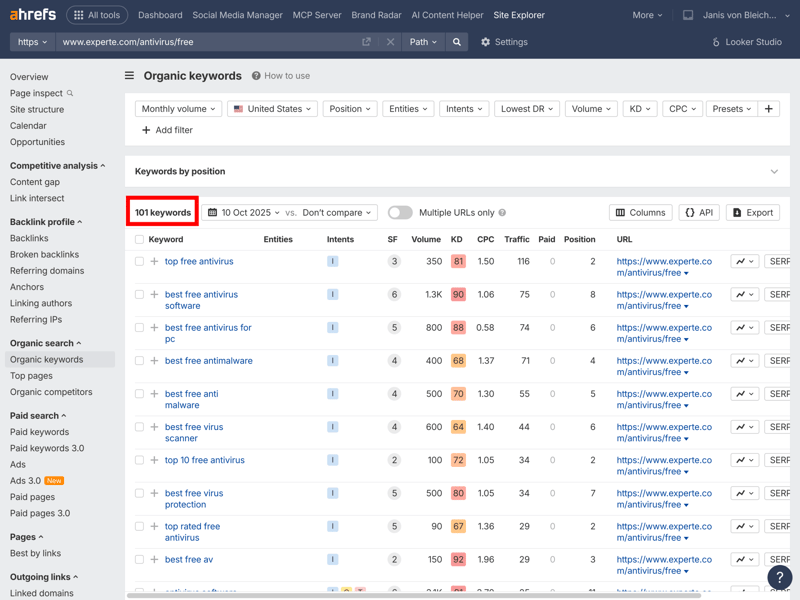
You can use an SEO tool to measure which content ranks for how many keywords.
Relevance
A keyword might promise tons of traffic potential, but if it doesn’t match your content, products, or expertise, visitors will quickly leave your site.
The keyword must be relevant and reflect what you offer. This is the only way to meet the users’ expectations. To properly assess a keyword’s relevance, ask yourself these questions:
Additional Metrics for Keyword Evaluation
Not every relevant keyword is equally easy to rank for. That’s why it’s worth looking at your competitors and other factors to assess the potential effort and separate the “quick wins” from long-term goals.
Here are the most important metrics for your final evaluation of potential keywords:
- 1.
Keyword Difficulty (KD) / Competition
This metric (often on a scale of 0–100) estimates how difficult it will be to rank on Google’s first page for a specific keyword. It typically analyzes the number and quality of backlinks from pages that already rank.A high KD score indicates strong competition: to compete here, you need an established domain and significant effort. A low score, however, can be a good opportunity to quickly gain visibility with relatively little investment.
- 2.
Cost per Click (CPC)
CPC shows how much advertisers pay on average per click for a Google Ads ad for this keyword. Even if you don’t run ads, this is a valuable indicator: a high CPC suggests high commercial relevance and purchase intent.When someone searches for a keyword that companies spend a lot of money on, there’s a high chance that this traffic will convert to paying customers.
- 3.
SERP Features
Google’s search results page often shows additional elements beyond classic links, like videos, images, FAQs, review stars, or AI Overviews (which are especially important now).These compete for attention with the standard blue link results and can strongly influence your page’s click-through rate (CTR). But they also offer opportunities: maybe you can rank with a video, or your text can make it into a Featured Snippet?
- 4.
Trend Data (Search Volume Over Time)
Looking at the timeline of search volume and clicks for a keyword shows you whether interest is rising, falling, or changing with the seasons.A keyword related to events or seasons is usually seasonal, while an upward trend indicates growing market demand. These insights help optimize content planning timing and publish the right topics at the right time.
Keyword research requires a comprehensive approach. It’s nearly impossible to manually track all the metrics and connections, which is where SEO tools like Ahrefs, Semrush, or Sistrix come in.
They support your research and help you evaluate keywords based on the metrics mentioned above.
The Process: Keyword Research With Ahrefs
The following 4-step guide shows how to use the SEO tool Ahrefs, using an online shoe store as an example. This way, you’ll find the right keywords and filter out those with the greatest potential from a wide range of options.
We need a comprehensive all-in-one SEO suite for this analysis. Ahrefs is particularly helpful for keyword research. The tool has one of the largest keyword databases on the market, delivers precise metrics, and has many valuable additional features built in. In the next section, we’ll walk through the search step by step so you can find SEO keywords.
Step 1: Find and Brainstorm Seed Keywords
Every keyword research starts with seed keywords (starting keywords). These are the basic terms that best describe your business, products, or services.
Here’s how to proceed:
- 1.
Open the Keywords Explorer in Ahrefs from the top menu bar.
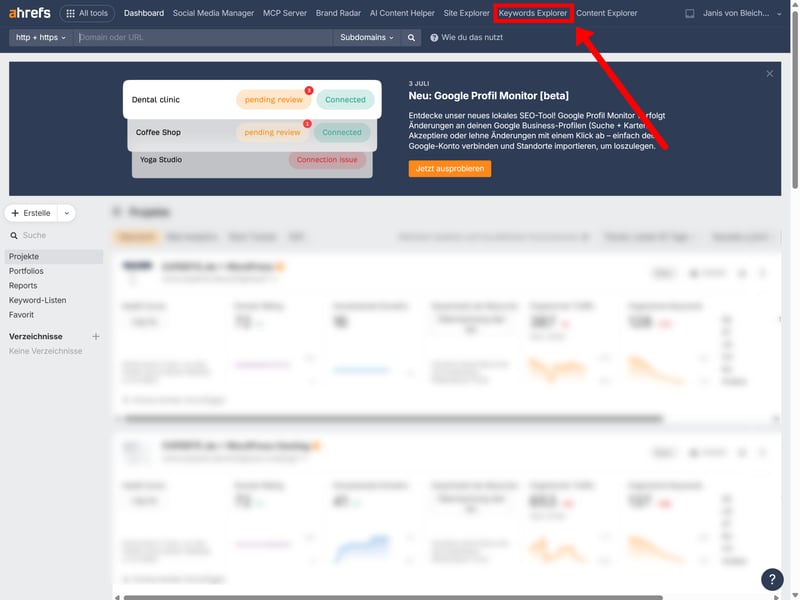
The Keywords Explorer is only one of Ahrefs’ features.
- 2.
Enter one or more terms that match your business into the white search box. In our example, we’ll choose the term “sneakers.”
- 3.
When you click “Search,” Ahrefs immediately provides an overview with the most important metrics for the seed keywords.
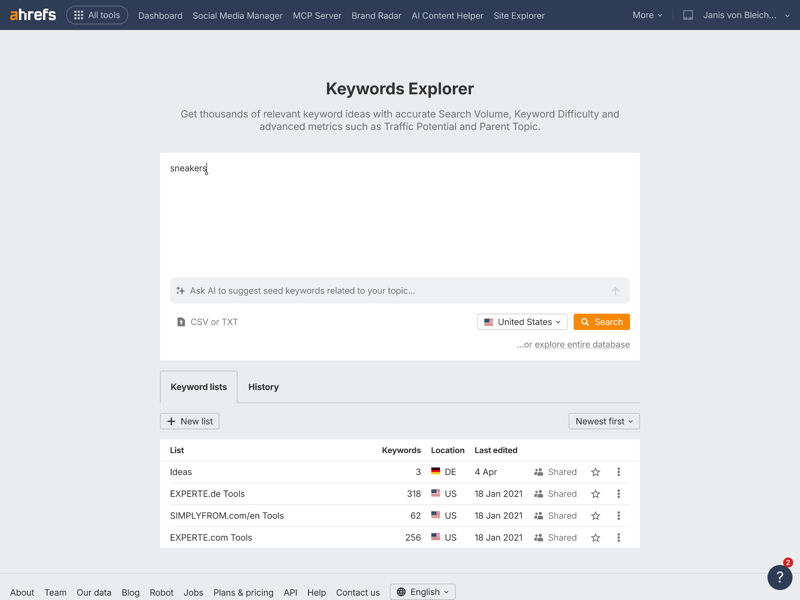
Open the Keywords Explorer in Ahrefs to search for keywords.
- 4.
Click on “Matching terms” under “Keyword ideas” in the left menu bar.
- 5.
Ahrefs now shows how many keywords contain the selected seed keyword.
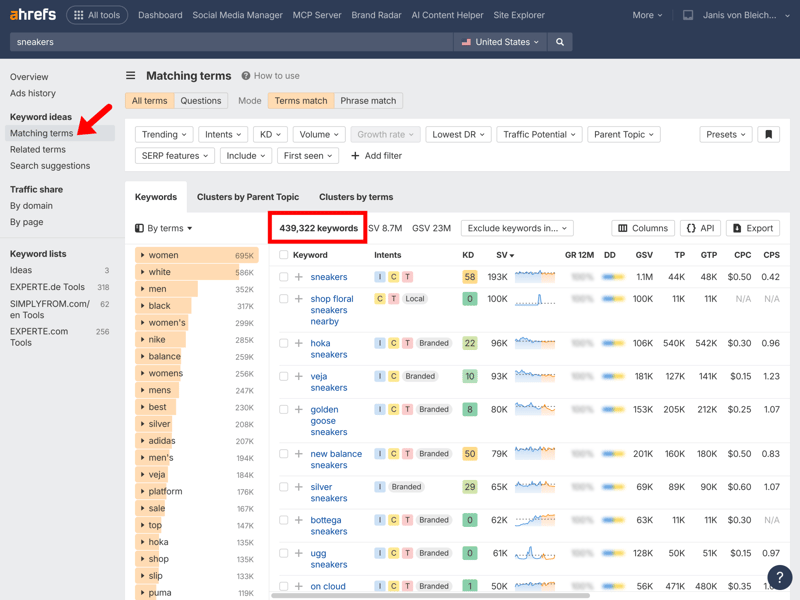
In the “Matching Terms” view, you’ll find all possible keywords (almost 440,000).
Step 2: Filter Keywords
Now you can use Ahrefs’ filters to narrow down your selection. This shows you how many keywords could potentially work:
- 1.
Select the search intents that match what you offer. In our example, the online store shouldn’t provide guide content but should lead visitors directly to purchase. That’s why we pick “C” (commercial) and “T” (transactional).
- 2.
You can use additional filters to exclude specific terms. In our example, all keywords with “men,” “balenciaga,” and “shop” aren’t relevant since we don’t carry these products or they’re our direct competitors.
- 3.
Now click “Show Results.”
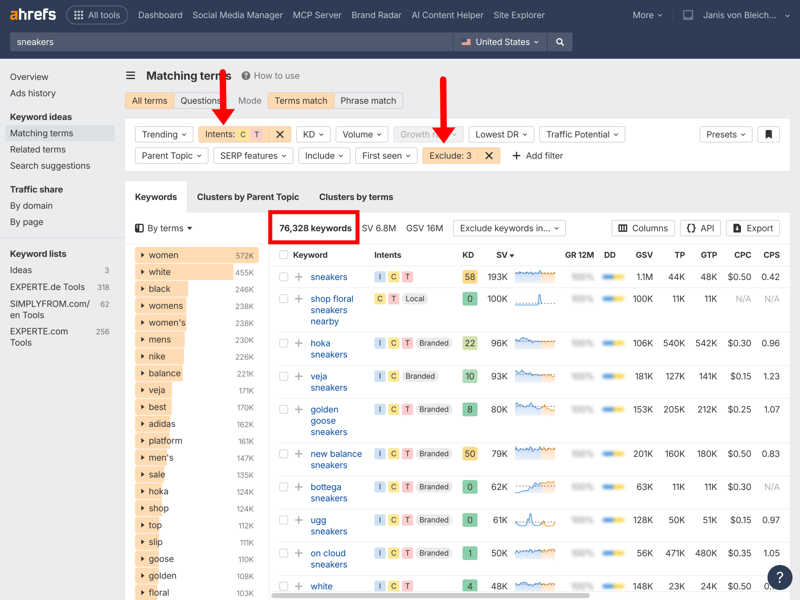
Use the tool’s filtering options to narrow your selection. Now it's “only” about 76,000 keywords.
Step 3: Cluster Keywords
To find out which keywords you can target with a single page or piece of content, you need to group keywords by topic. This creates structure in your list. Related keywords form clusters based on their main topics (“Parent Topics”).
The goal: Each cluster should later become its own comprehensive page. This prevents keyword cannibalization, where multiple pages on your website compete for the same keyword and hurt each other’s rankings.
- 1.
Click on the “Clusters by Parent Topic” view below the filters.
- 2.
Each parent topic appears as a color-coded tile, sized by importance. These topic blocks are made up of smaller parts—the individual keywords.
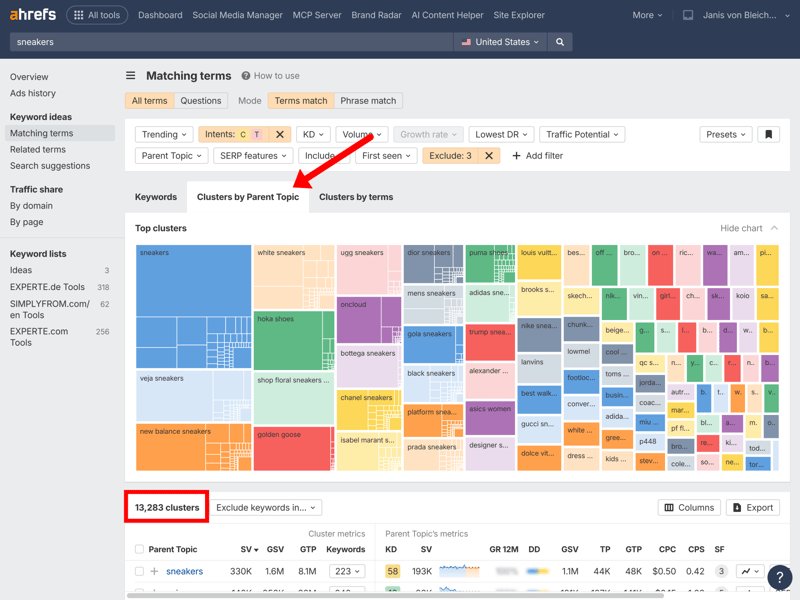
We get just over 13,000 clusters by parent topic.
In theory, each parent topic shows you the traffic potential and how many other keywords you can cover on the side. The rule of thumb: You should create tailored content for each parent topic and treat the largest keyword within the cluster as your primary keyword. The others become your secondary keywords.
In practice, however, step 4 almost always comes first: prioritization.
Step 4: Evaluate and Prioritize Manual Keyword List
No tool can replace the final and most important step: manual keyword evaluation. It wouldn’t make sense or be realistic to create a separate landing page for every parent topic.
To proceed strategically, we recommend this approach:
Export and Filter List
- 1.
Click “Export” to export the complete list to a spreadsheet program like Excel or Google Sheets. Alternatively, you can check the boxes next to specific parent topics to save only that selection.
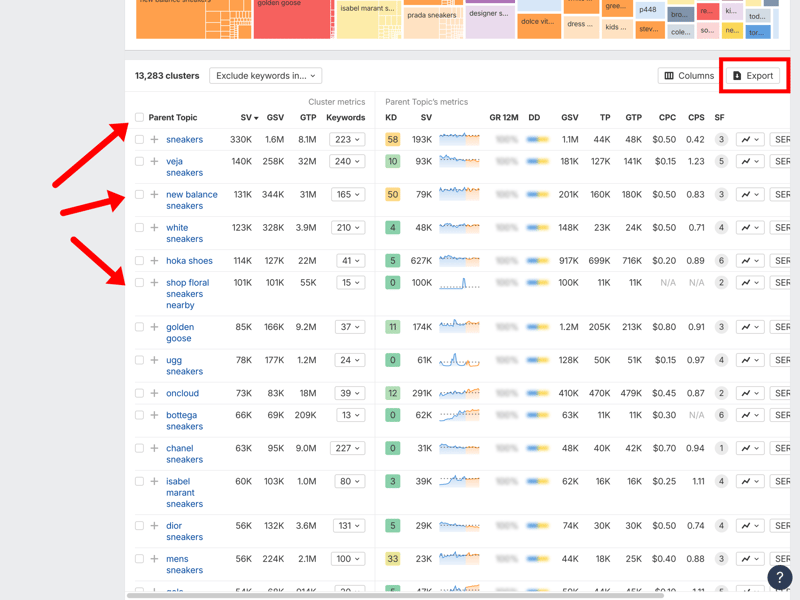
When exporting, you can choose between the first 1,000 entries or the complete list.
- 2.
In the exported list, you can now apply additional filters. For example, you can exclude all clusters with traffic potential under 500 and cluster search volume under 500 to avoid niche topics that don’t provide enough economic value.
- 3.
Then you can continue working with the list as usual: split it up, enrich it, visualize it, or analyze it using Excel functions.

The exported data allows for additional filter options and useful Excel features.
Check SERPs Manually
To make your final prioritization, it’s worth looking at the actual search results.
- 1.
Click on a keyword in Ahrefs to open the dashboard, then scroll down to the SERP view. There you’ll see at a glance which pages currently rank—including URL, meta title, domain rating, backlinks, word count, traffic, and more.
This information helps you realistically assess the competition and align your content strategy accordingly.
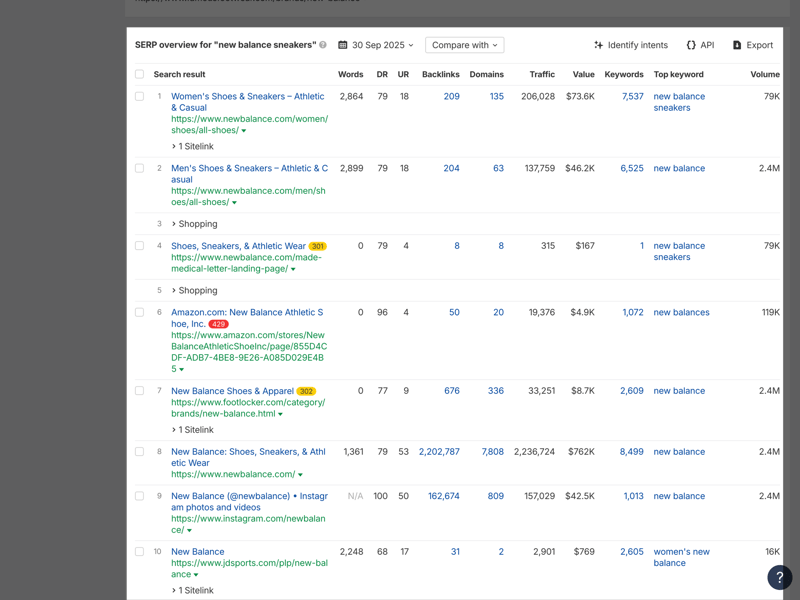
Let’s focus on the specific SERPs (here for “new balance sneakers”) to prioritize.
- 2.
If you notice that many similar content formats from similar companies rank well, your chances are good. However, if other types of content appear (like guide articles, YouTube videos, or forums), the keyword is less suitable for a transactional page.
In our example, other online shoe stores prove that Google considers them helpful and relevant.
Compare Additional Metrics
Beyond the classic metrics, additional metrics can be helpful in certain cases—for example, when you want to tailor your keyword strategy more specifically to campaigns, seasonality, or international markets.
Here are additional metrics you can also find in the Ahrefs dashboard:
Special Case | Suitable for … | Possible Applications |
|---|---|---|
Cost-per-Click (CPC) for SEA | SEO and marketing managers who aim to understand the commercial value of a keyword to run Google Ads |
|
Seasonal Search Volume | Season-dependent products or topics and specific periods (pre-Christmas season, etc.) |
|
Global Search Volume | Companies with an international focus or in foreign markets |
|
Note: All the information mentioned above is available in Ahrefs’ standard plan. The advanced version gives you additional details—such as growth rate, device distribution, or forecasts. However, for most analyses, the standard metrics are completely sufficient to find relevant SEO keywords and evaluate them meaningfully.
How to Ensure Long-Term Success with Your Keyword Research
You now know how to find, evaluate, and prioritize keywords. But SEO is constantly changing. Search engines are getting better at understanding context, evaluating content, and providing precise answers to user queries.
For keyword research, this means focusing purely on search terms isn’t enough anymore. What matters now is how well your content covers topics, how credible it appears, and how visible it is in AI-powered search results.

Three developments are shaping this future:
- 1.
Topical Authority: Topics Instead of Individual Keywords
Google increasingly evaluates how comprehensively a website covers a topic. Sites that regularly publish high-quality content in a subject area are considered authorities and rank faster for new, related keywords. - 2.
E-E-A-T: Trust, Expertise, and Credibility
E-E-A-T stands for experience, expertise, authoritativeness, and trustworthiness. These criteria determine how reliable Google considers your content. Practical experience, clear sources, and expertise build trust and strengthen your rankings long-term. - 3.
The Impact of AI on Search
AI-powered search results (like Google’s AI Overviews) are changing how users find answers. Content that precisely answers questions gains visibility because AI systems quote it directly. Creating content that provides real value keeps you relevant here too.
Common Keyword Research Mistakes
The same mistakes keep appearing in keyword research. Here are some of the most common ones and tips on how to avoid them:
Only Focusing on Search Volume
High numbers are tempting, but without the right search intent, they don’t deliver much. Focus on relevance to your business model. 200 targeted clicks that convert to customers are more valuable than 5,000 irrelevant visitors.Ignoring Search Intent
Every search query has a goal: to inform, compare, buy, or find a specific location. If your content misses this goal, users bounce immediately. This signals poor quality to Google.Always ask yourself, what do users really expect? Someone searching “running shoes review” wants a comparison article, not a brand story.
Looking at Keywords in Isolation Instead of Thinking in Topics
Google doesn’t just rank individual keywords but entire topic areas. Instead of creating ten small articles for ten similar keywords (like “running shoes for beginners” and “jogging shoes starter”), you should cover a comprehensive parent topic. Bundle related keywords into one outstanding guide to strengthen your topical authority.Not Manually Checking Search Results (SERPs)
SEO tools provide data, but the truth lies in live search results. Look at the top 5 results for your keyword: Are they blog articles, product pages, videos, or forums? This tells you what format Google prefers for this search query and what content you need to beat.Targeting Topics Without Your Authority
Your content must match your brand, product range, and business model. A vegan food blog will hardly have a chance to rank for “best steak recipes,” and even if it did, it would hurt the brand. Focus on topics where you can credibly and authentically appear as an expert. This is where E-E-A-T is crucial.Choosing the Wrong Content Format
Search intent determines format. Someone searching “how to tie a tie” wants a quick video or image tutorial, not a 2,000-word article about the history of ties. Provide the format that solves the user’s problem fastest and best.Keyword Stuffing (Unnatural Keyword Repetition)
Excessive repetition of a keyword sounds unnatural to both readers and Google. Search engines recognize such texts as manipulation attempts.Write for people instead of algorithms. Use synonyms and related terms. Google understands context better than ever and primarily evaluates the quality of your content, not its keyword density.
Conclusion: Your Roadmap to a Successful Keyword Strategy
High-quality and relevant content is the foundation for lasting success online. Good keyword research is the first critical step: it shows what your target audience is searching for and where opportunities exist for your content and determines whether the right people will find your content.
In four steps (brainstorming, filtering, clustering, and prioritizing), you can create a structured foundation to develop targeted content that fits your audience, what you offer, and your business goals. Tools like Ahrefs help you work with data while keeping sight of what matters most: the real value of your content.
SEO isn’t a one-time project but an ongoing process. Markets, trends, and algorithms change, and your keyword strategy should too. Review your list regularly, update content, and watch which topics are gaining relevance.
This approach pays off in the long term: when your website consistently covers relevant topics, provides real value, and is considered a reliable source, you create what Google rewards most today: authority, trust, and quality.