How to Improve Google Ranking: What Really Works?


A top ranking on Google is what practically every business with a web presence wants. High visibility in search results is the most direct way to attract visitors. But how do you reach those coveted top spots in an industry where the competition is literally just one click away?
Two fundamental pillars are crucial for search engine optimization (SEO): on-page and off-page. If you follow some practical tips, you can secure top rankings for relevant keywords and maintain them long-term.
Google Ranking Basics
Anyone who wants to improve their visibility on Google should first understand how the search engine works. Its business model is based on delivering the most relevant and trustworthy results for every user search query. Satisfied users come back—and click on profitable ads.
To ensure this quality, Google’s algorithms crawl and evaluate all websites based on hundreds of factors. That’s why it’s not enough to optimize a handful of things once and hope for the best. To be consistently visible on Google, you need a good SEO strategy.
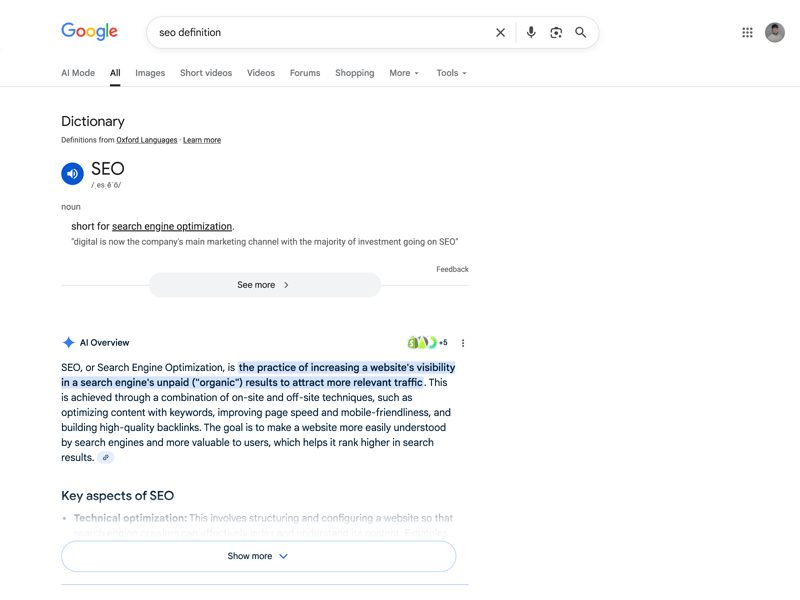
For the search query “seo definition,” you see snippets instead of usual Google rankings.
In short, your path to a better ranking involves sending Google convincing signals that your page provides the best answer.
First, familiarize yourself with a few relevant definitions:
SERP (Search Engine Results Page)
The SERP is the view of a search engine after entering a search query. It shows both organic results and paid ads.Crawling
During crawling, search engines systematically search the internet for new and updated content by jumping from link to link.Indexing
During indexing, Google analyzes the content found during crawling, sorts it in a massive database (the search index), and stores it.Ranking
It refers to the exact order (or position) of a website within the organic search results for a specific keyword.Ranking Factors
Ranking factors are the various criteria and signals that Google uses to evaluate websites to determine their ranking.
To achieve higher rankings, you need to make sure the algorithm finds positive ranking factors when crawling and indexing your content. When you appear higher in Google search results, you benefit in multiple ways:
Attract High-Value Traffic
A high ranking brings more visits. You also attract qualified traffic to your website because you reach users exactly when they’re actively searching for your solutions.Gain More Visibility
Since most users only look at the first Google page, a top ranking is essential for your visibility.Establish Topical Authority with Trust
When you consistently appear in top positions for important topics, Google recognizes you as an expert in that field over time. Because people trust Google results, this credibility transfers directly to your brand and accelerates the process of building trust.Create the Foundation for Sustainable Growth
With strong SEO rankings, you continuously gain organic traffic and leads without ongoing advertising expenses.
Learn the Theory Behind SEO
A successful SEO strategy aimed at improving Google rankings has two core components: on-page and off-page optimization. Only when you approach both areas strategically and consistently can a website reach its full ranking potential.
Pillar: On-Page SEO
On-page SEO includes all measures you can directly control and implement on your website. Here you have 100% control over setting the stage for good Google rankings.
On-page SEO can be divided into two closely connected areas: content and technical SEO. While the content part ensures your website is relevant and understandable for users and search engines, the technical part makes sure it functions smoothly and can be optimally indexed.
Content Optimization
The following overview shows which aspects are crucial for the content quality and structure of a page. It helps you strategically improve your content:
Area | Core Question/Goal |
|---|---|
Content Quality | Is the content high-quality, relevant, and trustworthy? |
HTML Structure and Metadata | Are the most important HTML elements optimized for SEO? |
User Experience and Readability | Is the content presented in a user-friendly way? |
Internal Linking | Is relevance distributed meaningfully within the site? |
Technical SEO
Beyond high-quality content, the technical foundation is crucial. The following table shows the key checkpoints to ensure your website functions flawlessly and Google can crawl it properly:
Area | Key Question/Goal |
|---|---|
Indexability and Visibility | Is the page visible and indexable by Google? |
Performance and Load Time | Are the Core Web Vitals and load time optimized? |
Mobile Optimization | Is the page fully mobile-friendly? |
Site Architecture and Technology | Is the technical on-page structure clean and logical? |
With a clean on-page structure, you’ve laid the groundwork on your site. Now it’s time to strengthen how your website is perceived across the rest of the internet.
These external signals are precisely what Google considers crucial proof of trust—making them the core of the second pillar.
Pillar: Off-Page SEO
Off-page SEO refers to all external signals that demonstrate your website’s authority and trustworthiness. This is about establishing yourself as a relevant authority in your industry. You can’t directly control these factors, but you can strategically influence them.
Backlinks — The Most Important Currency in Off-Page SEO
By far the most important factor in off-page SEO is backlinks. Backlinks are like digital recommendations: every link from another website to yours is like a positive reference for Google.
What matters isn’t how many backlinks you have. What’s essential is where they come from. A single link from a recognized, topically relevant industry site is more valuable than hundreds of links from irrelevant or even low-quality spam sites (“toxic links”).
You can also build links actively through “outreach” by reaching out to other website owners directly, for example, for guest posts or partnerships.
Learn more about backlinks here:



Other Off-Page Factors
Beyond traditional link building, there are several other off-page factors that can indirectly influence your ranking. These include:
Brand signals: Mentions of your brand or products in media, blogs, or forums strengthen your online reputation.
Social signals: Likes, shares, and comments on social media show relevance and generate additional attention.
Local signals: Consistent listing of your name, address, and phone number across all online directories and in your Google Business Profile builds trust with search engines.
Reviews: Authentic and positive customer reviews are a strong trust signal for both search engines and users.
In summary, a successful off-page strategy relies on a strong brand presence and positive external signals. Building and monitoring backlinks, mentions, and reviews strengthens your reputation and improves your ranking in search results.
From Theory to Practice: Putting Your Ranking Strategy into Action
Now that you understand the theoretical foundations of both SEO pillars, it’s time for practical implementation. The following sections serve as a detailed checklist for your on-page and off-page activities and translate theory into concrete tasks.
On-Page Optimization: The Most Important Steps at a Glance
On-page optimization is where you have direct control: you are fully in charge of the content, the structure, and the technical aspects of your website.
The following overview shows what matters most and why these points are crucial for your ranking:
☑Content Quality (E-E-A-T)
High-quality, relevant content is the core factor for answering your target audience’s questions.
☑HTML Structure and Metadata
Clean HTML structure helps search engines understand your content hierarchy.
☑User Experience and Readability
Good readability and clear user navigation increase time on page. Positive user signals are an important indicator to Google that your page is relevant.
☑Internal Linking
Internal links distribute “link equity (juice)” across your website, strengthen topical relevance, and help users and search engines discover influential content.
☑Indexability and Visibility
You need to make sure Google can find (crawl) and include your significant pages in the search index (index).
☑Performance and Load Time
A fast website is a confirmed ranking factor and is crucial for user experience. Slow pages lead to high bounce rates.
Want to find out how well your website is currently performing? Here are a few free tools that can help you:


☑Mobile Optimization
Since Google indexes using the "mobile first" principle, the mobile version of your website is the foundation for evaluation and ranking.

☑Site Architecture and Technical Setup
A clean technical foundation is the backbone of your website. It prevents ranking issues, helps Google better understand your content, and creates a positive user experience.
Off-Page Optimization in Practice: Your Checklist
While you can’t directly control off-page factors, you can strategically build your online reputation. The following points show how to actively strengthen the most important external signals:
☑Build Backlinks
Backlinks from relevant and trustworthy sites are like digital recommendations to Google and represent the strongest single off-page factor.
☑Strengthen Brand Signals
When your brand appears frequently and positively (even without direct links), Google sees this as a strong signal for relevance and authority.
☑Use Social Signals
While social signals (likes, shares) aren’t direct ranking factors, they increase your content’s visibility and can indirectly lead to more backlinks and brand signals.
☑Optimize Local SEO Signals
For local businesses, consistency in location data is crucial. It builds trust with search engines and helps you appear in local search results.
☑Actively Encourage Online Reviews
Positive and regular reviews are a clear signal of trustworthiness and customer satisfaction—especially important in local search.
Five Practical Tips for Ranking Optimization
Whether it’s content, technical aspects, or backlinks—what matters in the end is how you manage all these elements in your daily operations. These five tips help you structure your SEO efforts strategically and make them work long-term.
Tip 1: Optimize Holistically
Successful SEO is (unfortunately) not a checklist that one department can work through. It’s an integral part of your entire digital strategy. Achieving great Google rankings requires collaboration across many areas: good content from marketing lands on a technically perfect page from the web design team and generates backlinks through PR efforts.
SEO insights can feed back into product development. Align all your efforts with your overarching business goals. Here’s what this means: It’s unrealistic to improve your Google ranking “forever” with a one-time SEO effort. It's a continuous and often lengthy process.
To take a holistic approach to SEO, you need to understand Google’s quality criteria. The E-E-A-T model (Experience, Expertise, Authoritativeness, Trustworthiness) mentioned earlier is the best guide for this. The following table shows how you can strengthen each principle with specific formats:
E-E-A-T Principle | Possible Formats |
|---|---|
Experience |
|
Expertise |
|
Authority |
|
Trustworthiness |
|
Tip 2: Set Realistic Goals
The top position for all relevant keywords is an ambition, not a strategy. Instead, define achievable, measurable, and incremental goals. Analyze the competition and keyword difficulty (KD) to realistically assess opportunities. It’s regularly smarter to work toward a top-3 ranking or at least the first page on Google.
A good goal might be to increase organic leads by 15% after optimizing content for a specific keyword cluster.

With the rise of AI-generated answers—like Google’s AI Overview—the rules of the game are changing even more. More and more searches end as zero-click searches: users get their answer directly on the results page without clicking through to a website. This reduces organic traffic—even with top rankings.
You should adapt your SEO goals to this reality too: instead of focusing mainly on click-through rates or visitor numbers, the ranking position itself becomes the deciding factor. Only those who rank at the very top have a chance today of being cited as a source in an AI answer.
Tip 3: Keep Track of Your Rankings
Without data, you’re flying blind—this is rarely as true as it is with SEO strategy. You won’t know if your efforts are working unless you can measure the results.
There are several tools that help you track rankings, visibility, and user behavior:
Google Search Console: This free tool is practically essential. Use the performance report to analyze which search queries generate impressions and clicks and identify untapped potential. Monitor indexing and technical errors.
SEO Suites (e.g., Ahrefs, Semrush): Invest in a professional tool to track your keyword rankings over time, analyze your competitors’ backlink profiles, and discover new content opportunities.
Web Analytics (including Google Analytics): Connect your SEO success with user behavior. Which pages found through Google lead to the highest dwell times or most conversions?
Tip 4: Continuously Adjust Your Keyword Strategy
Markets, technologies, and your customers’ search behavior change constantly. Schedule regular reviews and ask, are there new trending topics in your industry? Have competitors established new content formats?
An important approach is updating existing content (“content refresh”). An article that ranked well two years ago can maintain or even improve its position through content and data updates.
Here’s a checklist to help you with updates:
Tip 5: Rankings Aren’t Everything
A high ranking is the first step toward achieving your business goals. The ultimate outcome is always your business success. What good is first place if visitors have a poor experience on your site and can’t find what they’re looking for?
Google measures exactly these user signals. A high click-through rate (CTR) in search results and long dwell time show that your content is relevant. If users bounce quickly instead, Google sees this as a negative signal—even a top ranking can be lost.
SEO isn’t a race to rank first. It’s an ongoing process to keep visitors happy. Only websites that provide real value stay visible long-term. You can read more about this directly from Google.
Conclusion: A Step-by-Step Approach to Better Rankings
SEO professionals often say that improving your Google rankings is a marathon, not a sprint.
It requires a strategic approach, patience, and a commitment to continuous improvement. When you systematically work on both pillars—creating an excellent on-page presence (both technically and content-wise) and building a strong off-page reputation—you lay the foundation for lasting digital success.
Think of SEO as an investment in one of your company’s most important digital assets: your visibility and reach with potential customers right when they need you most.