Link Building Strategies: How to Create one in 2026

Many businesses want to boost their SEO with backlinks. But acquiring backlinks without a clear strategy often wastes time and resources. The real goal is to secure high-quality, relevant links that build long-term trust with search engines.
A smart link building strategy replaces guesswork with a clear system. We’ll show you how to build one. You’ll learn which methods actually work, how to pick the right approach for your business, and how to put it into action so you can compete more effectively in search results.
What Is Link Building—and Why Does It Matter?
Link building is the process of getting other websites to link to yours (backlinks). Search engines like Google treat these links as votes of confidence. The more high-quality, relevant sites link to you, the more trustworthy and important your website looks to their algorithms.
Here’s why this matters for your SEO:
Higher rankings
Backlinks are one of the strongest ranking factors. A site with a strong, high-quality link profile has a much better shot at ranking at the top of search results.Stronger authority
Metrics such as Domain Rating (DR) and Domain Authority (DA) are heavily influenced by the quality and number of backlinks pointing to your site.More traffic
Links from other sites don’t just help your SEO; they also send direct visitors your way (referral traffic). A well-placed link on a high-traffic site can become a valuable source of new visitors.Faster indexing
Backlinks help search engine crawlers discover and index new content on your site more quickly.
Bottom line: without a solid backlink profile, long-term visibility is nearly impossible. In competitive markets, link building is one of the most important parts of a successful SEO strategy.
Analysis and Goal Setting: The Foundation of Your Link Building Strategy
A good strategy starts with a clear picture of where you stand. Before you send your first outreach email or launch your first content campaign, you need to know your website’s current status. Tools like Ahrefs, Semrush, or the free Google Search Console give you the data you need to spot opportunities and risks.
Understand Your Current Backlink Profile
If you have a new website or landing page with no backlink profile yet, skip to the competitor analysis section below.
Your backlink profile includes all external links pointing to your website. Analyzing it shows how strong your current link network is and where you should focus your efforts.
In Ahrefs, for example, you’ll find this data under “Site Explorer” > “Backlinks.”
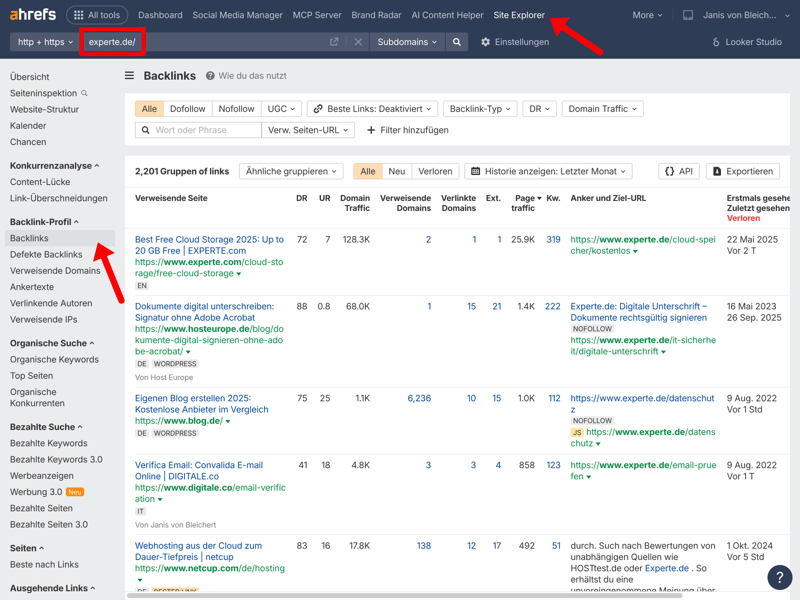
Go to “Site Explorer” and “Backlinks” to view your URL’s backlink profile.
Don’t focus solely on the total number of linking websites. To judge the real value of your links, focus on these key metrics:
Number of referring domains
Increasing the number of high-quality referring domains is often one of the fastest ways to strengthen a backlink profile.Quality of these links
Not all links are equal. What matters most is the authority, relevance, and trustworthiness of the linking site. These factors directly affect how search engines rank your page.Top-linked subpages
Which of your pages get the most backlinks? Often it’s your homepage. But a balanced profile shows that deeper subpages attract links regularly too.Anchor texts (the words behind the backlink)
A natural anchor text (the clickable text within a hyperlink) profile mixes brand names, URLs, and relevant keywords. Over-optimizing with too many promotional keywords can trigger spam signals or appear manipulative to search engines.Follow vs. nofollow links
Standard links pass link equity, while links marked with the rel="nofollow" attribute typically don't pass that authority signal directly.
Check Out Your Competitors’ Backlinks
Want to know where your best backlink opportunities lie? Look at your competition. Find out where the top-ranking websites for your main keyword get their strongest links. Those are the same places where you can find promising link prospects.
High-quality links often come from these sources:
Industry associations
Trade publications and blogs
Partner companies through strategic partnerships
Guest posting opportunities on relevant platforms
These sources are often your highest-value opportunities. If a site already links to several of your competitors, chances are it’ll be open to linking to your content too.
Most SEO tools offer a backlink gap analysis. It lets you compare your backlink profile directly with your competitors’ and shows you exactly which domains link to them but not to you yet.
Set Realistic Goals
Simply aiming for more backlinks isn’t enough. Without clear direction, your link building won’t have much impact. To get real results, you need specific, measurable goals. Every action should serve a purpose: do you want to build authority, increase visibility, or drive traffic to key pages?
Your focus depends on where you’re starting from. The table below shows common goals and how to turn them into measurable targets:
Focus | Goal | Metric and example target | Expected timeframe |
|---|---|---|---|
Overall authority | Close the gap with competitors | Increase Domain Authority from 35 to 45 | 12 months |
Brand awareness | Get mentions in industry publications | 5 mentions and links from relevant media outlets | 12 months |
Generate referral traffic | Drive visitors to your site | Increase referral traffic from industry sites by 20% | 9 months |
Product page | Rank in the top 5 for your main keyword | Build 15 high-quality links directly to the product page | 6 months |
You can frequently work toward multiple goals at once or in stages. The key is to give your strategy enough time. Link building is a long-term effort that requires ongoing adjustments and quality checks.
Two Paths to Success: Earn Backlinks vs. Build Backlinks
There are two main ways to get high-quality backlinks: a passive, content-driven approach and an active, outreach-based one. Both have their own strengths and challenges.
Passive Approach: Earning Backlinks
Here, the goal is to create content so valuable, data-driven, or original that other websites link to it on their own.
This approach is highly effective for building long-term authority and trust.
Very natural link profile
Links grow organically from different sources. Search engines read this as a positive signal and trust the site more.High potential if the content takes off
If a piece of content gains traction, it can keep attracting new backlinks for years with little to no extra effort.
Results are difficult to predict
Success depends on whether others find your content and choose to link to it. There’s no guarantee you’ll earn a set number of links in a given timeframe.Resource-intensive
Creating high-quality, unique content like studies or tools takes time. So does seeding: promoting the content through the right channels to reach the right people.
Want to learn how to earn backlinks with content and which formats work best? Read more here:
Active Approach: Building Backlinks
With active link building, you don’t wait to be discovered. You take charge: you identify relevant websites and reach out to decision-makers (outreach) to propose a link.
The key is research, communication, and relationship-building. That’s how you strengthen specific pages or close gaps with competitors.
Predictable and controllable
You stay in control and can set clear goals. Track the number and quality of links you build within a set timeframe.Targeted authority building
Decide which URLs (like product or category pages) to focus on. Build authority where it matters most for your goals.
Time-consuming
Outreach, finding the right contacts, and communication all require a lot of manual work.Risk of rejection
Low success rates are normal. Many of your requests will go unanswered or get rejected.
This guide shows you how to build backlinks and run outreach campaigns successfully:
Combine Both: The Hybrid Strategy
In practice, one approach alone rarely works. The best method is almost always a mix of both: great content plus targeted outreach. Even high-quality content often needs promotion to reach the right audience.
The hybrid strategy brings both approaches together:
- 1.
Lay the groundwork
Create standout content that solves a real problem for your audience or provides unique data. - 2.
Build reach proactively
Promote this content through targeted outreach to the correct people (like journalists or bloggers) to earn valuable links.
This approach gives you the best shot at success. High-quality content gives you a reason to reach out, and proactive outreach ensures your content gets the attention it deserves.
Quality meets reach
Combine outstanding content with targeted promotion through the right channels. Your content becomes the perfect hook for outreach, making every request credible and relevant.Typically the strongest results
Instead of leaving things to chance or making weak, unconvincing pitches, you offer real value. That sharply improves your chances of earning high-quality links and positive responses.
Most resource-intensive method
This approach demands top-tier content, thorough research, and professional outreach. It takes more work, but it usually pays off best.
Steer Clear of Harmful Link Strategies
Some link-building shortcuts may seem appealing, but they can backfire fast. Google flags outdated or manipulative tactics (black-hat SEO) and can hit you with steep ranking drops or even manual penalties (see Google’s spam policies).
Here’s what to avoid:
Buying links from cheap platforms
Stay away from links sold at rock-bottom prices without editorial review. They add no value, and Google reads them as manipulation.Private Blog Networks (PBNs)
Avoid participating in private blog networks (PBNs), networks of fake sites built only to pass link equity.Over-optimized anchor texts
Don’t overuse exact-match anchor texts. It’s a red flag for search engine algorithms.
The golden rule: quality over quantity. One link from a reputable industry publication outweighs 100 links from low-quality sources. Google frequently devalues or penalizes spammy websites. Here’s what a bad backlink profile looks like:
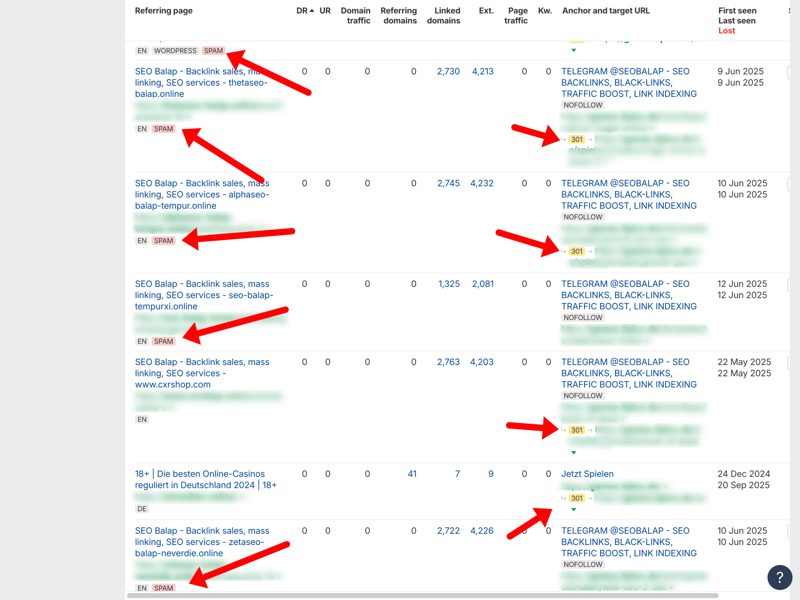
Backlink analysis (Ahrefs) of an online casino (URLs blurred for privacy).
Final Verdict: Build a Backlink Profile That Lasts
Successful link building isn’t random. It’s the result of a well-planned, ongoing process. Start by analyzing where your website stands today. Then build a targeted strategy that pairs strong content with active outreach. Finally, maintain a consistent process.
Building a strong backlink profile takes time, but it’s one of the most sustainable investments you can make for long-term organic search visibility. A strategic approach creates visibility that lasts, without relying on ongoing ad spend.