What Are Backlinks? A Crash Course for SEO Beginners


Think back to writing a research paper. To support your thesis, you cited established experts and pivotal studies. Each citation acted as a vote of confidence, bolstering your work’s credibility. On the Internet, backlinks serve this very purpose.
Simply put, backlinks are the currency of trust online. Every link pointing from one website to yours is a digital endorsement. This is precisely why link building is a cornerstone of effective search engine optimization (SEO).
But not all links are equal. We’ll break down what separates a high-quality link from a harmful one and show you the strategies to earn valuable backlinks for your website.
What Is a Backlink?
A backlink, which we can also call an inbound link, is a hyperlink from an external domain to your website. This is different from an internal link, which connects two pages on the same website of yours.
By the way, when an external site links to a specific page on your site rather than your homepage, it’s a deep link.
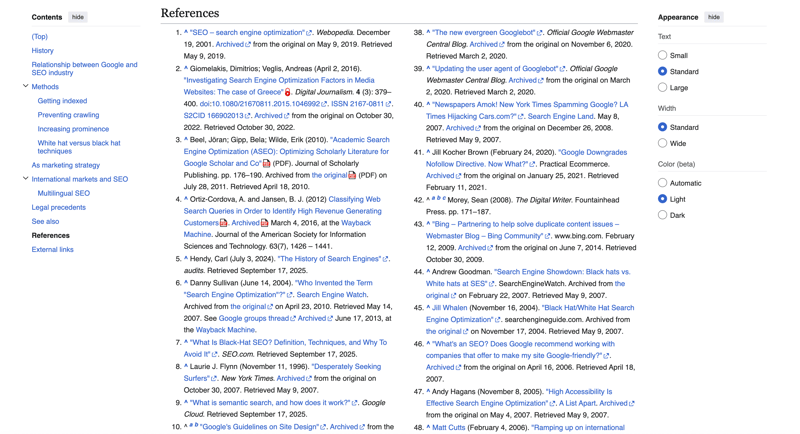
Every Wikipedia article shows links to other pages, using contextual backlinks.
Backlinks are critical because they transfer authority and trust (a concept experts often call “link equity” or “link juice”) from one website to another. The quality and relevance of the linking page are paramount.
A link from a reputable, topically related website passes more value and can significantly boost the linked page’s ranking in search results.
Every backlink consists of several core components. These elements are not just visible to users; they send crucial signals to search engines. Understanding this structure helps you evaluate a link’s quality.
Let’s break down each element:
Target URL
The specific web address (URL) a backlink points to. When a user clicks the link, they land on this page.Anchor Text
The visible, clickable text of a hyperlink. Ideally, anchor text is concise, descriptive, and contains relevant keywords, telling both users and search engines what the target page is about.HTML Attributes
These are snippets of code that give search engines more context about the relationship between the linking and linked pages.dofollow: This is the default state. It tells search engines to trust the link, follow it, and pass authority to the target page.
nofollow: This attribute instructs search engines not to pass authority to the target page. It acts as a citation without an SEO endorsement.
sponsored: This tag identifies links that advertisers pay for or sponsored content.
ugc (user-generated content): Webmasters use this attribute for links that users created, like those in blog comments or forum posts.
Link Placement
A link’s position on the page matters. A link embedded within the main body content typically carries more weight than one in a footer or sidebar.
Why Backlinks Are a Game-Changer—For Users and Google
The foundational importance of backlinks dates back to Google’s origins. The founders in charge developed the PageRank algorithm (detailed in their 1998 paper), which evaluated a page’s importance based on the quantity and quality of links pointing to it. The core idea was simple: a page is more important if more important pages link to it.
This revolutionized search by moving beyond simple keyword matching to a system of external recommendations. Today, backlinks fulfill three critical functions for your website’s success:
- 1.
They Boost Your Google Rankings (Ranking Factor):
Despite countless algorithm updates, backlinks remain one of the most powerful ranking factors. They signal your site’s relevance, trustworthiness, and authority (insights from the recent API leak reaffirmed their weighted importance). In competitive niches, a strong backlink profile is often the deciding factor for securing top rankings. - 2.
They Drive New Visitors (Referral Traffic):
Beyond SEO, backlinks send qualified traffic directly to your site. When a user clicks a link on another site to find you. Analytics tools track that visit as “referral traffic.” - 3.
They Build Your Authority (Reputation):
High-quality backlinks from reputable sites in your niche build your Topical Authority. This is crucial, as Google designed its algorithms to reward trustworthy and authoritative sources.
Backlinks create a win-win scenario. The linking site provides value to its audience by pointing to helpful resources. In return, search engines reward the site that earns the link, viewing it as a credible and relevant source, which positively impacts its rankings.
How to Spot Good Backlinks vs. Bad Ones
Not every backlink helps. Some can actively harm your website and trigger Google penalties. A classic example is links from link farms—low-quality sites operators created solely to sell spammy links and manipulate rankings.
Google is constantly fighting this “search engine spam.” If toxic sites frequently link to your site, it signals an unnatural link profile and can tank your rankings. Here’s how to tell the difference:
Topical Relevance
Comes from a website in a related niche.Domain Authority
Users know and trust the site.Integration
Editorially placed and adds value for the reader.
Bad (Toxic) Backlink
Comes from an irrelevant or unrelated site.Obviously Bought Link
Comes from a spammy, low-quality site.No Topical Connection
Placed in an irrelevant context.
Here's a quick checklist to assess a linking domain:
Feature | Good Backlink | Bad Backlink |
|---|---|---|
Source | Industry publication, respected blog, partner website, online news article | Obvious spam site, private blog network (PBN), link farm |
Anchor Text | Natural, descriptive, provides context | Over-optimized with exact-match keywords (“keyword stuffing”) |
Placement | Naturally integrated within editorial content | Hidden in footers, buried in long link lists, or stuffed in forum signatures |
Google prioritizes trustworthy sources. As long as your backlinks are helpful, topically relevant, and editorially earned, they will almost always contribute to your SEO success. Regularly monitoring your backlink profile is essential for improving your Google ranking.
Acquiring Backlinks for Your Site
Strategically acquiring backlinks is a process we call link building. It’s a proven SEO success factor focused on increasing the number and quality of links pointing to your site.
There are three primary ways to get backlinks: earn them, build them, or buy them. We strongly advise against the last method.


How To Earn Backlinks
The best way to get high-quality backlinks is to earn them organically. You do this by creating content so valuable that other websites want to link to it as a resource.
Content formats that are highly linkable include:
In-depth guides and step-by-step tutorials
Original research, studies, and data analysis
Compelling case studies with real-world results
Well-designed infographics that simplify complex topics
The formula is simple: create best-in-class content that provides real value to your target audience. A popular framework for this is the Skyscraper Technique (developed by Brian Dean): find existing content that ranks for your target keyword, and then create something significantly better, more comprehensive, and more up-to-date.
Warning: The term “generating backlinks” can refer to black-hat SEO tactics, which use automated software to create thousands of spammy links. These links are worthless and will harm your site. That is why you should prefer calling it “earning backlinks.”
How To Build Backlinks
Unlike the passive approach of earning links, building links is about proactive outreach. You actively find opportunities to place links and expand your profile. Proven tactics include:
Guest Posting
Write an article as a guest author for a reputable site in your industry.Digital PR
Pitch your content, data, or expertise to journalists and bloggers.Outreach
Directly contact website owners and suggest they link to a relevant resource on your site.Broken Link Building
Find broken links on other websites and propose your content as a replacement.
While earning links relies on others discovering your content, link building means you actively work to get it in front of the right people. The most effective strategies combine both approaches.
How To Buy Backlinks
Buying backlinks is a dangerous game. Google considers paid links that only intend to manipulate rankings a clear violation of its spam guidelines. If caught, you risk severe penalties, including a massive drop in visibility.
It’s crucial to distinguish between illicit link buying and legitimate paid promotions like event sponsorships. You should tag these links with nofollow or sponsored. We strongly recommend against buying links for SEO:
It Violates Google’s Guidelines:
Google treats unmarked paid links as spam. This can lead to ranking losses or manual penalties.Link Schemes Are Risky
Search engines also consider link exchanges and private blog networks (PBNs) manipulative and may penalize your site.Automated Tools Look Unnatural:
Services that promise hundreds of links overnight create a spammy footprint that hurts more than it helps.Improperly Labeled Content is a Violation
Sponsored posts or advertorials must use nofollow or sponsored tags. Failing to do so is a violation.
Analyzing a Website’s Backlink Profile
To analyze your backlink profile or spy on competitors, you need specialized SEO tools. These platforms crawl the web like Google and maintain massive link indexes, providing detailed reports on any domain.
The most popular tools for backlink analysis are:
Ahrefs
Experts widely consider it the gold standard for backlink analysis due to its massive and up-to-date link index. It’s a favorite among experts for its data accuracy and depth.Semrush
A comprehensive, all-in-one marketing suite where backlink analysis is one powerful feature among many. It excels at combining link data with keyword research, on-page SEO, and content marketing.Majestic SEO
A highly specialized tool that focuses almost exclusively on backlink analysis. Its proprietary metrics like “Trust Flow” and “Citation Flow” are industry standards for assessing link quality.
These tools do more than just count backlinks. They reveal key metrics like the linking domain’s authority, the anchor text used, and link attributes (dofollow/nofollow), providing the data you need to build a winning backlink strategy.
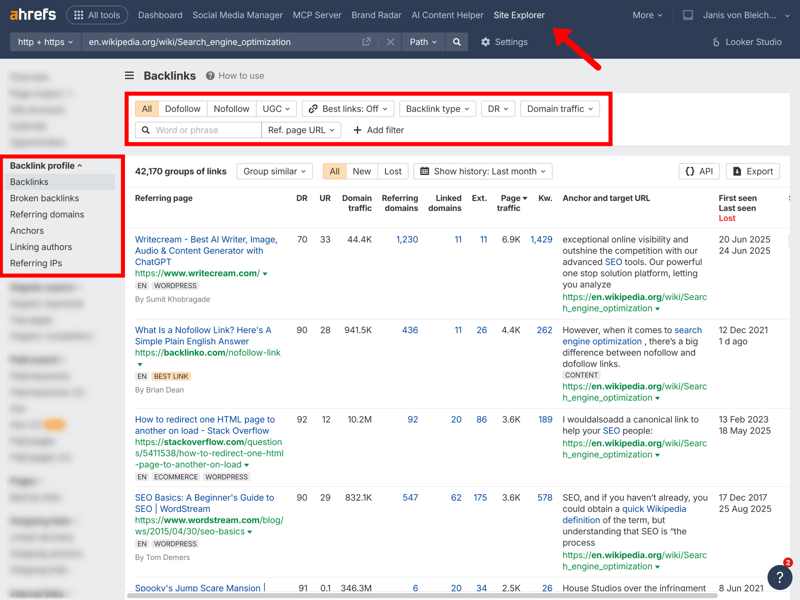
Example of a backlink analysis in Ahrefs for Wikipedia’s Search engine optimization page.
Are Backlinks Still Important for the Rankings Today?
The debate over the importance of backlinks is as old as SEO itself. Let’s be clear: backlinks remain a core ranking factor, but their role has evolved.
Recent insights, including from Google’s API leaks, confirm that so-called user signals are also heavily weighted. These include metrics like click-through rate (CTR) from the search results, time on page, and bounce rate.
Click-Through Rate (CTR): The percentage of users who click your result after seeing it.
Time on Page: The amount of time a visitor spends on your page after arriving from Google.
Bounce Rate: The percentage of visitors who leave after viewing only one page.
However, this doesn’t diminish the importance of backlinks. They now work in tandem with user signals. A page with great user engagement but no backlinks will struggle to rank in a competitive space. Likewise, a page with many backlinks but a poor user experience will eventually fall.
The truth is, you need both. Backlinks build foundational authority, while positive user signals validate it.
Let’s Conclude: A Strategic Approach to Backlinks
Backlinks are digital endorsements that signal trust and authority to search engines. Quality trumps quantity every time. The most sustainable strategy is to earn backlinks by creating content so valuable that it becomes a go-to resource in your industry. At the same time, proactively build relationships to foster natural linking opportunities.
Avoid risky shortcuts like buying links or using automated tools. These black-hat tactics violate Google’s guidelines and will ultimately do more harm than good.
Ultimately, a winning SEO strategy is about building a website that offers real value. When you do that, you’ll earn the high-quality backlinks and positive user signals needed to climb the rankings and stay there.