SpyFu Review 2026: The Best SEO Tool for Competitor Analysis?


Most SEO tools strive to cover every aspect of search engine optimization as all-in-one suites. SpyFu, however, takes a different approach—its name already gives it away: it focuses on competitive intelligence, specifically analyzing what your competitors are doing.
But how effectively does such a specialized tool perform, especially when measured against the broader SEO all-rounders? We put SpyFu through its paces to find out what it’s fantastic for as an SEO tool—and where it falls short.
SpyFu* is an SEO and PPC analysis tool built specifically for competitor research. It reveals which keywords your competitors rank for, the advertisements they’re running, and the strategies they use for both organic search and Google Ads.
Unlike broader SEO suites, SpyFu focuses specifically on the overlap between search engine optimization (SEO) and paid advertising (PPC). The goal is simple: show what’s working for your competitors and leverage those insights to fuel your own growth.
The U.S.-based company has been in operation for years, having launched in 2006 under the name “GoogSpy” before rebranding to “SpyFu.” Its core idea has remained consistent: to deliver competitor data that companies typically keep confidential.
This sharp focus means SpyFu caters to a specific audience. It’s not built for technical SEOs who need to run audits or fix crawl issues. Instead, it is designed for marketers and advertising professionals aiming to identify weaknesses and opportunities within their competitors’ strategies.
SpyFu Review
Specialist for competitive analysis
SpyFu goes deeper into competitor strategies than most SEO tools. It doesn’t just show where others rank—it also highlights their areas of underperformance.Unique PPC data
SpyFu reveals your competitors’ Google Ads campaigns, giving you insight into budgets, ad copy, and click-through rates.Low cost of entry
SpyFu is remarkably affordable compared to broader SEO suites, even for team-based usage.
No technical SEO
SpyFu is not an all-in-one tool. Features essential for technical website analysis, such as site audits, are entirely absent.Sometimes unreliable data
Beyond competitive analysis, data quality is not consistently reliable. This is particularly problematic for keyword research.Tiny backlink index
SpyFu is not well-suited for comprehensive link analysis. Its backlink index is comparatively small, capturing only a fraction of the links discovered by other SEO tools.
Interface and Usability
| User interface |
| 6/8 |
| Performance |
| 2/2 |
SpyFu keeps the interface stripped down to the essentials. Instead of nested menus, the tool relies on a clean, straightforward structure. The interface is exclusively in English, a common trait among many international SEO tools. However, users can easily select various countries and regions for their analyses, including Germany.
The primary focus lies on visual data presentation. Many metrics are displayed directly within charts and overviews, so you can quickly spot trends.
For advanced users, this approach can feel a bit too “stripped down,“ as detailed data can sometimes be missing or more challenging to access. For beginners, however, the learning curve is notably gentle.
No traditional dashboard
Upon logging in, there’s no traditional dashboard packed with metrics. Instead, they can either work directly with the central search bar or navigate straight to their project overview.
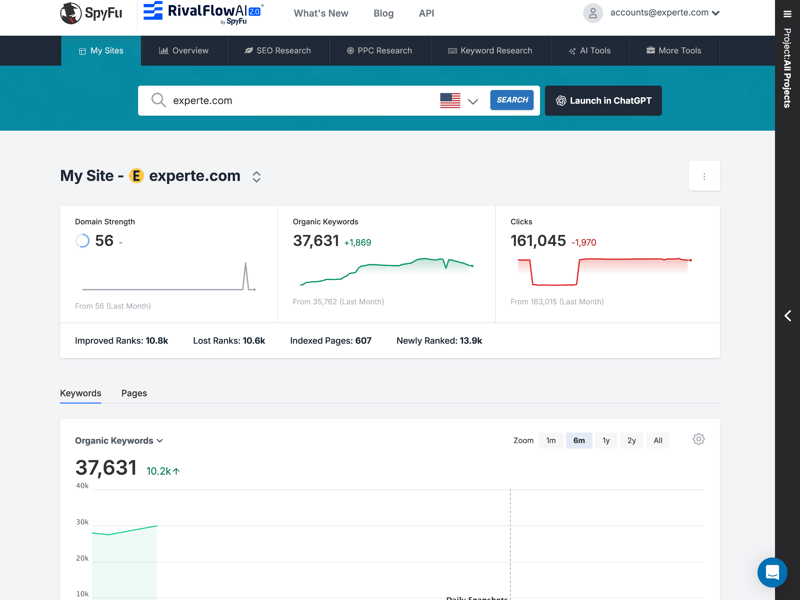
SpyFu skips the traditional dashboard and takes you directly to your projects and campaigns.
When a domain is looked up—whether as a saved project or via a quick URL search—users are first presented with a monthly overview. This is where SpyFu’s core strength becomes evident: the tool consistently displays organic search results (SEO) and paid ads (PPC) side by side, making connections easy to spot.
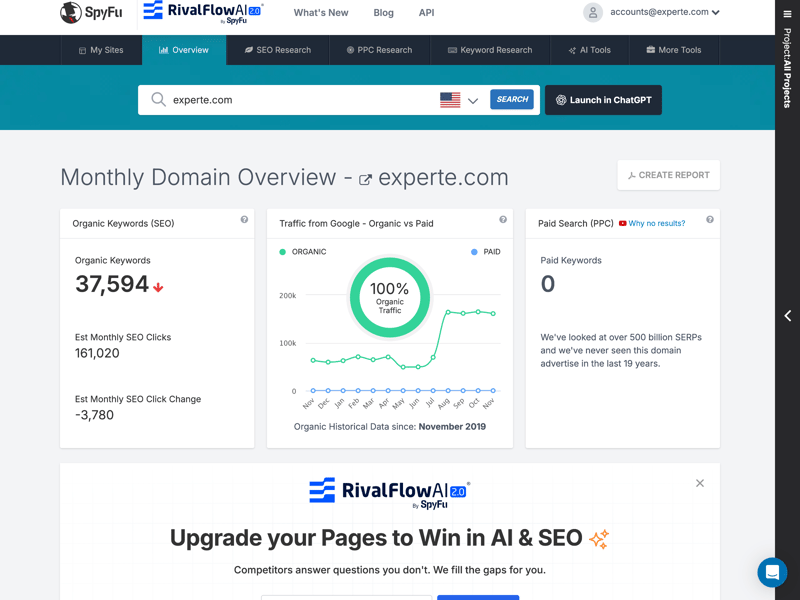
The overview places organic traffic and paid ads (paid) side by side to highlight connections.
Scrolling down further reveals additional details on the top keywords and best-performing pages of the domain being analyzed.
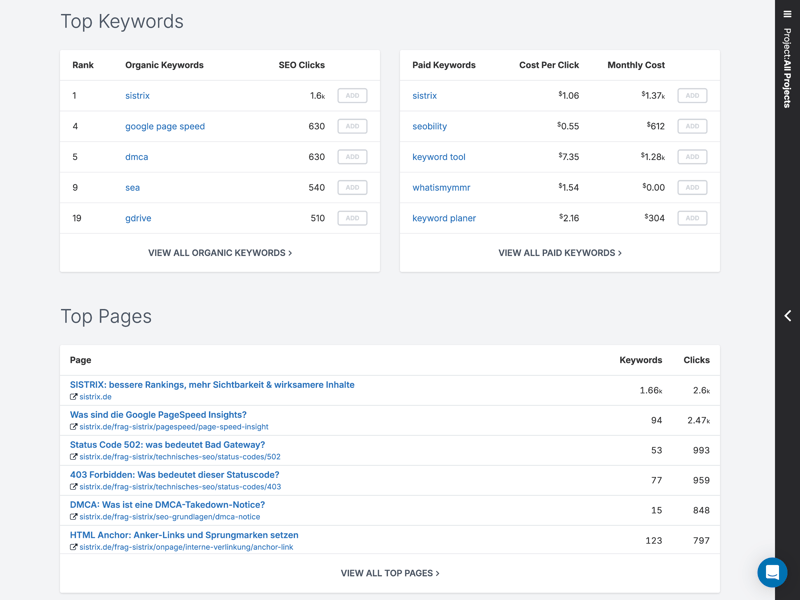
In the “SEO Research” section, you can quickly identify your strongest keywords and the pages driving the most traffic.
Performance with minor hiccups
During testing, SpyFu didn’t always run smoothly. Occasionally, reports would initially appear empty. Typically, a quick page refresh resolved the issue. Nevertheless, these glitches can disrupt your workflow.
Occasional interruptions: the data table initially appeared empty during testing and only loaded results after a refresh.

SpyFu impresses with its focus on essentials and the well-designed visual presentation of data trends. While the absence of a traditional dashboard might initially feel unfamiliar, it allows users to jump straight into analysis.
A standout feature is the consistent side-by-side comparison of SEO and PPC data, which simplifies the identification of connections and the understanding of competitor strategies at a glance. However, the loading issues detract from the overall positive impression. For users requiring uninterrupted, rapid workflow, occasional delays in data display could prove frustrating.
Competitor Analysis
| Analysis level | Available at all levels except subfolders/paths. | 1.5/2 |
| Scope of traffic estimation |
| 6/6 |
| Accuracy of traffic estimation | 53.6 % | 4/6 |
| Keyword rankings |
| 3.5/4 |
| Page structure | Only hostnames are tracked; support for directories and internal/external links is missing. | 0.5/2 |
SpyFu certainly lives up to its name: competitor analysis is front and center; it’s the core of the tool. Unlike many other SEO solutions, competitor data is not merely a supplementary feature here; it serves as the foundation for nearly all other reports.
The initial overview immediately highlights your main organic competitors. SpyFu visualizes shifts in market share over time, so you can instantly see which domains are gaining visibility and which are losing ground.
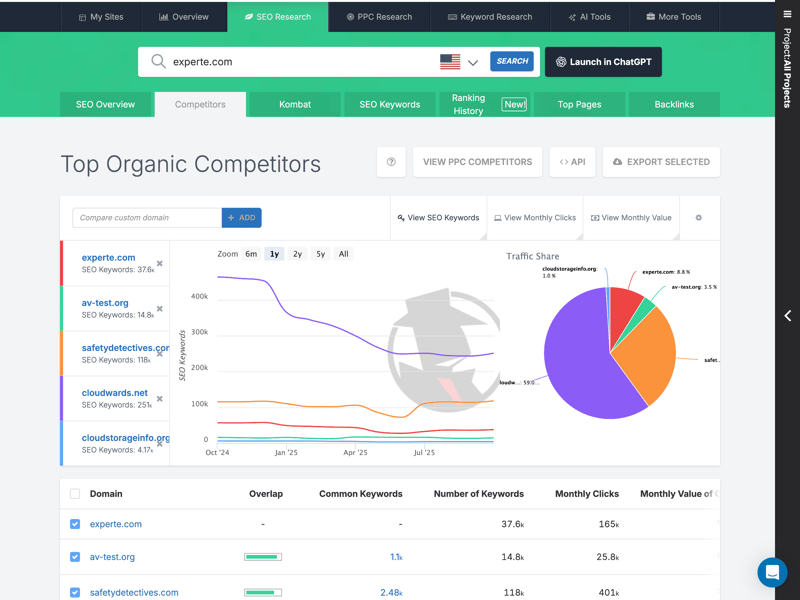
SpyFu tracks how your organic competitors evolve. You can instantly spot rising and falling players in your niche.
Comprehensive keyword analysis features
Knowing that a competitor receives traffic is insufficient to adjust your own strategy. SpyFu provides nearly all key information here, including ranking changes, shared keywords, and keyword gaps. However, a notable omission is its inability to display the total number of pages from a domain indexed by Google.
 SpyFu |  Ahrefs |  Moz |  Semrush |  SE Ranking |  Sistrix |  Mangools |  Ubersuggest |  Serpstat | |
|---|---|---|---|---|---|---|---|---|---|
Number of keywords (history) | ✓ | ✓ | ✓ | ✓ | ✓ | ✓ | ✓ | ✓ | ✓ |
Number of URLs (history) | ✗ | ✓ | ✓ | ✓ | ✓ | ✓ | ✓ | ✓ | ✗ |
Top pages | ✓ | ✓ | ✓ | ✓ | ✓ | ✓ | ✓ | ✓ | ✓ |
Ranking history per keyword | ✓ | ✓ | ✓ | ✓ | ✓ | ✓ | ✓ | ✓ | ✓ |
Ranking changes | ✓ | ✓ | ✓ | ✓ | ✓ | ✓ | ✓ | ✓ | ✓ |
Ranking distribution | ✓ | ✓ | ✓ | ✓ | ✓ | ✓ | ✓ | ✗ | ✗ |
Organic competitors | ✓ | ✓ | ✓ | ✓ | ✓ | ✓ | ✗ | ✓ | ✓ |
Keyword gap analysis | ✓ | ✓ | ✓ | ✓ | ✓ | ✓ | ✓ | ✓ | ✓ |
Total | 7 | 8 | 8 | 8 | 8 | 8 | 7 | 7 | 6 |
Competitor analysis for paid search
Further down, the tool presents a direct comparison between organic search (SEO) and paid advertising (paid search). Directly within the dashboard, users can identify which domains are competing for the same keywords, both in organic results and advertisements.
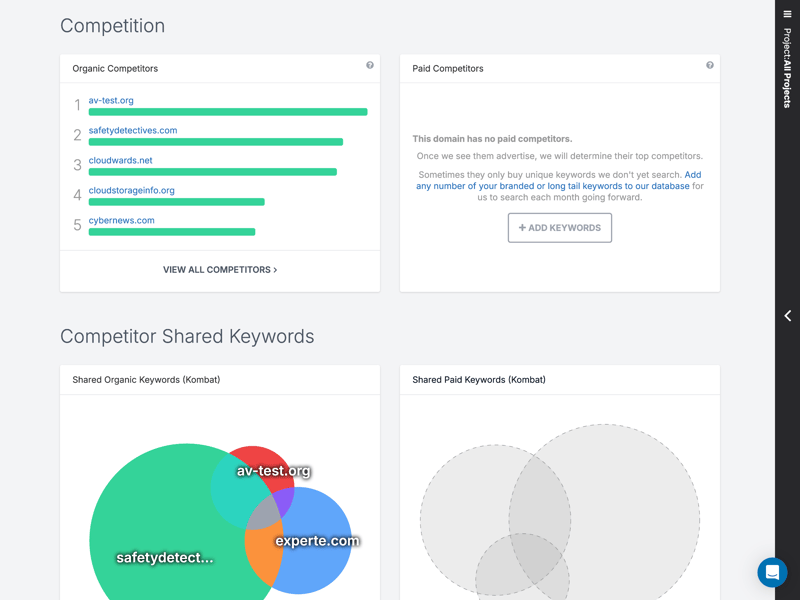
Which domains are competing with you for the same keywords?
This view mirrors the organic competitor display, showcasing trends over time, market shares, and the top-traffic keywords of competitors utilizing paid advertisements (SEA).
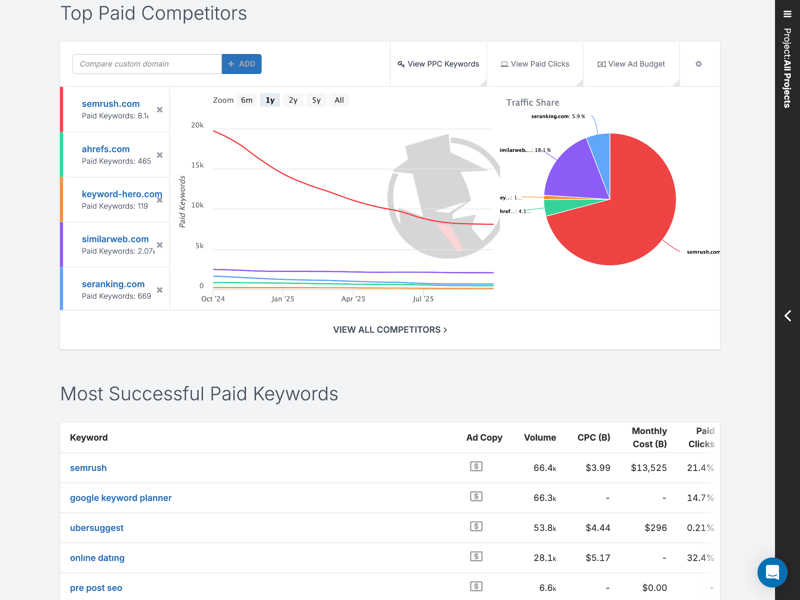
SpyFu reveals who’s running ads on your keywords and how aggressively competitors are pushing paid search.
Keyword-based competitor analysis
SpyFu delves deep into the details: it provides lists of your competitors’ top-performing keywords, allowing users to see which search terms drive the most traffic for them.
The curve shows how a competitor’s organic traffic has developed over months or years.
This view is particularly useful for analyzing SEO competition surrounding specific keywords. Users will often find that their SEO competitors are not necessarily the same as their actual business competitors.
URL-based competitor analysis
Which of your competitors’ pages perform optimally? SpyFu answers this in the “Top Pages“ section, where users can see which pages garner the most clicks and which keywords drive traffic to them.
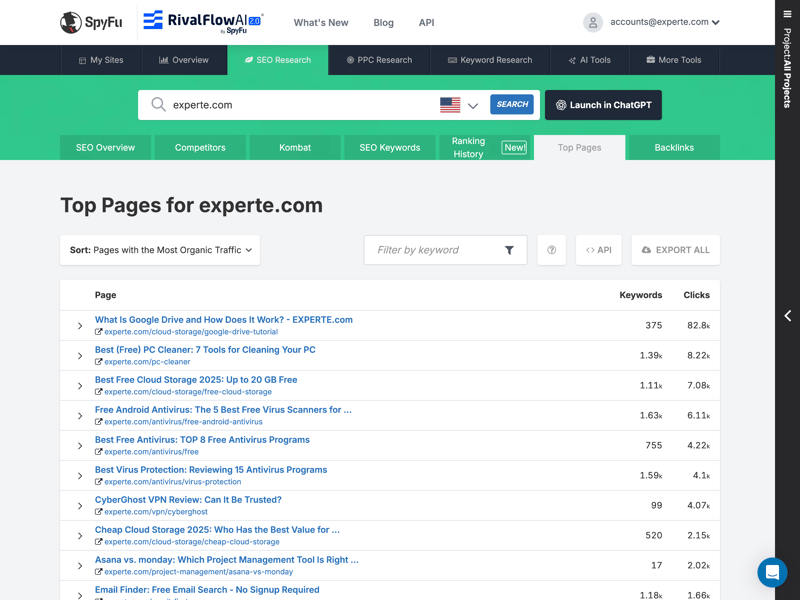
Here you can see which content works best for your competitors and attracts the most visitors.
To better understand why certain pages are so successful, SpyFu provides detailed keyword data for each URL. For every page you analyze, SpyFu lists all keywords along with volume, ranking, traffic, and more.
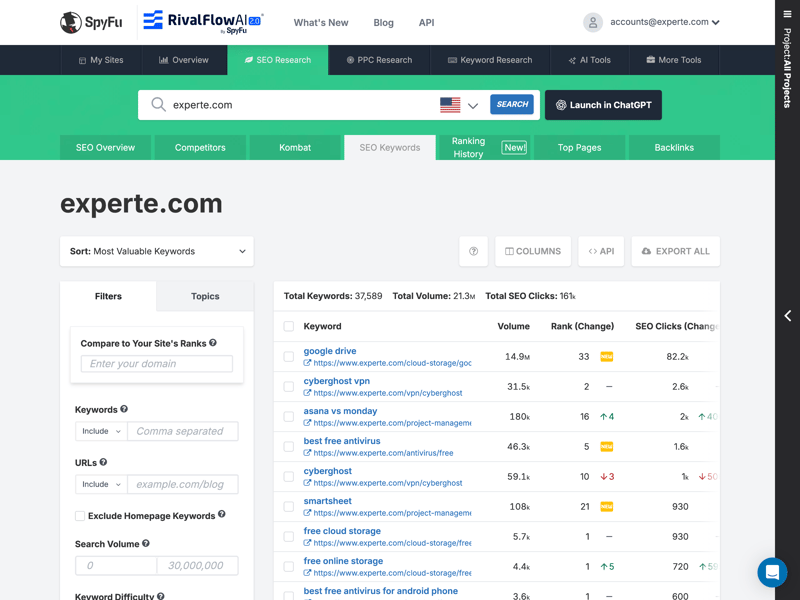
This list reveals your competitors’ most valuable search terms, sorted by clicks and cost equivalent.
How reliable is SpyFu’s traffic data?
SpyFu impresses not only with its clear visualizations and strong emphasis on competitor analysis, but its data foundation also holds up well compared to larger tools.
SpyFu covers all key traffic categories: organic traffic, paid traffic, estimated traffic value, and country breakdowns. A standout feature is its extensive data history, which extends back up to 16 years in numerous instances, covering nearly the tool's entire lifespan.
SpyFu | Ahrefs | Mangools | Moz | Semrush | SE Ranking | Serpstat | Sistrix | Ubersuggest | |
|---|---|---|---|---|---|---|---|---|---|
Organic traffic | ✓ | ✓ | ✓ | ✗ | ✓ | ✓ | ✓ | ✓ | ✓ |
Paid traffic | ✓ | ✓ | ✗ | ✗ | ✓ | ✓ | ✓ | ✓ | ✓ |
Trafic value | ✓ | ✓ | ✗ | ✗ | ✓ | ✓ | ✓ | ✓ | ✓ |
Traffic by country | ✓ | ✓ | ✓ | ✓ | ✓ | ✓ | ✓ | ✓ | ✓ |
Traffic history | 16 years | 5 years | 1 years | 1 years | 14 years | 8 years | 9 years | 5 years | 3 years |
When analyzing competitors, the reliability of traffic data is paramount. If planning budgets or basing marketing decisions on competitor figures, you need reasonably accurate estimates.
To test accuracy, we compared the tools’ traffic data against real reference values. SpyFu performed excellently in this test as well:
| Traffic estimation accuracy | |
|---|---|
| 53.6 % |
| 51 % |
| 50.1 % |
| 49.1 % |
| 46.1 % |
| 45.9 % |
| 45.4 % |
| 18.9 % |
| 0 % |
With a 53.6% match against real measurements, SpyFu delivers the most reliable numbers in our test. Large deviations are normal with this type of technology, but no other SEO tool we tested currently provides more accurate results.
In its core discipline, SpyFu truly plays to its strengths and leaves little to be desired. The tight integration of organic research and paid advertising (PPC) offers a comprehensive view of competitor strategies, an approach that is uncommon at this price point.
The quality of its traffic data is particularly impressive: as the accuracy winner in our comparison, SpyFu provides the most reliable estimates. For those aiming to understand which channels competitors utilize to attract visitors and where advertising budgets might be misspent, this stands as one of the strongest tools on the market.
Backlink Analysis
| Feature set |
| 3.5/5 |
| Number of backlinks | 224 referring domains | 0/4 |
| Data quality |
| 1.5/4 |
| Backlink filters |
| 1.25/2 |
SpyFu’s backlink analysis is directly integrated into its competitor research. Upon entering a competitor’s URL, users receive an overview of referring pages.
The focus is clearly on identifying backlinks your competitors already have so you can find opportunities for your own link building.
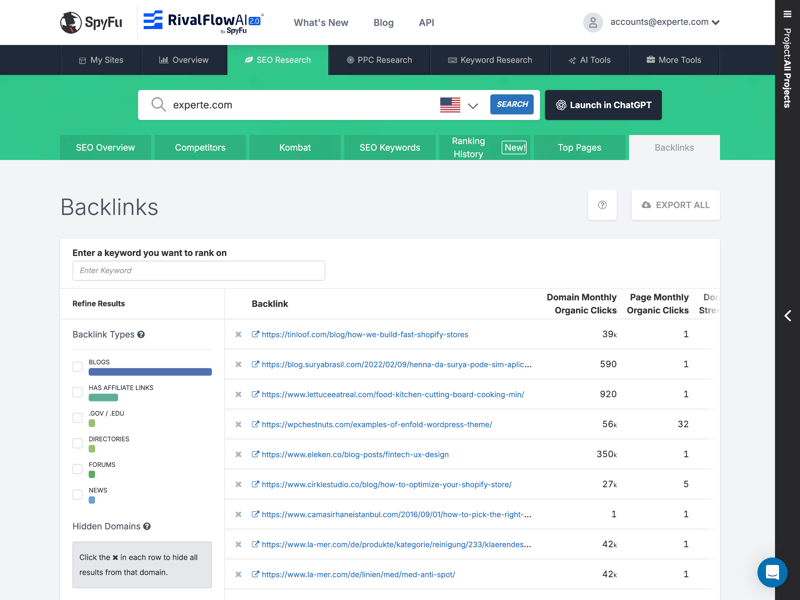
SpyFu lists your competitors’ backlinks so you can identify potential link-building partners.
Solid backlink analysis with some gaps
Backlink analysis typically serves two key purposes: understanding effective link strategies employed by competitors and maintaining one’s own backlink profile by identifying harmful links.
SpyFu handles the former well. Historical data and anchor text analysis facilitate the reverse engineering of competitor strategies. The gap analysis is also valuable for locating shared link sources across multiple domains.
Where SpyFu falls short, however, is in technical maintenance. Key features are absent: the tool does not display referring IP addresses or flag potentially toxic links. Furthermore, broken link analysis is unavailable. To effectively monitor and protect one’s own link profile, a separate tool will be necessary.
SpyFu | Ahrefs | Mangools | Semrush | SE Ranking | Moz | Sistrix | Serpstat | Ubersuggest | |
|---|---|---|---|---|---|---|---|---|---|
Backlink history | ✓ | ✓ | ✓ | ✓ | ✓ | ✓ | ✓ | ✓ | ✓ |
Referring domains | ✓ | ✓ | ✓ | ✓ | ✓ | ✓ | ✓ | ✓ | ✓ |
Referring IPs | ✗ | ✓ | ✓ | ✓ | ✓ | ✗ | ✓ | ✓ | ✗ |
Lost links | ✓ | ✓ | ✓ | ✓ | ✓ | ✓ | ✓ | ✓ | ✓ |
Toxic links | ✗ | ✓ | ✓ | ✓ | ✓ | ✓ | ✗ | ✗ | ✗ |
Broken links | ✗ | ✓ | ✓ | ✓ | ✓ | ✓ | ✓ | ✗ | ✗ |
Link quality metrics | ✓ | ✓ | ✓ | ✓ | ✓ | ✓ | ✓ | ✓ | ✓ |
Anchor text analysis | ✓ | ✓ | ✓ | ✓ | ✓ | ✓ | ✓ | ✓ | ✓ |
Top pages by links | ✓ | ✓ | ✓ | ✓ | ✓ | ✓ | ✓ | ✓ | ✓ |
Backlink gap analysis | ✓ | ✓ | ✓ | ✓ | ✓ | ✓ | ✓ | ✓ | ✓ |
Total | 7 | 10 | 10 | 10 | 10 | 9 | 9 | 8 | 7 |
SpyFu’s biggest weakness: a tiny backlink index
Backlink analysis is only as good as the data behind it. For link building, the most comprehensive picture of existing backlinks is essential. This is precisely where SpyFu encounters its most significant challenge.
In our tests, the tool identified an average of just 224 referring domains—representing only about 19% of what even SE Ranking, the second-weakest tool in our comparison, managed to find. Our top pick, Ubersuggest, yielded 54 times as many results.
| Referring domains (on average) | |
|---|---|
| 12,100 |
| 12,100 |
| 8,927 |
| 5,627 |
| 5,200 |
| 3,505 |
| 2,305 |
| 1,172 |
| 224 |
Basic filters, limited depth
When analyzing a competitor’s strategy, users are often seeking patterns. Effective filters assist in quickly discerning these. SpyFu enables data sorting by common criteria.
Users can refine and broadly organize lists. However, attempting to delve deeper will reveal limitations: filters for link position within the text, link age, or source page language are not available.
SpyFu | Ahrefs | Semrush | Mangools | SE Ranking | Sistrix | Serpstat | Ubersuggest | Moz | |
|---|---|---|---|---|---|---|---|---|---|
Nofollow/Dofollow | ✓ | ✓ | ✓ | ✓ | ✓ | ✓ | ✓ | ✓ | ✓ |
Link authority | ✓ | ✓ | ✓ | ✓ | ✓ | ✓ | ✓ | ✓ | ✓ |
Anchor text | ✓ | ✓ | ✓ | ✓ | ✓ | ✓ | ✓ | ✓ | ✓ |
Link type (text, image, …) | ✓ | ✓ | ✓ | ✓ | ✓ | ✓ | ✓ | ✓ | ✗ |
Link position (content, footer, …) | ✗ | ✓ | ✓ | ✓ | ✗ | ✗ | ✗ | ✗ | ✗ |
Link age | ✗ | ✓ | ✓ | ✗ | ✓ | ✓ | ✓ | ✓ | ✓ |
Traffic of referring page | ✓ | ✓ | ✓ | ✗ | ✓ | ✗ | ✗ | ✗ | ✗ |
Language of referring page | ✗ | ✓ | ✓ | ✓ | ✗ | ✓ | ✗ | ✗ | ✗ |
Total | 5 | 8 | 8 | 6 | 6 | 6 | 5 | 5 | 4 |
The backlink analysis underscores SpyFu’s limitations. While it logically integrates into the competitor research workflow and aids in identifying potential link sources, a small dataset constrains it.
The backlink index is comparatively tiny, capturing only a fraction of the links discovered by other tools. Important quality metrics for evaluating links are also absent. This renders the feature useful for a first impression but unsuitable for serious link building or comprehensive technical backlink audits.
Keyword Research
| Features |
| 4.5/5 |
| Number of countries | 15 countries | 0/1 |
| Number of keywords | 3,032 keywords | 2/3 |
| Accuracy of search volume | 29.9 % | 0/5 |
| Filters |
| 1.5/2 |
On paper, SpyFu offers all the standard keyword research features. Users can group terms, organize them into clusters, and filter results in various ways. In practice, we ran into serious data reliability issues.
Useful features and filters
The feature set for keyword analysis is decent overall. Users can filter keyword lists by word count, difficulty, click-through rate, or cost per click (CPC). The inclusion or exclusion of specific terms also functions reliably.
Similar to many competitors, SpyFu does not display search intent, which complicates understanding the context behind each keyword.
SpyFu | Ahrefs | Semrush | SE Ranking | Sistrix | Mangools | Serpstat | Moz | Ubersuggest | |
|---|---|---|---|---|---|---|---|---|---|
Search volume by month | ✓ | ✓ | ✓ | ✓ | ✓ | ✓ | ✓ | ✓ | ✓ |
Search volume by country | ✓ | ✓ | ✓ | ✓ | ✓ | ✓ | ✓ | ✓ | ✓ |
Keyword difficulty | ✓ | ✓ | ✓ | ✓ | ✓ | ✓ | ✓ | ✓ | ✓ |
Cost per click (CPC) | ✓ | ✓ | ✓ | ✓ | ✓ | ✓ | ✓ | ✗ | ✓ |
Search intent | ✗ | ✓ | ✓ | ✓ | ✓ | ✓ | ✗ | ✓ | ✗ |
Current SERPs | ✓ | ✓ | ✓ | ✓ | ✓ | ✓ | ✓ | ✓ | ✓ |
Historical SERPs | ✓ | ✓ | ✓ | ✓ | ✓ | ✗ | ✓ | ✗ | ✗ |
SERP comparison | ✓ | ✓ | ✓ | ✓ | ✓ | ✓ | ✓ | ✓ | ✗ |
SERP overlap | ✓ | ✓ | ✓ | ✓ | ✓ | ✓ | ✓ | ✓ | ✗ |
Keyword clustering | ✓ | ✓ | ✓ | ✓ | ✓ | ✓ | ✓ | ✗ | ✓ |
Total | 9 | 10 | 10 | 10 | 10 | 9 | 9 | 7 | 6 |
Quite the keyword database
SpyFu also delivers decent results when it comes to the size of its keyword database. This matters because a larger database means more topic ideas, long-tail keywords, and niche terms to discover. The bigger the data pool, the better your chances of finding low-competition keywords or terms with clear search intent.
For our comparison, we defined 20 identical seed keywords like “vpn” and checked how many keyword variations each tool had in its database for these starting terms.
SpyFu also yields decent results regarding the size of its keyword database. This is significant because a larger database translates to more topic ideas, long-tail keywords, and niche terms for discovery. The larger the data pool, the greater the likelihood of finding low-competition keywords or terms with clear search intent.
| Number of keywords (on average) | |
|---|---|
| 5,325 |
| 3,831 |
| 3,504 |
| 3,331 |
| 3,032 |
| 1,801 |
| 410 |
| 106 |
| - |
Single serious data errors
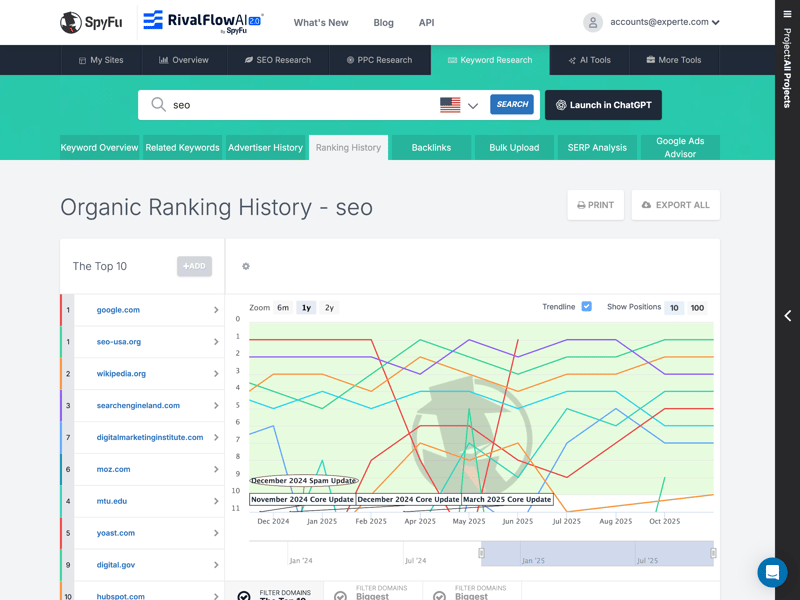
Problems arise when the underlying data is inaccurate. In our test with the keyword “seo,“ SpyFu exhibited a clear mistake. The tool reported a monthly search volume of under 20, a figure way off from reality:
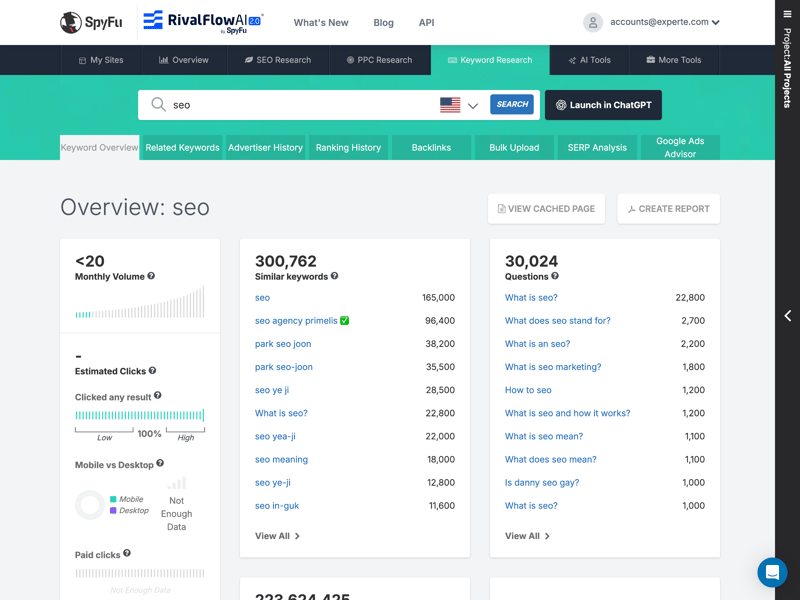
An obvious error: SpyFu estimates the search volume for the main term “seo” at nearly zero.
This inaccurate estimate directly impacts other analyses. Since SpyFu presumes the search volume to be practically irrelevant, the tool displays no rankings or historical trends for this term. Where no data is presumed, no developments can be displayed.
Errors like this are problematic because they don’t just affect individual metrics. They can make entire analyses unusable. For reliable keyword research, this is a clear weakness.
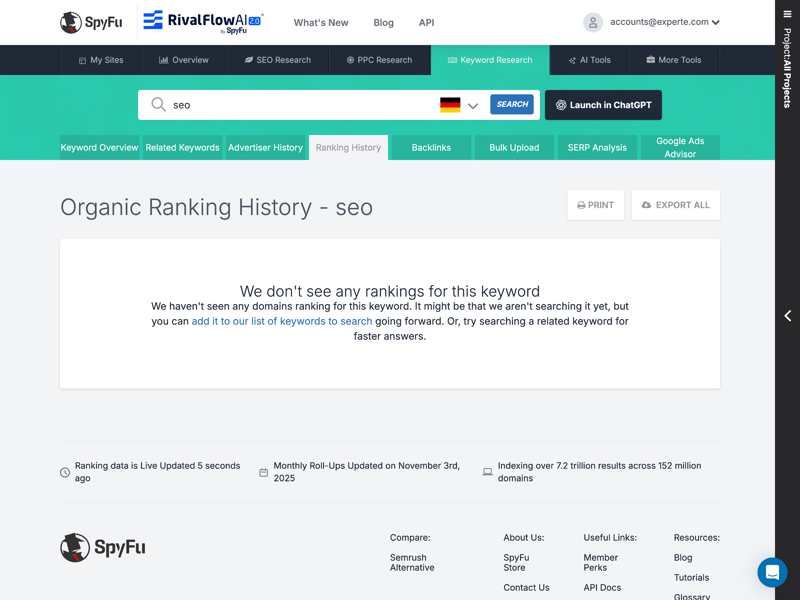
Where there’s no data, there are no charts: because of the wrong volume estimate, ranking trends are completely missing here.
Disappointing data quality
SpyFu’s data quality distinctly leaves much to be desired. To evaluate it objectively, we compared the tools’ search volume estimates against actual data.
We utilized 30 keywords for which we or partner websites consistently ranked within the top 3 positions of Google search results. For these keywords, the actual monthly impressions are visible in Google Search Console, indicating how often they were truly displayed. We then compared these actual values to the search volumes reported by the SEO tools.
Here are the results:
| Search volume accuracy | |
|---|---|
| 83 % |
| 75.3 % |
| 73.4 % |
| 72.4 % |
| 65.5 % |
| 55.7 % |
| 54.9 % |
| 52.8 % |
| 29.9 % |
SpyFu disappoints across the board. In our test, it came in last place, and by a wide margin. With an accuracy of just 29.9%, it’s the only tool below our tolerance range. Even the second-to-last tool (SE Ranking) delivered nearly twice the accuracy.
On one hand, SpyFu offers useful clustering features and highly granular filters that aid in structuring even large keyword lists. On the other hand, the module is hampered by weak data quality, which severely limits the trustworthiness of its results.
When search volume for primary terms is estimated at nearly zero and the data’s accuracy is questionable, even the most sophisticated interface offers little utility. For rough brainstorming, the keyword research feature might still prove useful. However, for reliable assessments, prioritization, or forecasts, the underlying data foundation is simply too unreliable.
Other Features
| Rank tracking |
| 3/5 |
| AI-Tracking |
| 1/5 |
| Site audit | SpyFu does not offer a comprehensive technical site audit tool. | 0/5 |
| Additional features |
| 3.5/5 |
SpyFu stays true to its core focus when it comes to additional features. Marketing, sales, and competitive data remain front and center, while traditional technical SEO takes a back seat.
Mixed results with tracking features
The rank tracking yields mixed impressions. Even setting it up for a single URL feels unintuitive. Following a brief loading time, the tool automatically suggests keyword groups. In our testing, these suggestions often appeared random and did not consistently align with the project’s focus.
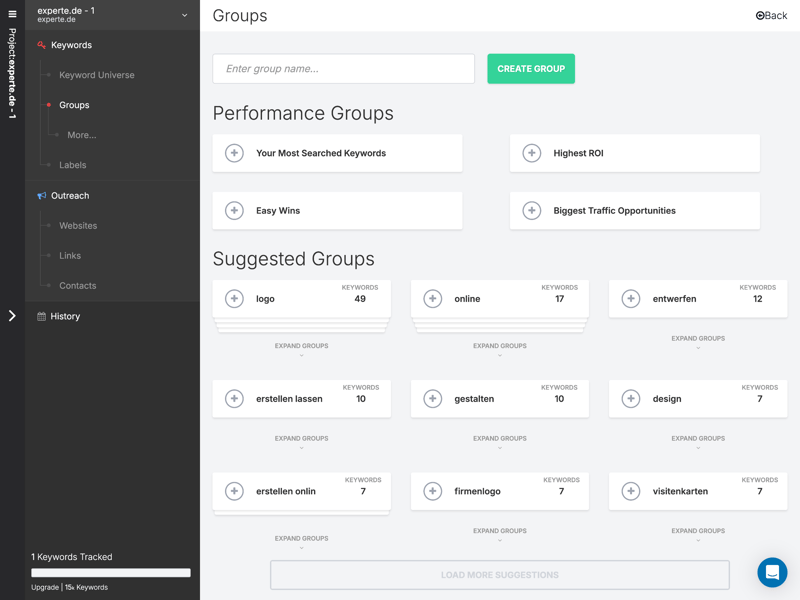
Rank tracking feels a bit clunky: the automatic keyword suggestions don’t always match the project’s focus.
AI tracking is also still in its nascent stages. Currently, the feature primarily detects brand mentions within AI tools such as ChatGPT.
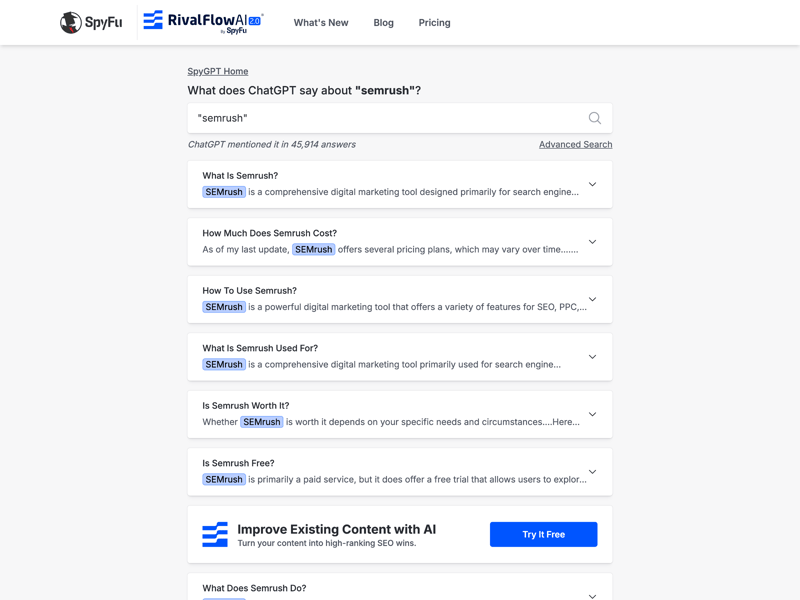
SpyFu is experimenting with AI tracking, but for now it’s limited to finding brand names in AI responses.
No site audit, but strong PPC data
SpyFu doesn’t offer a traditional site audit for checking technical issues such as 404 errors or other on-page problems. However, it compensates for this in another area.
The PPC Overview provides detailed insights into your competitors’ paid campaigns. It clearly displays click data and illustrates how advertising budgets are distributed.
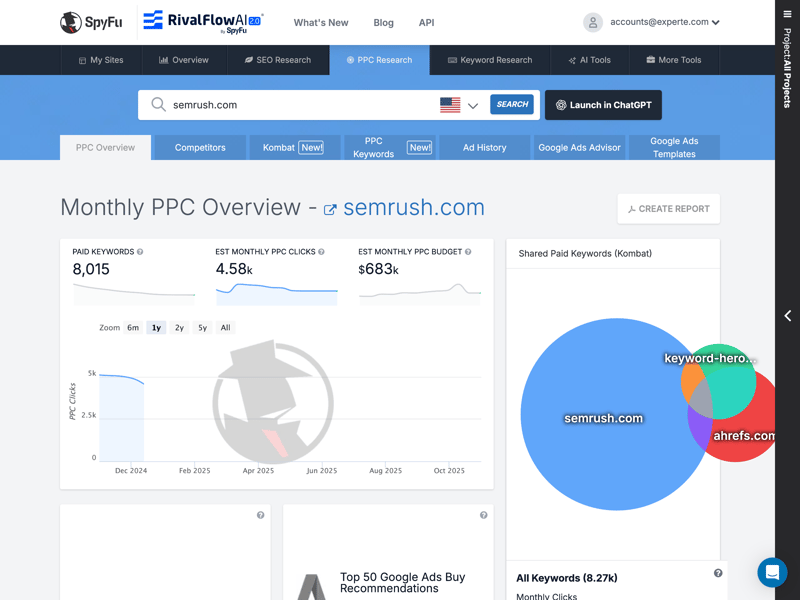
This is where SpyFu shines: the paid campaign (PPC) overview provides valuable data on competitor clicks and budgets.
Unique among SEO tools: “Leads”
One truly standout feature is the leads section. Here, users can search for business contacts and company data, which proves useful for outreach and sales activities—a capability traditional SEO tools typically do not offer.
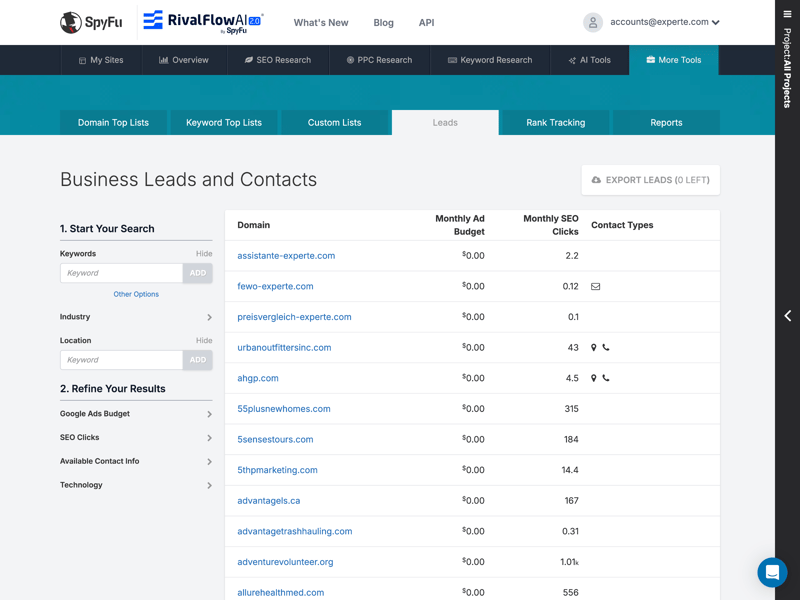
Unusual for an SEO tool: the leads section lets you filter potential business contacts for your sales efforts.
Standard reporting and integrations
Regarding basic reporting and integrations, SpyFu provides what one might expect. This encompasses regular (and automated) reports, along with an API available in higher-tier plans.
For larger datasets, a batch analysis option is also available. A bulk upload allows users to process up to 1,000 keywords simultaneously, thereby saving time on larger projects or competitive analyses.
SpyFu prioritizes different aspects than traditional SEO suites. Technical SEO tasks such as site audits are entirely absent, and rank tracking feels awkward. However, marketing and sales teams will find much to appreciate here.
The ability to identify leads and business contacts, coupled with detailed insights into competitors’ advertising budgets and strategies, adds value that extends beyond pure search engine optimization.
SpyFu positions itself less as a technical SEO tool and more as a strategic platform for growth, competitive analysis, and sales.
Support
| Documentation and tutorials |
| 1.5/3 |
| Support channels | Support available via email, live chat, and even phone. | 2/2 |
| Quality of support | The team provides helpful and friendly responses within 24 hours. | 1.5/2 |
| Reviews on review platforms |
| 3/3 |
SpyFu provides a solid collection of help resources, including a knowledge base, a blog, and various tutorials and feature guides.
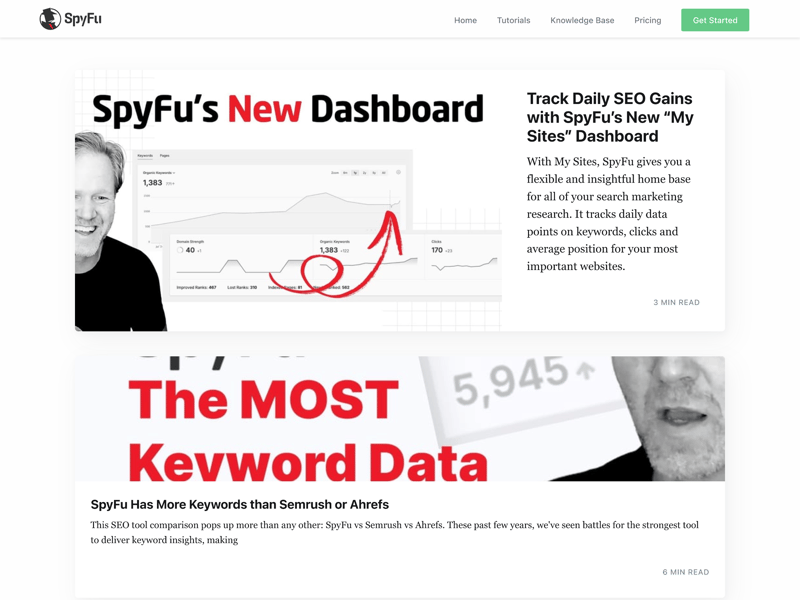
The blog has a very minimalist look and lacks modern design elements.
Visually, however, there’s a degree of inconsistency. The blog appears plain, and the knowledge base design does not entirely align with the rest of the tool.
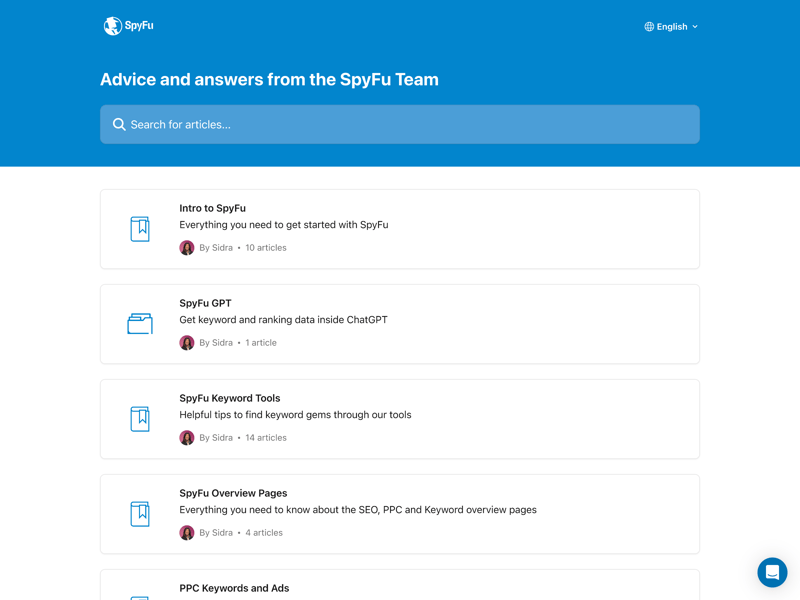
The knowledge base looks noticeably different from the main tool design.
The tutorials present a different picture. They are modern, well-organized, and visually consistent with the brand. The content quality is high, significantly simplifying the onboarding process.

The tutorials look modern, clean, and visually consistent with the brand.
Fast, reliable answers for questions
Regarding actual support, there is little to fault. SpyFu offers several contact options: email, live chat, and even a 24/7 hotline.
In our testing, the team addressed our questions within a day, demonstrating both knowledge and friendliness. This aligns with user feedback on review platforms, where many describe the support as consistently reliable and helpful.
While SpyFu’s help sections range from modern to somewhat outdated in appearance, the support truly shines where it matters most: content quality. The tutorials are well-crafted and genuinely helpful for initial setup.
Should further questions arise, the support team is easily accessible and provides solid solutions across all channels: email, live chat, and phone. User reviews on third-party platforms consistently award the support high marks.
Pricing
| Trial version |
| 1.5/2 |
| Starter plan | $29.00 | 2/2 |
| Advanced plan | $89.00 | 2/2 |
| Team plan | $149.00 | 2/2 |
| Rank tracking | $29.00 | 2/2 |
SpyFu is notably affordable. In addition to a perpetually free plan with limited data, there are three paid tiers:
| Basic | Pro + AI | Team / Agency | |
|---|---|---|---|
| Monthly price | from $29.00 | from $89.00 | from $187.00 |
| Contract period (months) | 1 - 12 | 1 - 12 | 1 - 12 |
| General limits | |||
| Users included | 1 | 1 | 5 |
| Maximum user | unlimited | unlimited | unlimited |
| Reports per day | 10,000 | unlimited | unlimited |
| Results per report | 10,000 | unlimited | unlimited |
| Historical data | 0 years | 10 years | 10 years |
| Site audit | |||
| Projects | 1 | 10 | unlimited |
| Crawled pages | - | - | - |
| JavaScript Rendering | ✗ | ✗ | ✗ |
| Rank tracking | |||
| Keywords | 5,000 | 15,000 | 50,000 |
| Frequency | Weekly | Weekly | Weekly |
While there is no traditional free trial for the premium plans, SpyFu offers a 30-day money-back guarantee on all of them. This provides users with a full month to determine if the tool meets their expectations.
SpyFu price comparison
But how does SpyFu’s pricing compare against more comprehensive SEO suites? To ascertain this, we compared costs across four typical use cases:
- 1.
Beginner: 1 user, 100 queries per day
- 2.
Advanced: 1 user, 500 queries per day, min. 50,000 results per query
- 3.
Team: 5 users
- 4.
Rank tracking: 1,000 keywords monitored
Here are the results:
| Beginner | Advanced | Team | Rank tracking | |
|---|---|---|---|---|
| $29.00 | $89.00 | $149.00 | $29.00 |
| $29.00 | $99.00 | $29.83 | $49.00 |
| $37.70 | $52.70 | $145.70 | $97.70 |
| $50.00 | $100.00 | $169.00 | $50.00 |
| $52.00 | $95.20 | $132.00 | $95.20 |
| $117.33 | $416.66 | $297.33 | $208.33 |
| $138.04 | $277.24 | $392.78 | $138.04 |
| $143.25 | $239.00 | $235.00 | $143.25 |
| $208.00 | $374.00 | $448.00 | $208.00 |
As you can see, SpyFu ranks among the most affordable options in every category. Its entry-level plan is actually the cheapest in our comparison.
SpyFu distinguishes itself with exceptionally fair pricing that keeps the barrier to entry as low as possible. Plans are significantly more affordable than traditional SEO suites, and with a perpetually free tier plus a generous money-back guarantee, users incur virtually no upfront risk.
If one can operate without high-end technical features and primarily requires competitor data, there is currently no more affordable alternative on the market.
Final Verdict
SpyFu is not an all-in-one SEO tool; rather, it is a highly specialized expert in competitor analysis. The tool excels in niches that others overlook: combining SEO and PPC data and generating genuine sales leads. It also provided the most accurate traffic estimates in our tests, all while remaining one of the most affordable options available.
As a standalone SEO solution, however, it quickly reaches its limitations. Technical site audits are absent, its backlink analysis is hindered by a tiny database, and occasionally inaccurate search volumes in keyword research detract from the overall impression. For classic SEO tasks, SpyFu is only partially suitable.
For technical SEOs, SpyFu is of limited relevance. However, as a strategic add-on tool, it provides valuable and sometimes unique insights that other SEO suites simply do not offer.

SpyFu User Reviews
What do users think of SpyFu? To find out, we looked at ratings and reviews on platforms like G2, Capterra, and Trustpilot. Here’s the recurring feedback:
Great for competitor analysis
Users agree: when it comes to uncovering competitors’ “secrets,“ SpyFu indeed lives up to its reputation.Few data restrictions
Many users appreciate that SpyFu’s paid plans often permit unlimited data queries. Users rarely encounter hard limits, which offers considerable freedom during research.Easy to use
Marketing teams like that SpyFu presents data visually, thereby reducing complexity. It is often simpler to understand than technical SEO suites.
Outdated interface
Reviews indicate that the user interface appears dated in certain areas and feels inconsistent.Not for technical SEOs
Technical SEOs regularly criticize that the tool is unsuitable for their work due to its lack of crawlers and audit features.US focus
Some European users note that data quality is excellent for the US market but noticeably weaker in smaller European markets.
Alternatives to SpyFu
SpyFu is a specialized tool for competitor analysis. If you’re looking for a more traditional SEO suite, these alternatives might be worth considering:
Ubersuggest
Ubersuggest is priced similarly to SpyFu but offers greater support for content creation, with significantly more features for keyword ideas and content marketing.Serpstat
Serpstat is also relatively affordable and, as an all-around SEO tool, includes a robust site audit module.Moz Pro
If your focus is on the US market, Moz Pro, similar to SpyFu, boasts a strong US emphasis and a long track record. It also offers reliable domain authority metrics.
You can find the best alternatives to SpyFu here: