Shopify Pricing 2026: How Much Does Shopify Cost, Really?


Shopify's plans start at USD 29 per month. That's just the cheapest tier, though - and the subscription fee is only part of the total cost. Payment processing fees, paid apps, premium themes, and other optional expenses can all add to your monthly bill. So, how much does it cost to run a Shopify store, really?
We'll break down Shopify's pricing plans and the additional costs you should factor in, so you can plan your budget with a clear idea of what to expect.


Shopify is subscription-based. There are three standard plans: Basic, Grow, and Advanced. The costs range from $29 to $399 per month, depending on whether you’re billed monthly or annually.
Upgrading to a higher-tier plan can make financial sense as your sales increase. While the subscription fees are higher, the lower payment fees will outweigh the additional monthly cost once your sales volume reaches a certain level.
The subscription is only part of the cost: You also have to factor in processing fees for every sale, along with the potential cost of apps and themes.
Shopify charges an extra transaction fee if you use a third-party payment provider. You can avoid it by using Shopify Payments, Shopify's own payment gateway.
How Much Does it Actually Cost to Run a Shopify Store?
A Shopify store costs at least $29 per month — that's the current price of the cheapest plan when billed annually. Even if the entry-level plan is enough for your needs, though, you'll probably end up paying more than that, since the monthly subscription is only one part of the total cost.
Before we look at the plans in detail, let's break down at the main factors that affect the total cost:
Subscription costs
This is your fixed cost for using the platform. Shopify offers different plans with different features and price points.Payment fees
Every order comes with a fee from the payment provider (the company that handles the credit card transaction). This applies whether you use Shopify Payments or a third-party gateway like PayPal.Transaction fees
If you don't use Shopify’s own payment system (Shopify Payments), Shopify charges an additional transaction fee on every sale. Using Shopify Payments is the only way to avoid this extra cost.Domain
To have a professional web address (a URL like yourstore.com), you’ll need a custom domain. You can buy one through Shopify or connect one you already own.Paid apps
Shopify doesn’t include every possible feature out of the box. Apps can fill those gaps, but most professional tools come with their own monthly subscription fees.Paid themes
Shopify offers more than 1,000 themes, but only 24 are free. Most themes require a one-time purchase.Developer costs
If you need specific customizations that require coding and you can't do it yourself, you’ll need to hire a developer—which can be a significant investment.
Let's look at each of these ____ in detail:
Subscription fees
Shopify offers three standard plans: Basic, Shopify, and Advanced (there's a fourth plan called “Plus,” but it’s an enterprise-level solution for larger companies). Here's a breakdown:
| Basic | Grow | Advanced | |
|---|---|---|---|
| Monthly price | from $29.00 | from $79.00 | from $299.00 |
| Contract period (months) | 1 - 12 | 1 - 12 | 1 - 12 |
| Product management | |||
| Number of products | unlimited | unlimited | unlimited |
| Product filters | ✓ | ✓ | ✓ |
| Product variants | ✓ | ✓ | ✓ |
| Product inventory | ✓ | ✓ | ✓ |
| Product reviews | ✓ | ✓ | ✓ |
| Internationalization | |||
| Multiple languages | ✓ | ✓ | ✓ |
| Multiple currencies | ✓ | ✓ | ✓ |
| Automatic tax calculation | ✓ | ✓ | ✓ |
For the most part, the core features (like unlimited products and sales channels) are the same across all tiers. The real differences are in the staff accounts and the payment processing fees.
Shopify Basic: Best for solo sellers
Monthly cost: $39/month
Annual cost: $29/month
Transaction fees (if not using Shopify Payments): 2%
“Basic” is the entry-level plan and covers all the fundamentals. You can list unlimited products and sell across any sales channel with no limits on revenue.
The biggest limitation is that you don't get any staff accounts, so this plan is strictly for solo entrepreneurs. You also have limited API access (which can make some complex app integrations difficult) and you miss out on advanced international tools like localized storefronts or multi-currency payouts.
Shopify Grow: Best for small teams
Monthly cost: $105/month
Annual cost: $79/month
Transaction fees (if not using Shopify Payments): 1%
If you’re working with a team, you’ll eventually need to upgrade to the “Grow” plan, which includes five staff accounts. Aside from the extra accounts, the features are mostly identical to the Basic plan. You still won’t get the high-end tools for international selling, though your transaction fees for credit cards will be slightly lower.
Shopify Advanced: For global brands
Monthly cost: $399/month
Annual cost: $299/month
Transaction fees: 0.6%
The “Advanced” plan is designed for larger, international businesses. It supports up to 15 staff accounts and includes the global tools that the cheaper plans lack. For example, you can create localized storefronts for specific countries and accept payments in multiple local currencies.
Payment and transaction fees
Once you start selling, a slice of every sale goes toward fees. There are two types of fees you need to know about: transaction fees charged by Shopify, and processing fees charged by the payment gateway. Here's the difference:
- 1.
Processing fees are the unavoidable costs you pay to whichever payment gateway handles the transaction. The exact rate depends on your Shopify plan and the payment method.
- 2.
Transaction fees are fees paid to Shopify on top of the processing fees — but only if you use a third-party provider like PayPal or Stripe. They're essentially a penalty for straying from Shopify’s built-in solution, and an incentive to use Shopify Payments so they can capture the processing fees for themselves.
Transaction fees
If you use Shopify Payments, you won't pay any Shopify transaction fees. However, if you choose a third-party payment provider such as PayPal, Stripe, or Klarna, Shopify charges an additional transaction fee on each sale.
The exact fee depends on your subscription plan:
Basic | Grow | Advanced |
|---|---|---|
2% | 1% | 0.6% |
Important: These transaction fees are charged in addition to the payment processing fees charged by the payment provider. That's why using Shopify Payments is (usually) the cheaper option.
Payment processing fees (with Shopify Payments)
Every time a customer pays for an order, you'll pay a payment processing fee. The exact amount depends on your Shopify plan, the payment provider you use, and the customer's payment method.
Most payment methods charge a fixed fee plus a percentage of the transaction value. Here are the rates for Shopify Payments:
Basic | Shopify | Advanced | |
|---|---|---|---|
Online standard card rates | 2.9% + $0.30 | 2.7% + $0.30 | 2.5% + $0.30 |
Online premium card rates | 3.5% + 30¢ | 3.3% + 30¢ | 3.1% + 30¢ |
Online international rates | + 1% | + 1% | + 1% |
PayPal Wallet rates | Starting at 3.49% + 49¢ | Starting at 3.49% + 49¢ | Starting at 3.49% + 49¢ |
In-person card rates | 2.6% + 10¢ | 2.5% + 10¢ | 2.4% + 10¢ |
USDC rates | 2.9% + 30¢ | 2.7% + 30¢ | 2.5% + 30¢ |
In-person manual rates | 3.5% + 10¢ | 3.5% + 10¢ | 3.5% + 10¢ |
If you use a third-party payment provider, check its website for the latest rates and terms. While payment processing fees are often similar across providers, using a third-party gateway triggers Shopify's additional transaction fees, as explained above. Again, that's why Shopify Payments is usually the cheaper option.
Say you sell a product for $100 on the Basic plan.
With Shopify Payments, an online standard card payment costs 2.9% + $0.30, or $3.20 in total. You receive $96.80, and Shopify doesn't charge an additional transaction fee.
With PayPal as a third-party provider, PayPal charges 2.99% + $0.49, or $3.48 on a $100 sale. Shopify then adds its 2% third-party transaction fee, another $2.00. Your total fees come to $5.48, leaving you with $94.52.
In this example, using PayPal increases your total fees by $2.28 per sale. The exact costs depend on your Shopify plan, payment provider, and payment method, but using Shopify Payments is usually the more cost-effective option because it avoids Shopify's additional transaction fee.
Other Costs to Consider
Beyond the monthly subscription and transaction fees, there are several other expenses that can impact your bottom line.
Domain name
While Shopify allows you to publish a store (for free) under a “myshopify.com” address, a professional business needs a custom domain. You can buy one through Shopify for around $14 a year, or connect one from a third-party provider. Either way, it’s a small but necessary annual expense.

Third-party apps
Shopify's extensive app store has an app for almost everything, but very few of the good ones are free. Costs vary wildly: some are just a few dollars, while others can run into the hundreds. If you aren’t careful, your “app stack” can easily end up costing more than your actual Shopify plan.
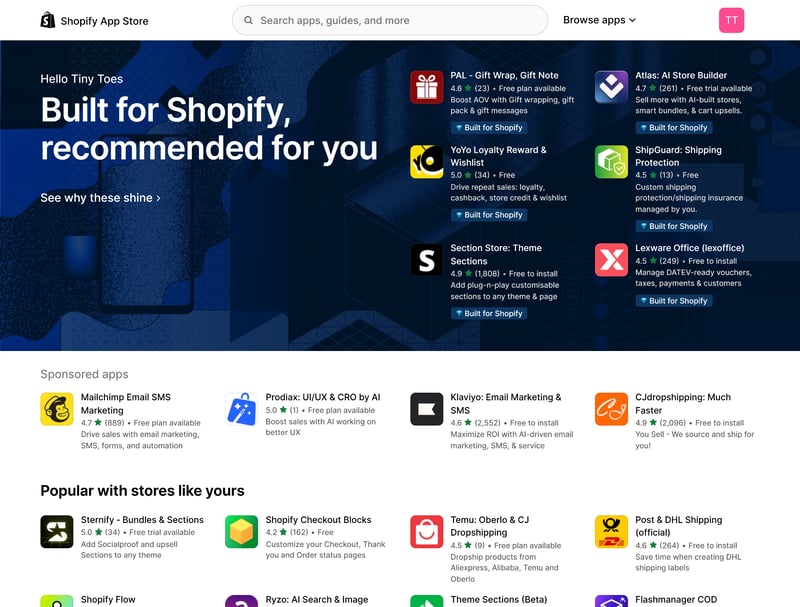
Shopify’s App Store.
Premium themes
Shopify offers a handful of free themes, but most themes in the Shopify Theme Store are paid. Prices typically range from $100 to $400 as a one-time purchase.
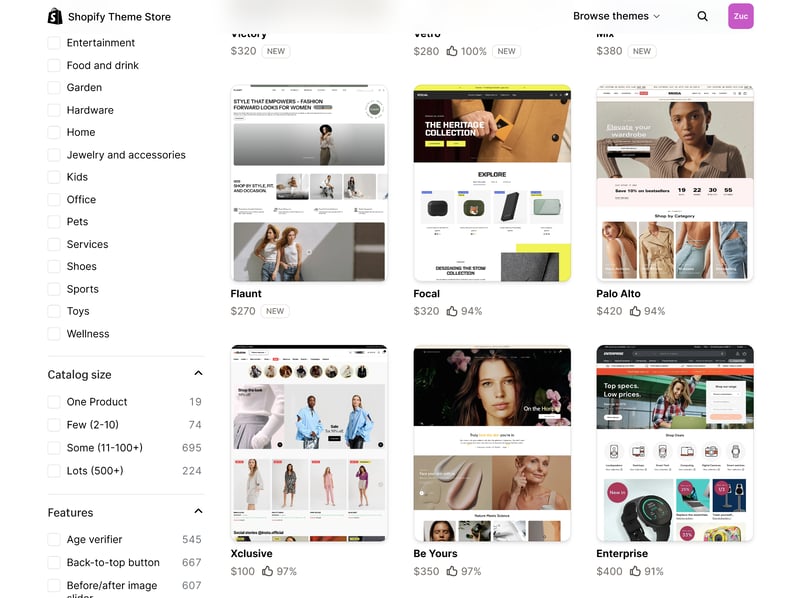
Most Shopify themes are paid.
Development and design
Shopify is a “no-code” solution, but some customizations still require coding. If you need a custom layout or a specific feature that apps can't handle, you might need to hire a developer. Freelance Shopify developers typically charge between $80 and $160 per hour.
Shipping and logistics
Once you start selling physical products, you'll also need to account for shipping costs. These aren't paid to Shopify but to your shipping carrier, such as DHL or UPS. Shopify offers reduced, pre-negotiated rates through its carrier partnerships.
You'll also need to decide whether to charge customers for shipping or include the cost in your product prices. Offering free shipping can increase conversions, but you'll need to factor those costs into your pricing to protect your margins.
Marketing & advertising
Unlike marketplaces like Amazon or Etsy, Shopify doesn’t come with a built-in audience. If you want your store to actually get found, you’ll need a dedicated budget to drive your own traffic via social media or Google Ads.
Taxes & accounting
To keep your books in order, you’ll likely need professional accounting software or a tax professional to help with filing. Between tracking your sales and staying on top of your tax obligations, this administrative overhead is a necessary cost of doing business.
Comparing Shopify's Pricing to the Competition
Comparing the cost of different ecommerce website builders can be tricky, since every provider uses a different pricing model, and subscription costs are only part of the equation. Still, the monthly subscription is the easiest cost to compare across providers.
To make the comparison as fair as possible, we defined three typical store scenarios and compared what each provider would charge in those situations:
Small store: 10 products, up to $10,000 in annual sales, with a custom domain
Medium store: 500 products, up to $200,000 in annual sales, with product variants
Large store: 10,000 products, up to $2 million in annual sales, with variants, product filters, and multilingual support
Here's the result:
| Small shop | Mid-size shop | Large shop | |
|---|---|---|---|
 | $2.75 | $2.75 | |
 | $10.00 | $10.00 | $19.93 |
 | $10.00 | $10.00 | $19.93 |
 | $11.75 | $11.75 | $11.75 |
 | $12.60 | $22.00 | |
 | $14.00 | $14.00 | $68.00 |
 | $22.00 | $119.00 | |
 | $23.00 | $23.00 | |
 | $25.00 | $45.00 | $105.00 |
 | $29.00 | $299.00 | |
 | $29.00 | $29.00 | $29.00 |
For small stores, Shopify's base subscription is on the higher side. But unlike some cheaper ecommerce platforms, the Basic plan already includes most key features, and there are no product or revenue limits. Aside from the lower staff account limit and the higher payment processing fees, the Basic plan has few major limitations. If you're running a small store on your own, it may be all you ever need.
Keep in mind that this comparison only covers subscription costs. It doesn't include payment and transaction fees, paid apps, premium themes, domains, or marketing expenses, all of which can have a significant impact on your total costs.
One of the downsides of using a hosted ecommerce platform like Shopify (compared to self-hosted solutions such as WooCommerce) is vendor lock-in. If Shopify raises its prices, there's not much you can do — aside from switching platforms, which can be both costly and time-consuming.
With a self-hosted solution, you can usually switch hosting providers or replace individual services without rebuilding your entire store.
Final Thoughts: Is Shopify Worth the Cost?

Shopify offers three standard plans (Basic, Grow, and Advanced), plus the enterprise-level Plus plan. The standard plans range from $29 to $399 per month, with discounts available if you pay annually. The subscription is only one part of the total cost, though. Payment and transaction fees, paid apps, premium themes, domains, and marketing tools can all increase your monthly expenses.
While Shopify isn't the cheapest ecommerce platform, its Basic plan already includes most of the features businesses need to launch and grow an online store. There are no product or revenue limits, and the main reasons to upgrade are additional staff accounts and lower payment processing fees. As your sales volume increases, the lower fees can easily offset the higher subscription cost.
If you're comparing ecommerce platforms, don't focus on the subscription price alone. A cheaper platform may require paid add-ons or higher-tier plans to match the features Shopify includes out of the box. If you're still weighing your options, check out our roundup of the best Shopify alternatives.