IONOS Ecommerce Review 2026: Is the German Ecommerce Platform a Match for Shopify?


IONOS might be a household name in web hosting, but they’ve got more than just servers up their sleeve. Their ecommerce website builder aims to get beginners selling online in no time, no experience required. But how does it stack up against industry giants like Shopify?
We spent some time putting IONOS through its paces. What we found was a platform with unexpected depth when it comes to ecommerce (thanks to its integration with Ecwid) but limited creative control.


Based in Montabaur, Germany, IONOS* is one of Europe’s leading web hosting and cloud infrastructure providers. The brand, which is part of the United Internet family, was forged through a merger between 1&1 and ProfitBricks.
While IONOS made its name through hosting, domains, and server solutions, the company has shifted toward a more “all-in-one” approach to cater to everyone from complete beginners to more advanced users. This includes a streamlined website builder with ecommerce capabilities powered by Ecwid, the ecommerce engine behind IONOS’s online store functionality.
It’s a smart move: IONOS provides the ease of use with its beginner-friendly website builder, while Ecwid brings the retail power. But can a generalist like IONOS really compete with dedicated ecommerce giants like Shopify? We tested the platform hands-on to find out where it shines and where it falls short.
IONOS Ecommerce Review
Ultra-intuitive website builder
The IONOS page builder is so simple, it's almost fool-proof. Even total beginners should feel comfortable with it almost immediately.Fast setup with no technical skills required
Thanks to the AI generator and ready-made templates, you can get a basic online store up and running in just a few minutes.Powerful ecommerce features
You get access to Ecwid’s capable ecommerce platform, complete with sales, inventory, and payment tools that are surprisingly powerful for such a simple website builder.
Disjointed platforms
The basic website builder and the more advanced store backend feel like two separate products stitched together rather than one cohesive platform.Generic, interchangeable templates
IONOS’s templates don’t have much personality. They all feel fairly generic and interchangeable, aside from a few differences in colors, fonts, or images.Very limited customization
The platform keeps things simple, but at the cost of flexibility. The templates are barely customizable beyond the basics, and you can’t add your own code.
Setup & Ease of Use
| Setup |
| 2/4 |
| User interface |
| 5/8 |
| Performance |
| 2.5/3 |
The IONOS ecommerce website builder is clearly aimed at complete beginners, and once you’re inside, it’s generally very easy to use. Getting there, however, involves a somewhat clunky signup process that aggressively pushes add-ons and upsells.
Getting started with IONOS
Signing up for IONOS is more of a hurdle than it is with most of its competitors. There's no free trial, meaning you have to commit to a paid plan before you can even lay eyes on the ecommerce builder.
While they do offer a 30-day money-back guarantee, you still have to pay upfront. To get started, select one of the four ecommerce plans (more on those later) and proceed to checkout.
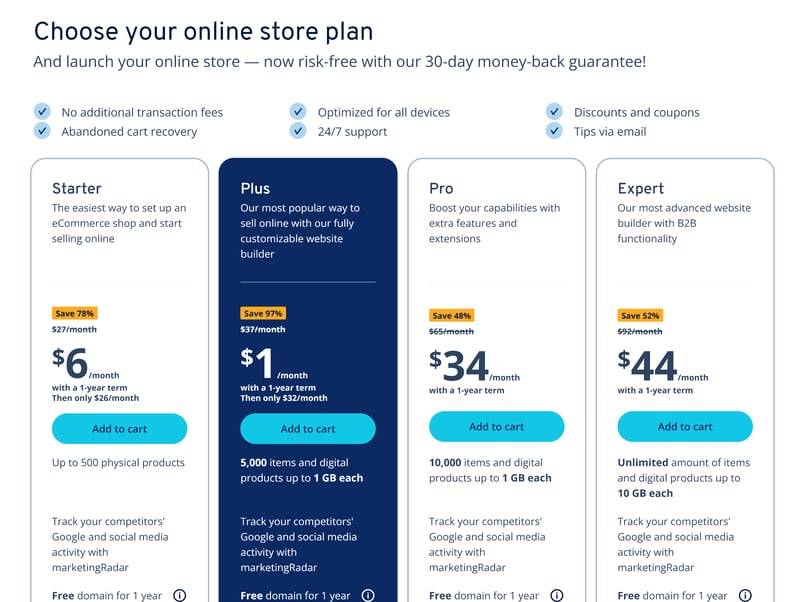
First, you need to select a plan.
Keep in mind that most plans are heavily discounted for the first few months. Be sure to check the “regular” price, so the price jump doesn’t catch you off guard later on.
The checkout process is a bit more tedious than it needs to be, largely because IONOS is a bit aggressive with its upsells. Unfortunately, this is a persistent issue with IONOS. We've been billed for email or marketing add-ons that we never intentionally selected before — and this time, our experience was no different.
Despite carefully opting out of every available add-on, a service called rankingCoach was still automatically added to our order and billed immediately. And once we canceled our subscription during the 30-day money-back window, we were billed an amount that didn't clearly match the invoice details shown in our account.
If you're new to IONOS, we strongly recommend double-checking every line item and charge applied to your account.
Once you’ve cleared the checkout hurdles, IONOS takes a few minutes to provision your site. When that’s finished, you can find your plan by heading to the “Websites & Shops” section of the IONOS dashboard:
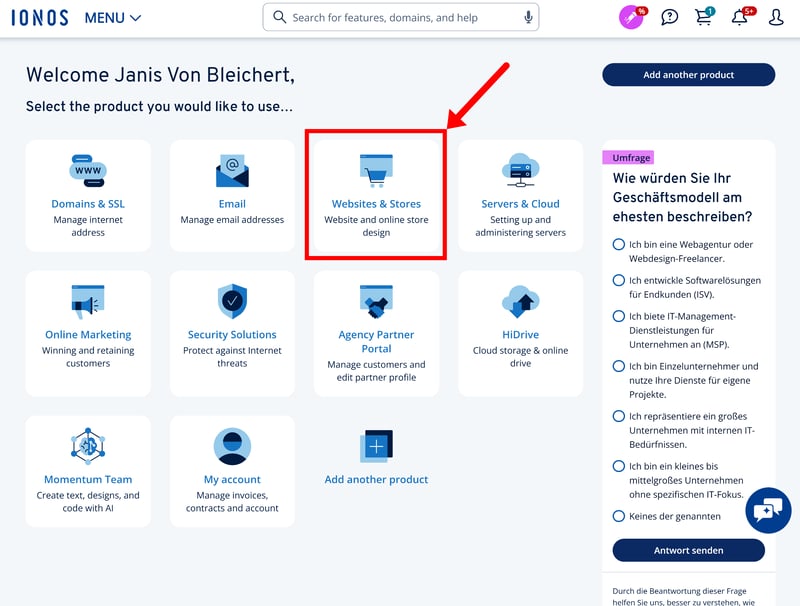
You'll find your new ecommerce project under “Websites & Shops.”
From there, simply select your plan to begin setting up your store:
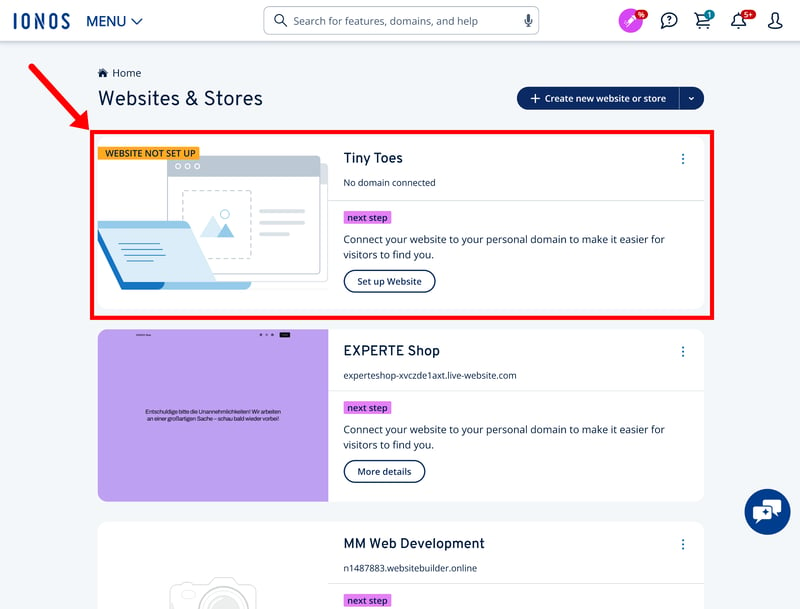
Your online store is ready to set up.
Setting up your store with AI or website templates
When starting a new project, IONOS gives you two setup options: you can either use the AI website builder or take the more traditional route by choosing a pre-made template.
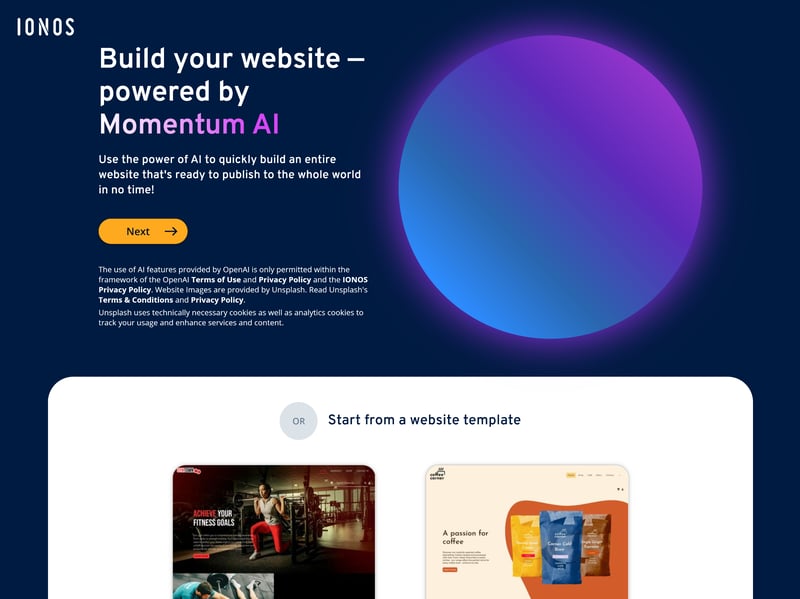
You can use the AI builder or pick a website template.
- 1.
AI builder: If you choose the AI option, IONOS first asks a few simple questions about your business, such as your store name, industry, and preferred visual style. Based on your answers, it then generates several website drafts that you can use as a starting point.
- 2.
Website template: Alternatively, you can browse through a collection of pre-made templates. The selection isn’t huge, but it covers a handful of common industries and business types.
Neither the AI-generated designs nor the templates are especially impressive (more on that in a minute), but the actual setup process is extremely straightforward. Whichever route you choose, you can have the basic structure of an online store ready within minutes.
Managing your store in the IONOS dashboard
Once setup is complete, you’ll land in the main IONOS dashboard. The interface is clean and easy to navigate, with a sidebar that lets you switch between your website, store management tools, marketing features, and apps.
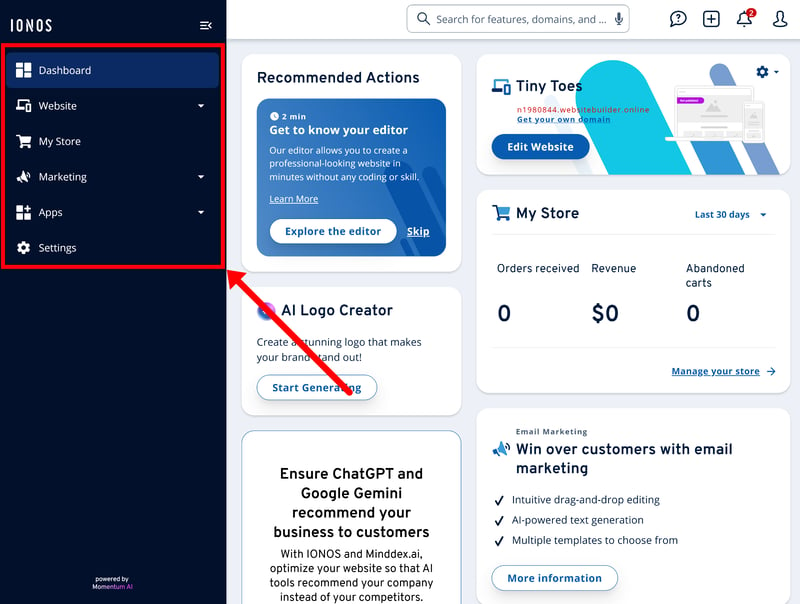
The IONOS dashboard acts as the central control panel for your online store.
IONOS keeps website editing and ecommerce management very clearly separated:
Website: This section contains the IONOS website builder, where you manage your site’s layout, pages, and overall design. The editor opens in a separate interface and feels largely disconnected from the ecommerce backend.
My Store: This is the actual ecommerce management area powered by Ecwid. Here, you’ll manage products, orders, shipping, payments, and other day-to-day store operations.
Overall, the dashboard is straightforward and beginner-friendly, though it’s also fairly simplified and clearly geared toward smaller stores.
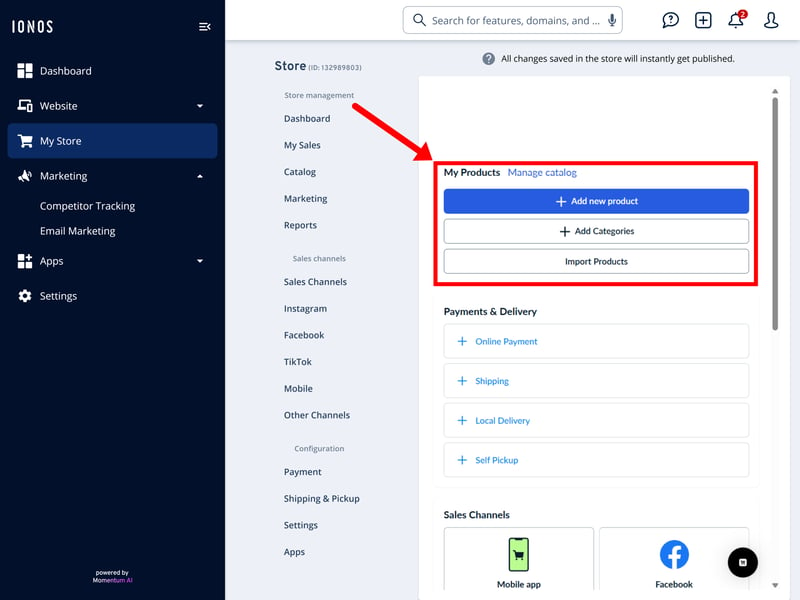
You can collapse the sidebar to free up a bit more screen space.
The “My Store” area can feel a bit cramped due to the three-pane layout, which leaves the main area feeling quite narrow. Thankfully, you can collapse the left-hand navigation menu to make things feel a bit less crowded.
A clean, snappy interface
Because IONOS offers such a wide range of products and services, the main account area can feel a little cluttered at first. Once you get into the actual store backend, though, the experience becomes much more streamlined and focused.
The dashboard is easy to navigate, with all the key tools clearly labeled and simple to access. It’s very obviously designed with beginners in mind. Performance was solid throughout our testing too. The interface felt responsive, pages loaded quickly, and we didn’t encounter any major bugs or technical hiccups along the way.
Getting started with IONOS could be a lot smoother. There’s no free trial, and the checkout process feels dated and a bit pushy with all the upselling. Since IONOS offers such a huge range of services, the main dashboard can also feel a bit overwhelming if all you want to do is launch a simple online store.
Things improve once you get into the website and store backend, though. It’s a very accessible platform with a straightforward interface and a clean layout that makes it easy to find your way around. The downside is the lack of flexibility: IONOS's website builder is so stripped back that there’s very little room for customization.
Templates & Design
| Number of templates | 47 | 0/2 |
| Template quality |
| 1/3 |
| Website builder |
| 1.5/4 |
| Customizing shop pages |
| 1/4 |
| Custom code |
| 0.5/2 |
IONOS offers very little creative freedom. The ecommerce builder is designed for speed rather than customization. While you can move pre-built blocks around and tweak them slightly, you're working within a very rigid framework.
Generic designs, whether AI-generated or pre-made
As mentioned earlier, there are two ways to set up the basic structure of your store: you can either use the built-in AI generator or start from a pre-made template.
The AI generator is fairly limited. You enter your store name, industry, and a short description, then pick from a few broad style preferences. IONOS will then generate a handful of draft designs using the builder’s standard content blocks. Beyond that, there’s very little flexibility. You can't vibe code your way any further or make specific adjustments via prompts.
In practice, the output feels generic and often doesn’t reflect the descriptions particularly well. We tested the generator multiple times across different projects, but the results barely changed. Aside from the text itself, the layouts, images, and overall feature set looked almost identical every time.
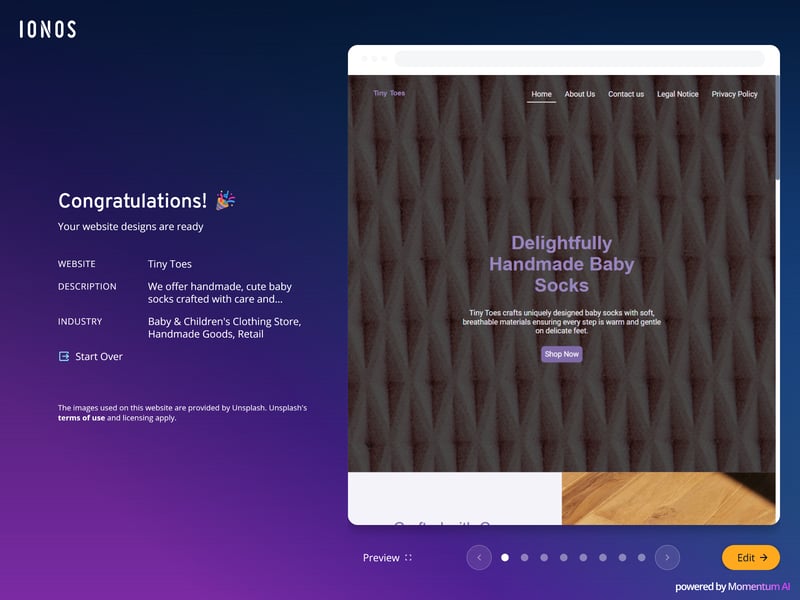
The AI generator delivers generic blueprints.
The pre-made templates have a bit more personality, but they’re built on the same underlying structure. As a result, even the supposedly “handcrafted” designs end up looking very similar to the AI-generated ones (and to each other).
The overall template selection is also fairly limited. With just 47 templates available, most of the variation comes down to different color palettes and stock photos rather than genuinely distinct layouts or design styles. On top of that, only a small number of the templates are actually designed specifically for ecommerce stores.
Other website builders offer a lot more choice and variety here:
| Number of templates | |
|---|---|
 | 3,000 |
 | 1,000 |
 | 500 |
 | 225 |
 | 190 |
 | 170 |
 | 70 |
 | 47 |
 | 34 |
 | 12 |
 | 11 |
Customizing your store
IONOS uses a section-based editor that prioritizes simplicity over creative control. Unlike the free-form editing found in platforms like Wix, everything here is built around predefined sections. You can tweak layouts and styles to a degree, but you’re always working within a fairly rigid structure.
Under the “content” tab, you arrange the building blocks of your site. Each page is made up of sections, and each section comes with a selection of preset layouts for things like headings, text, images, buttons, and product displays.
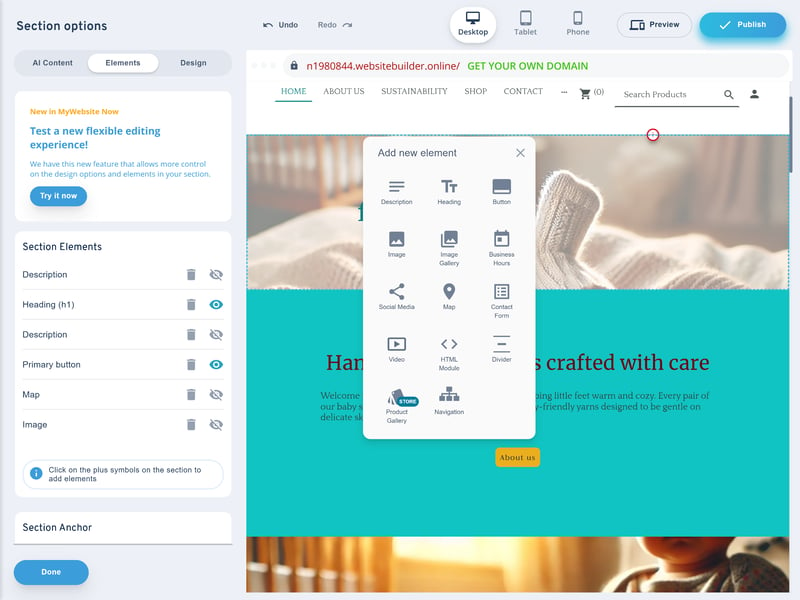
You can add new elements, but the layouts are fairly rigid.
By default, these elements are locked into their specific layouts. There's a “flexible editing” mode that allows you to drag and drop individual elements, but it feels half-baked. Selecting the correct element when items overlap can be frustrating, and the whole feature gives the impression that the editor wasn’t really designed for this level of customization in the first place.
The “Design” tab handles your global styling settings, including colors, typography, spacing, and other sitewide design choices.
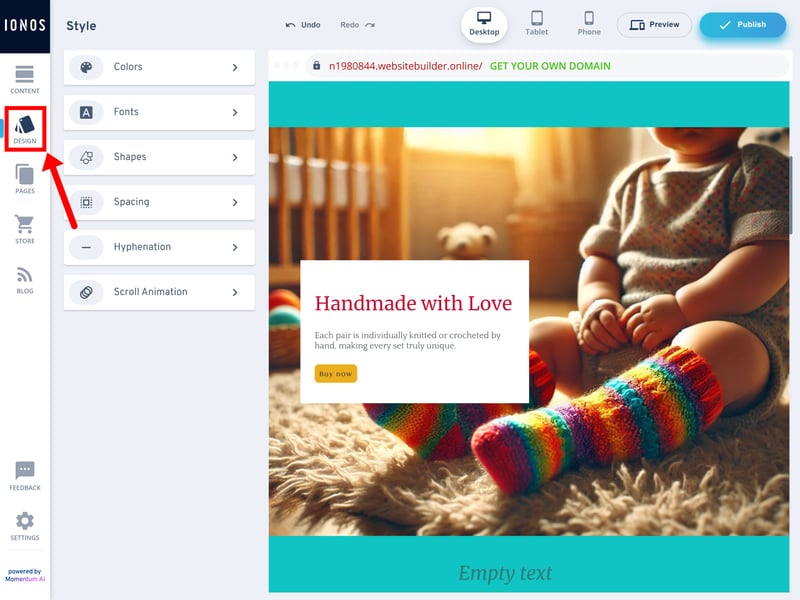
Global styles and page management.
Meanwhile, the “Pages” menu is where you manage your site structure and create new pages. There are no full-page templates, though. Every new page has to be assembled manually by stacking individual sections one by one.
At the end of the day, the IONOS builder isn’t built for creative flexibility. You’re working within a fairly locked-down system with limited room for customization. On the other hand, that simplicity is also a big part of why the platform so easy to use for beginners.
There’s no option to directly edit your store’s HTML or CSS. You can add custom code to the header area for things like scripts, analytics, or tracking tools, but beyond that, you’re limited to the platform’s built-in customization options.
Limited control over store pages
Customization becomes even more restrictive once you move from general website content to the actual ecommerce side of your store. To edit store pages, you hover over a product section and open the “Design” settings.
From there, you can switch between two views: the “Listing” view for product overviews and the “Details” view for individual product pages. Neither gives you much creative control. Most of the customization boils down to choosing between a few preset layouts and deciding whether certain elements — like prices, descriptions, or buttons — should be shown or hidden.
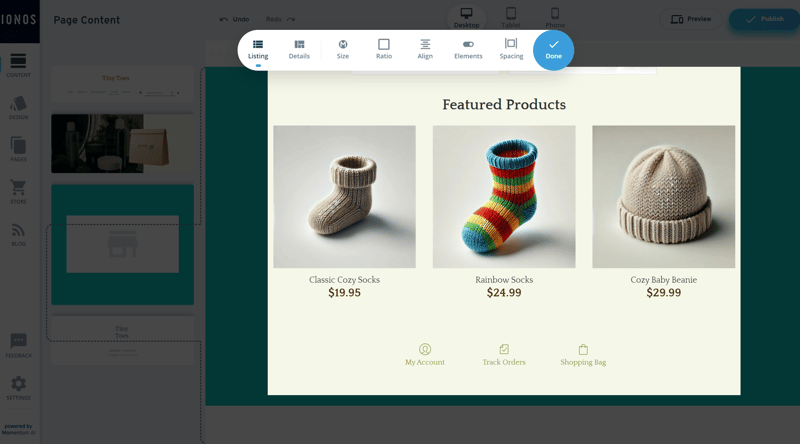
You can choose which elements appear on your product pages, but layout options are very limited.
Product organization is similarly rigid. If you create categories, they’re automatically displayed within the product section, and there’s no way to manually arrange or prioritize them.
You also can’t freely position shop sections or category pages throughout your website. Instead, IONOS automatically generates a dedicated shop page with a fixed layout that can’t really be changed. Your only real options are renaming the page, hiding it, or excluding certain categories from the navigation menu.
Overall, the platform clearly isn’t designed for large product catalogs or more complex store structures. It’s much better suited to smaller shops with relatively simple ecommerce needs.
Editing for mobile screens
All IONOS templates are fully responsive, meaning they automatically adapt to smartphones and tablets. There’s also a built-in preview mode that lets you quickly check how your store looks across different screen sizes.
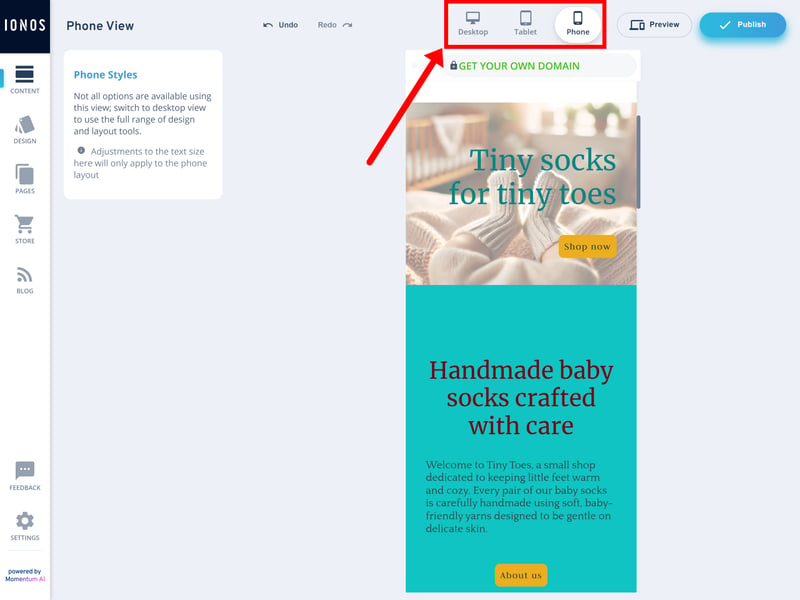
Font sizes can be adjusted specifically for mobile.
Mobile-specific customization is extremely limited, aside from adjusting font sizes for certain headings and text elements. IONOS doesn’t support custom breakpoints, there’s no option to hide sections on mobile, and you can’t rearrange elements to better fit smaller screens. Still, given how simplified the builder is overall, we weren’t really expecting much more flexibility here.
Design definitely takes a back seat at IONOS. The editor is built around getting a decent-looking store online as quickly and easily as possible, even if you have no design experience whatsoever.
Compared to dedicated ecommerce platforms like Shopify or more design-focused website builders like Wix, though, IONOS feels almost like a toy. The templates are generic, customization options are heavily restricted, and there’s no access to the underlying code.
This might be enough if your main goal is to launch a small store quickly without dealing with technical or design complexity. But if you want to build a professional, unique, and scalable online store, IONOS’s creative limitations will likely be a real dealbreaker.
Product Management
| Product types |
| 2.5/4 |
| Product features |
| 2.5/3 |
| Product variants |
| 6/6 |
| Product pricing |
| 2.5/3 |
| Product organization |
| 1/2 |
| Inventory |
| 1.5/2 |
Given how basic it looks on the surface, IONOS offers surprising depth when you dig deeper into its ecommerce capabilities. The contrast between the ultra-simplified website builder and the much more advanced ecommerce system (powered by Ecwid) can make the overall experience feel a little uneven, though.
Adding new products
IONOS supports both physical and digital products. You manage your inventory under “My Store” > “Catalog,” where you can browse existing items or add new products in just a few clicks.
Inventory limits vary quite a bit depending on your plan. The Starter plan supports up to 500 products, while the Plus, Pro, and Expert tiers increase that limit to 5,000, 10,000, and unlimited products respectively (more on this later).
There’s no dedicated option for choosing a product type when creating a new item. By default, every product is set up as a physical item.
If you want to sell digital products, you need to upload the file manually under the “Files” tab and disable shipping in the “Shipping & Pickup” settings.
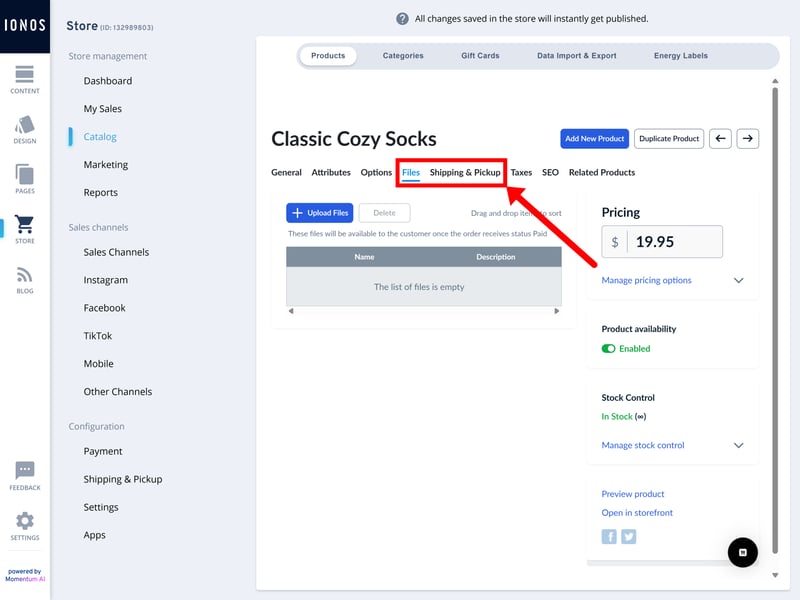
You can sell digital products, too.
IONOS also lets you sell services and appointments, although these aren’t managed directly through the ecommerce dashboard. Instead, you have to add a separate “BookingPress” section through the website editor, which relies on a third-party booking tool.
Overall, IONOS supports a decent variety of product types, but the workflow could be a bit more streamlined.
IONOS | Wix | Shopify | Squarespace | Ecwid | Hostinger | BigCommerce | Jimdo | Sellfy | Square | WooCommerce | |
|---|---|---|---|---|---|---|---|---|---|---|---|
✓ | ✓ | ✓ | ✓ | ✓ | ✓ | ✓ | ✓ | ✓ | ✓ | ✓ | |
✓ | ✓ | ✓ | ✓ | ✓ | ✓ | ✓ | ✗ | ✓ | ✓ | ✓ | |
✓ | ✓ | ✗ | ✓ | ✗ | ✓ | ✗ | ✓ | ✗ | ✗ | ✗ | |
✗ | ✓ | ✓ | ✓ | ✗ | ✗ | ✗ | ✗ | ✗ | ✗ | ✗ | |
✓ | ✓ | ✓ | ✓ | ✓ | ✓ | ✓ | ✗ | ✗ | ✗ | ✗ | |
✓ | ✓ | ✗ | ✗ | ✓ | ✓ | ✓ | ✓ | ✗ | ✗ | ✗ | |
✗ | ✓ | ✓ | ✓ | ✓ | ✗ | ✗ | ✗ | ✓ | ✗ | ✗ | |
✗ | ✓ | ✓ | ✗ | ✗ | ✗ | ✗ | ✗ | ✗ | ✓ | ✓ | |
Total | 5 | 8 | 6 | 6 | 5 | 5 | 4 | 3 | 3 | 3 | 3 |
Managing your products
The product editor itself is clean and well-organized, with a tabbed interface that keeps everything easy to navigate. In the “General” tab, you can add product titles, descriptions, images, pricing, and other core details.
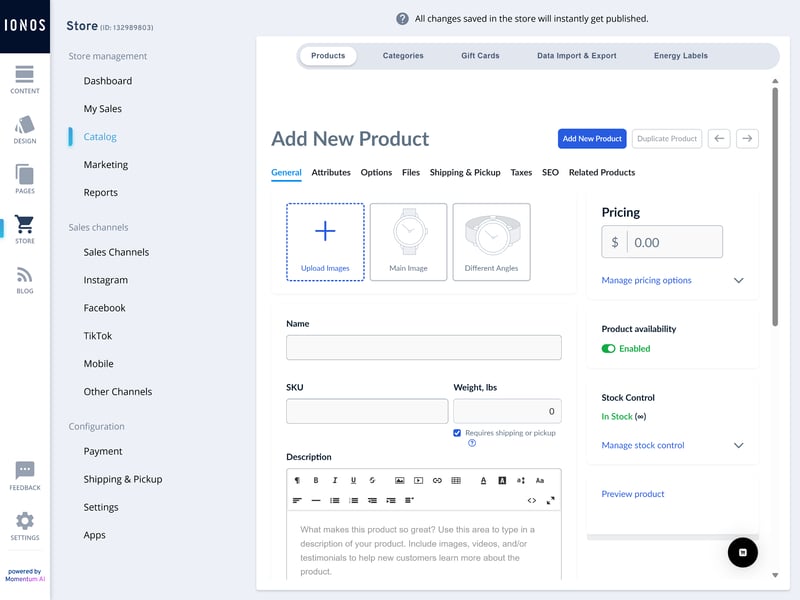
The IONOS product editor.
The “Properties” tab is where you add structured data like UPCs, brand names, or unit pricing (such as price per kilogram). If the built-in fields aren't enough for your catalogue, you can also create custom attributes within the settings.
There’s also a bulk editor that displays your products and variants in a spreadsheet-style layout, making it much easier to update multiple items at once. For stores with larger inventories, this can be a massive time-saver.
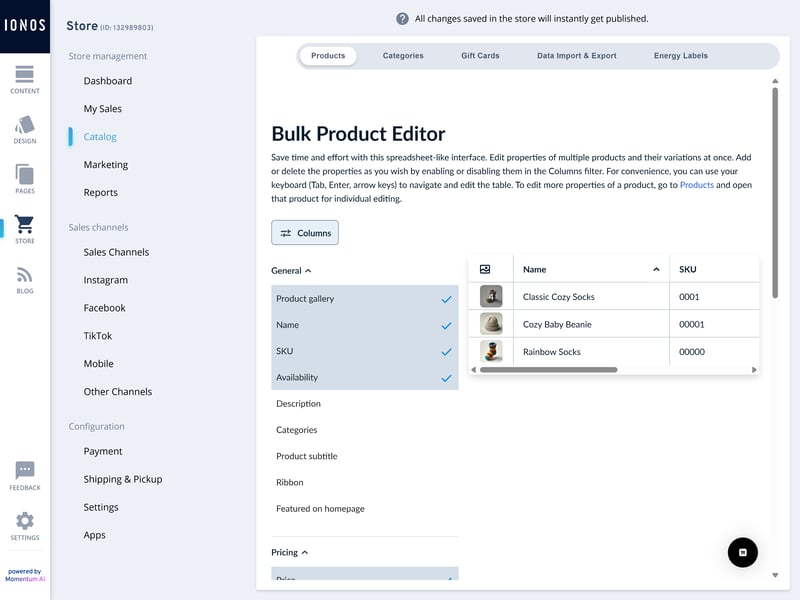
Update multiple products at once with the bulk editor.
Setting up product variants
Under the “Options” tab, you can create product attributes like size or color and define the available values for each one (such as “Small” or “Yellow”). Customers can then combine these options when selecting a product.
IONOS supports five different display styles for product options:
Dropdown lists
Color swatches
Radio buttons
Size grid
Checkboxes
There don’t appear to be any meaningful limits on the number of options or variants you can create, and each variant can have its own individual settings.
Annoyingly, though, IONOS doesn't automatically generate every possible variant combination for you. If you want a specific combination to have its own price, SKU, image, or stock level, you have to manually create that exact variant yourself.
Once created, those variants behave like standalone products with their own independent properties, all of which can also be managed through the bulk editor.
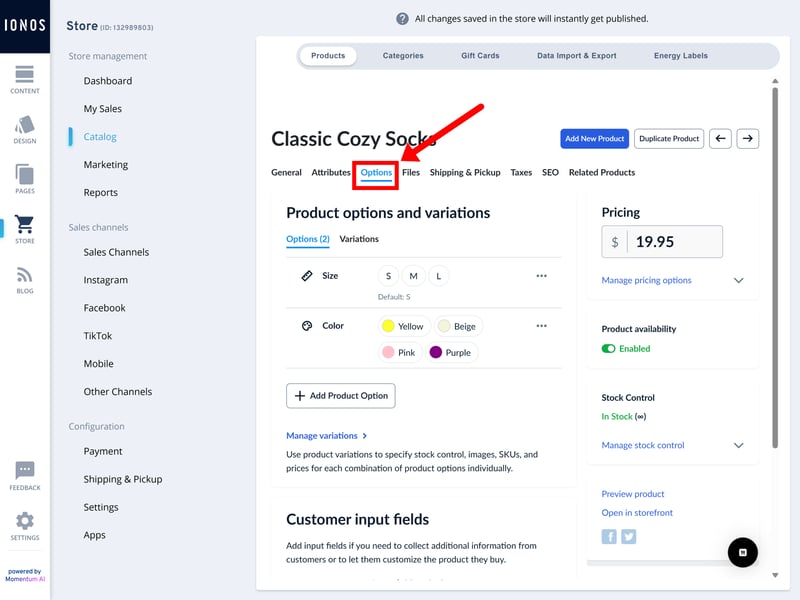
Managing variants in IONOS' product form.
This workflow is perfectly fine if you only have a handful of variants. But if you’re dealing with dozens of combinations that each require unique pricing or stock levels, the manual setup might become a bit of a bottleneck.
IONOS | BigCommerce | Ecwid | Hostinger | Shopify | Square | Squarespace | WooCommerce | Sellfy | Wix | Jimdo | |
|---|---|---|---|---|---|---|---|---|---|---|---|
Max. number of options | unlimited | unlimited | unlimited | unlimited | 3 | 6 | 6 | unlimited | unlimited | 6 | 2 |
Max. number of variants | unlimited | 600 | unlimited | 100 | 2048 | 250 | 250 | unlimited | unlimited | 1000 | 36 |
Variant-specific images | ✓ | ✓ | ✓ | ✓ | ✓ | ✓ | ✓ | ✓ | ✓ | ✗ | ✗ |
Variant-specific pricing | ✓ | ✓ | ✓ | ✓ | ✓ | ✓ | ✓ | ✓ | ✓ | ✓ | ✗ |
Variant-specific SKU | ✓ | ✓ | ✓ | ✓ | ✓ | ✓ | ✓ | ✓ | ✗ | ✓ | ✗ |
Variant-specific inventory | ✓ | ✓ | ✓ | ✓ | ✓ | ✓ | ✓ | ✓ | ✓ | ✓ | ✗ |
Total | 4 | 4 | 4 | 4 | 4 | 4 | 4 | 4 | 3 | 3 | 0 |
Pricing and discount options at the product level
Product-level pricing controls are pretty robust. You can add a “compare to” price that appears crossed out to highlight the discount. You can also attach promotional labels like “Sale” or “New” to make certain products stand out more clearly.
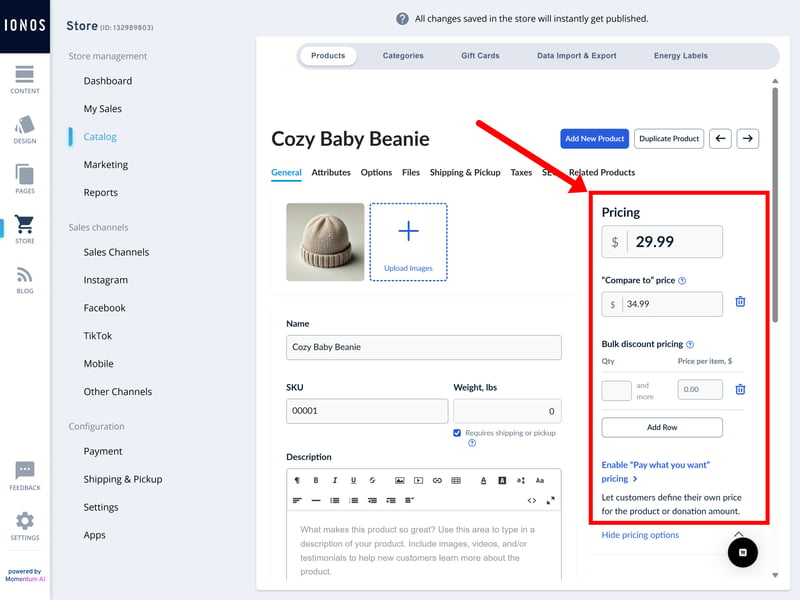
The product-level pricing options are quite comprehensive.
Unit pricing is supported as well, allowing you to display values like price per kilogram or liter. However, the setup isn’t particularly streamlined. You have to enter both the unit price and unit of measurement manually, since the platform doesn’t calculate these dynamically based on your main product price.
For bulk discounts, IONOS supports tiered pricing, letting you offer lower prices for larger order quantities. There’s even a “pay what you want” option, which works well for donations, tips, or gift cards.
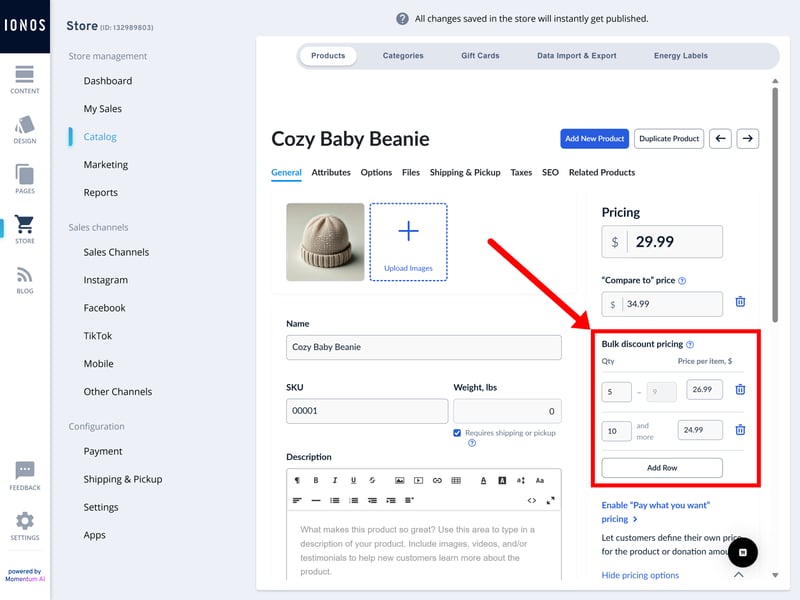
You can set up bulk discounts.
Individual variants can have their own unique pricing, provided they have been manually added to the system as described earlier. When setting up product options, you can also define price modifiers, which are useful if a specific size or material requires a fixed-rate or percentage-based surcharge.
Organizing and categorizing your products
IONOS takes a fairly simple approach to product organization, which works best for smaller catalogs. Inside the category manager, you can create nested categories and subcategories using a straightforward drag-and-drop interface. Each category also comes with basic customization options for things like descriptions, images, names, and SEO settings.
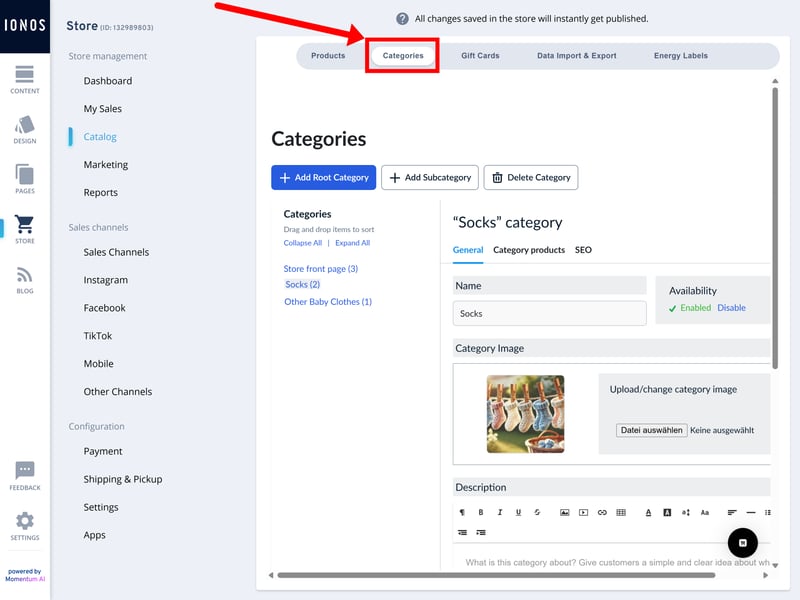
You can organize your product catalogue using categories.
The actual storefront structure, however, is much more restrictive. IONOS automatically generates a central shop page for your products, but you can’t create fully customized category pages or freely place product collections throughout your website.
Basic sorting options (by price, name, or date) are included out of the box. Depending on your subscription tier, you also get access to more advanced filtering tools, although these are somewhat buried inside the settings and need to be enabled manually. Once activated, you can define custom filter criteria and add a search bar to make larger catalogues easier to navigate.
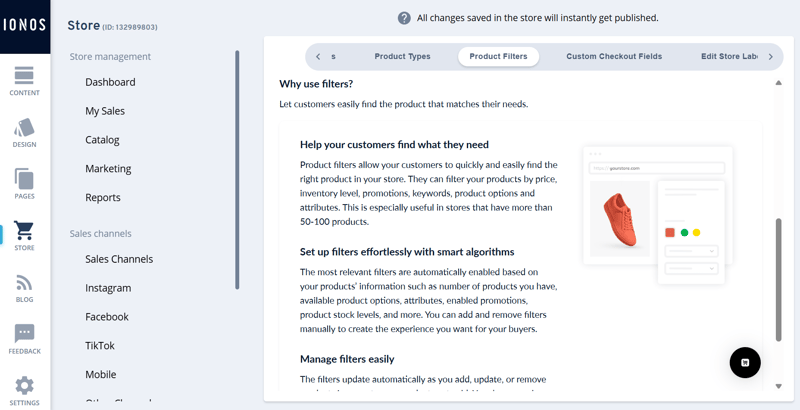
Product filters must be enabled within the settings menu.
These filters are configured inside the ecommerce backend rather than the website builder itself, which once again highlights the somewhat clunky split between the two systems.
Switching back and forth between the IONOS website editor and the Ecwid-powered ecommerce backend is a bit of a disjointed experience. You're effectively jumping between two different worlds: a stripped-down website builder aimed at beginners and a much more advanced set of ecommerce management tools.
The disconnect isn’t just visual, it also creates practical limitations. While the ecommerce backend itself is actually quite capable, the website builder often lacks the flexibility needed to fully take advantage of those features.
You’re often stuck with rigid layouts and restricted placement options, meaning many of the platform's more advanced ecommerce tools end up feeling underutilized because the website builder simply can't keep up.
Managing your inventory
The product editor includes a dedicated “Inventory” tab where you can track stock levels for every item. If you leave this field blank, the system simply treats the product as available in unlimited quantities.
For out-of-stock items, you can decide whether they should remain visible on your storefront or be hidden automatically. There’s also a built-in low-stock alert system that notifies you once inventory drops below a custom threshold, making it easier to stay on top of restocking.
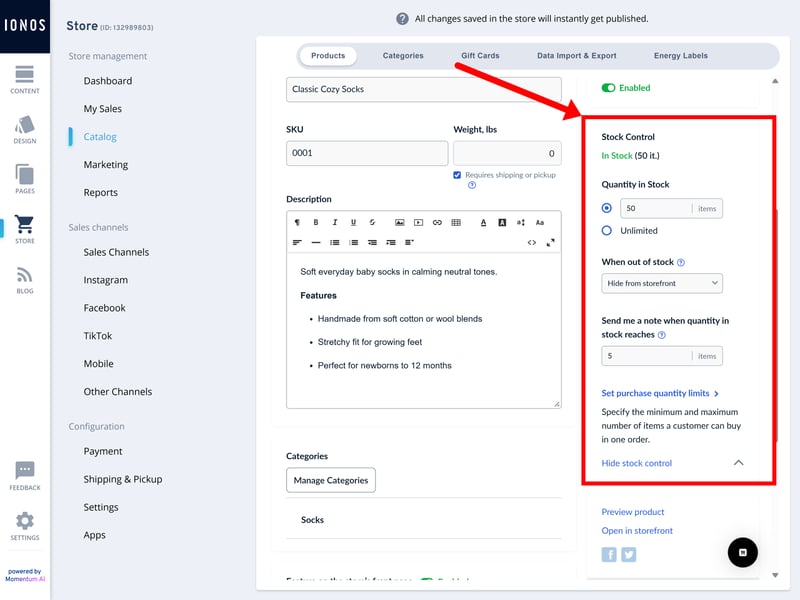
IONOS allows you to set custom low-stock alerts.
The platform also supports purchase limits, allowing you to define minimum or maximum order quantities per customer. That’s useful for things like enforcing minimum order values or limiting bulk purchases. Inventory levels update automatically in real time as new orders come in.
What’s missing are advanced features like multiple warehouse locations, reservations, and partial shipments, along with a central inventory dashboard.
For such a simple website builder, IONOS offers a surprising level of ecommerce depth thanks to its integration with Ecwid. Still, while the underlying product management features are robust, the restrictive website builder acts as a persistent bottleneck for more ambitious projects.
The ecommerce engine might have plenty of power, but it’s too constrained by the builder to truly reach its full potential.
Sales Features
| Taxes |
| 3/3 |
| Shipping options |
| 2/3 |
| Discounts |
| 3/3 |
| Payment providers |
| 2.75/3 |
| Order management |
| 1.5/2 |
| Advanced features |
| 4.5/6 |
Thanks to its integration with Ecwid, IONOS offers a comprehensive set of tools for handling payments, taxes, shipping, and day-to-day store operations, making it fully viable for running a small online business.
Setting up payments: Stripe, PayPal & more
Unlike Shopify or Wix, IONOS doesn’t offer its own proprietary payment gateway. Instead, it relies on a wide range of third-party payment providers that cover all the standard payment methods. The main integrations are Stripe and PayPal, which support everything from credit and debit cards to Apple Pay and Google Pay.
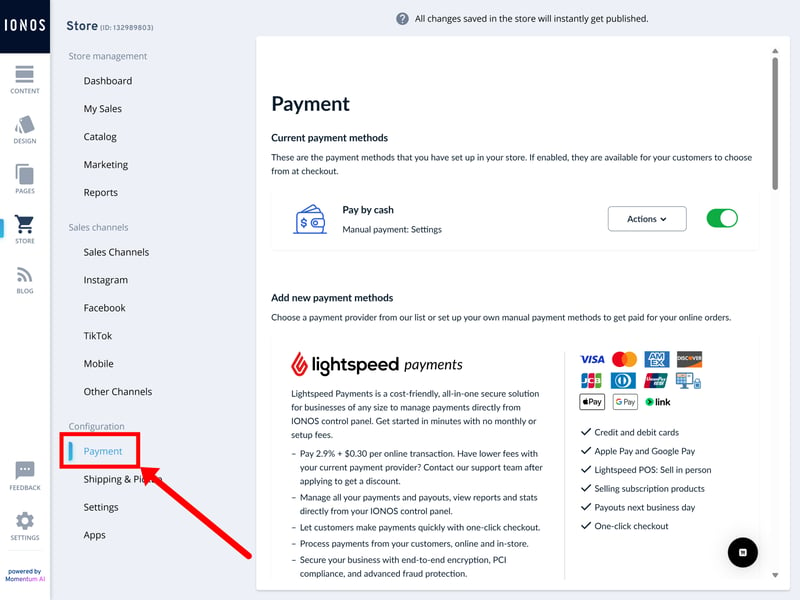
IONOS supports a wide range of payment methods.
Aside from Stripe and PayPal, IONOS supports a broad range of additional payment providers, including Klarna, Mollie, and Amazon Pay, alongside various regional gateways depending on your market. You can also set up manual payment methods like bank transfers or cash on delivery, with custom payment instructions. For small shops, this covers just about everything you'd need.
IONOS | WooCommerce | Shopify | Ecwid | Wix | BigCommerce | Squarespace | Hostinger | Jimdo | Sellfy | Square | |
|---|---|---|---|---|---|---|---|---|---|---|---|
Number of payment providers | 120 | 19 | 100 | 120 | 80 | 65 | 5 | 4 | 2 | 2 | 1 |
Paypal | ✓ | ✓ | ✓ | ✓ | ✓ | ✓ | ✓ | ✓ | ✓ | ✓ | ✗ |
Stripe | ✓ | ✓ | ✓ | ✓ | ✓ | ✓ | ✓ | ✓ | ✓ | ✓ | ✗ |
Square | ✗ | ✓ | ✗ | ✗ | ✗ | ✗ | ✓ | ✗ | ✗ | ✗ | ✓ |
Amazon Pay | ✓ | ✓ | ✓ | ✓ | ✗ | ✓ | ✗ | ✗ | ✗ | ✗ | ✗ |
Klarna | ✓ | ✓ | ✓ | ✓ | ✓ | ✓ | ✓ | ✗ | ✗ | ✗ | ✗ |
Mollie | ✓ | ✓ | ✓ | ✓ | ✓ | ✗ | ✗ | ✗ | ✗ | ✗ | ✗ |
Native payment solution | ✗ | ✓ | ✓ | ✗ | ✓ | ✗ | ✓ | ✗ | ✗ | ✗ | ✗ |
Manual payment methods | ✓ | ✓ | ✓ | ✓ | ✓ | ✓ | ✗ | ✓ | ✗ | ✗ | ✗ |
Total | 6 | 8 | 7 | 6 | 6 | 5 | 5 | 3 | 2 | 2 | 1 |
Flexible tax settings
IONOS offers a fairly comprehensive set of tax tools that work well for both U.S. and international stores. By default, the platform automatically calculates taxes at checkout based on your business location and the customer’s shipping address. If needed, you can also create custom tax rules for specific states, regions, or product categories.
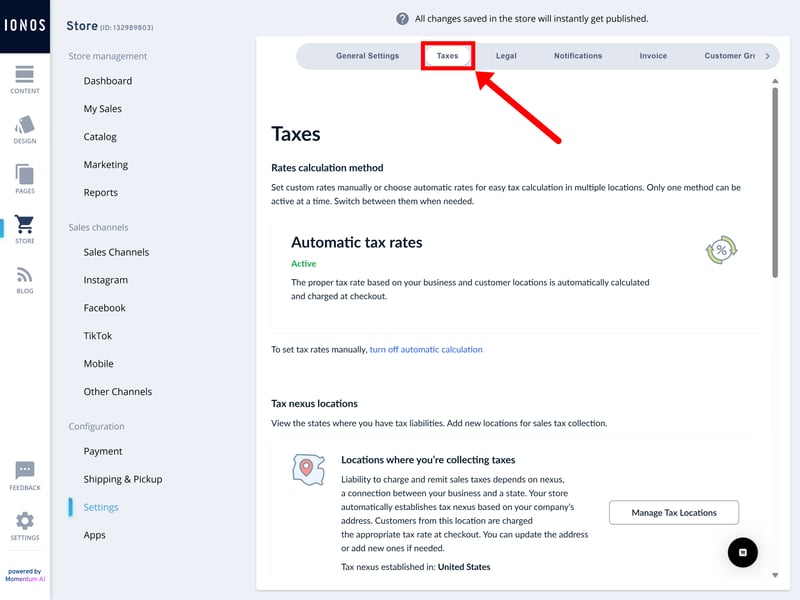
Tax settings in IONOS.
The platform handles B2B scenarios well, too. If you sell to both private customers and businesses, you can require VAT or tax IDs during checkout, and the system can automatically apply rules like VAT reverse charges where applicable.
Shipping, delivery, & pickup
All fulfillment settings are managed through the “Shipping & Pickup” section. IONOS supports the three main delivery methods:
Standard shipping (e.g., DHL, USPS, FedEx, UPS)
Local delivery with defined delivery zones
In-store pickup (with optional time slots)
Shipping costs can be configured as flat rates or calculated dynamically based on order weight or cart value. Setting up free shipping thresholds is also quick and straightforward.
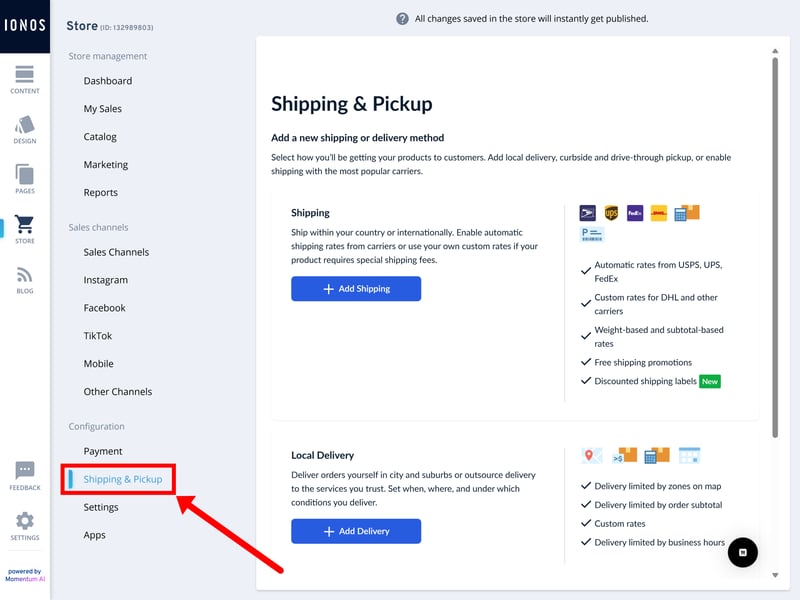
Shipping options are solid.
IONOS also supports real-time carrier rates for major providers like USPS, UPS, and FedEx, allowing customers to see live shipping prices directly at checkout without manual calculations.
For carriers that aren’t directly integrated, you’ll need to configure custom shipping rates manually. If you need broader automation or access to additional international shipping providers, you can connect third-party services like Sendcloud or Easyship through the app marketplace, although these often require an additional subscription.
Setting up discounts and sales
IONOS gives you a solid amount of flexibility when it comes to promotions and discounts. In addition to standard sale pricing and quantity discounts, the “Marketing” section includes two dedicated promotional tools: coupon codes and automatic discounts.
Coupon codes let customers redeem discounts at checkout, whether that’s a percentage off, a fixed amount, or free shipping. You can also control things like minimum order values, expiration dates, usage limits, or restrict discounts to certain products or customer groups.
Promotional discounts apply automatically once certain conditions are met, no code required. For example, you can automatically discount specific products or trigger an offer once someone spends above a certain amount. It’s a simple way to run seasonal sales or storewide promotions.
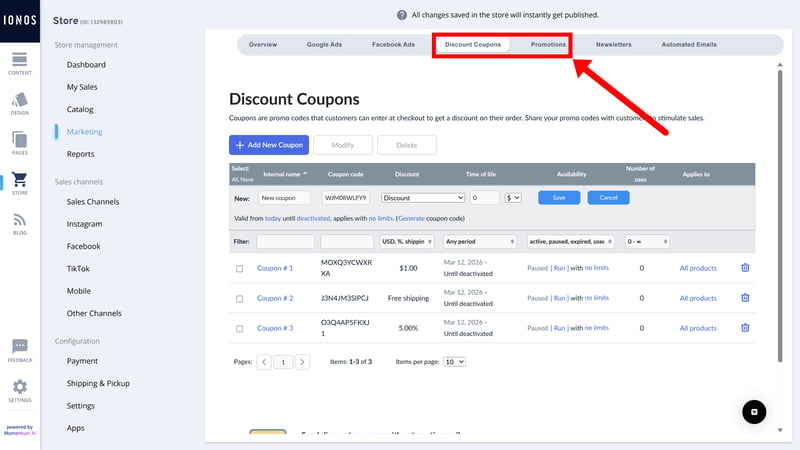
IONOS supports both manual coupon codes and automatic promotional triggers.
Managing your orders
All incoming orders are managed through the “My Sales” dashboard, which provides a clean and easy-to-scan overview of your transactions. From here, you can quickly check order statuses or use the built-in search and filter tools to locate specific customers, products, or order numbers.
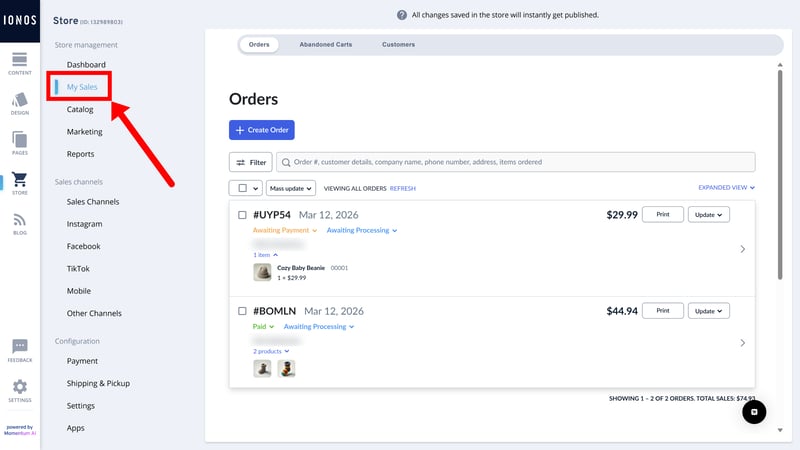
IONOS' order management dashboard.
Opening an order gives you access to all the key information in one place. You can manually update payment and fulfillment statuses, which is particularly useful for offline payment methods like bank transfers or cash on delivery, and leave internal notes to track shipping progress or customer communication.
The platform also includes bulk actions for managing multiple orders at once, including batch updates and invoice generation. Another useful addition is abandoned cart recovery: if a customer leaves before completing checkout, IONOS can automatically send reminder emails to encourage them to return and finish their purchase.
Selling globally with IONOS
IONOS supports multilingual stores, although the setup feels a little fragmented because the website builder and ecommerce backend handle translations separately. Store translations themselves are powered by Ecwid. Once multilingual support is enabled, you can manually translate product names, descriptions, and categories directly inside the product editor.
The website builder has its own separate translation feature, which is only available on the higher-tier plans. This relies primarily on automatic translation and only applies to your general website pages, not the ecommerce content itself.
While IONOS supports a wide range of currencies, you can only use one active checkout currency at a time. That means international customers can browse your store, but they can’t complete purchases in their own local currency unless it matches your store’s default one.
Additional features
IONOS offers a wide range of extra features, though some require paid extensions:
Multi-channel selling
You can connect your store to a variety of external sales channels directly from the ecommerce dashboard. Supported integrations include Instagram, Facebook, Google Shopping, TikTok, Amazon, and eBay.Point of sale (POS)
IONOS doesn’t provide its own native POS system, but you can integrate third-party retail solutions through the app marketplace.Email marketing
IONOS only handles standard emails, such as order confirmations and abandoned cart reminders. For more advanced email marketing and newsletters, you’ll need to integrate third-party services like Mailchimp.Dropshipping
If you want to run a dropshipping business, you can connect specialized providers through third-party apps. Supported services include Spocket, Syncee, and Printful.Extensions and app marketplace
IONOS actually has two separate app marketplaces: one for the website builder itself and another for the ecommerce backend. The Ecwid app marketplace is by far the more powerful of the two, with more than 60 extensions covering shipping, marketing, accounting, customer support, automation, and more.
With Ecwid's ecommerce engine under the hood, IONOS delivers some serious retail muscle. The core sales features — payments, shipping, and order management — are genuinely solid and cover pretty much everything most small stores would need.
The recurring problem, though, is the disconnect between the capable ecommerce backend and the restrictive storefront editor. While the sales tools offer plenty of depth, the website builder just isn't flexible enough to make the most of them.
Customer Support
| Documentation and tutorials |
| 1.5/2 |
| Support channels |
| 1.5/2 |
| Speed and quality |
| 2/3 |
| Customer reviews |
| 2/3 |
IONOS maintains a large and fairly comprehensive help center, though it spans the company’s entire product ecosystem — everything from domains and hosting to servers and ecommerce. As a result, it can feel a little overwhelming if you’re only looking for help with the website builder.
The content is well-organized, though, and the website builder and online store each have their own dedicated sections.
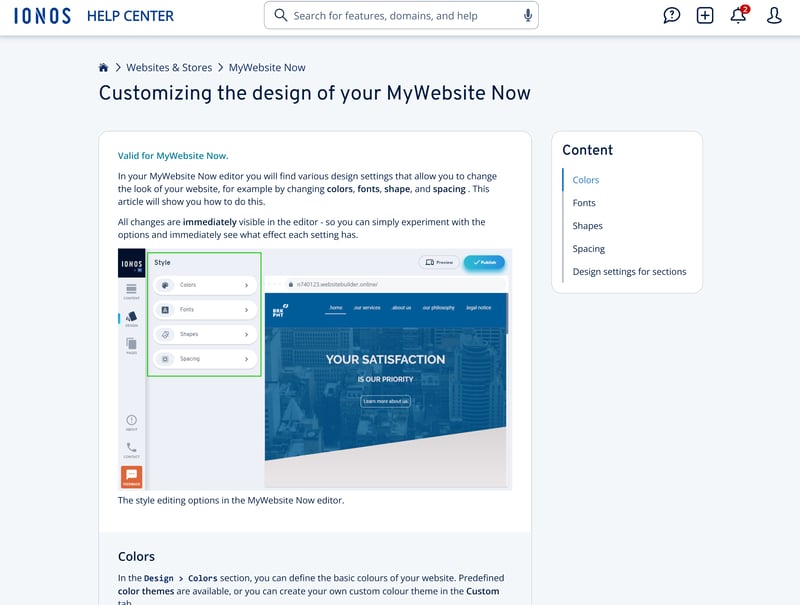
The website builder has its own section within the IONOS help center.
The articles themselves are high quality: they're concise, easy to follow, and supported by plenty of screenshots. The content is a bit fragmented, though, since the ecommerce documentation comes from Ecwid and essentially lives in its own separate ecosystem.
IONOS could do a better job of explaining where the website builder ends and the ecommerce backend begins, because the relationship between the two systems isn’t always immediately clear.
Personal support via phone and live chat
For direct support, IONOS offers both phone and live chat assistance. Every customer gets assigned a personal consultant, essentially a dedicated account contact who acts as your primary point of communication.
There's no traditional email support, though. If you need help outside of live chat hours, your only real option is to request a callback.
In our experience, response times were consistently fast across both channels. The support staff were friendly and genuinely helpful, though they did seem a bit out of their depth with more technical ecommerce questions. When agents didn’t have an immediate answer, however, they were usually quick to point us toward the relevant documentation or support article.
That experience broadly matches customer feedback online. IONOS is frequently praised for its responsiveness and availability, even if the technical expertise of individual agents can sometimes vary.
IONOS offers decent support. Whenever we needed help, we were able to reach someone quickly via chat or phone, and most customer reviews online report similarly fast response times.
The help center is extensive and does offer plenty of useful content, but the split between the website builder and ecommerce platform makes the support resources feel a bit fragmented.
Pricing
| Costs for a small shop | $14.00 | 4/6 |
| Costs for medium-sized shop | $14.00 | 6/6 |
| Costs for large shop | $68.00 | 1/3 |
| Pricing model |
| 1.5/3 |
| Trial version |
| 1/2 |
IONOS offers four ecommerce plans, each aimed at different store sizes:
The Starter plan supports up to 500 physical products and includes only the core ecommerce features, making it best suited to very small stores or side projects.
The Plus plan increases the product limit to 5,000 and adds features like digital downloads (up to 1 GB), third-party app integrations, and appointment booking support.
The Pro plan raises the limit to 10,000 products and unlocks more advanced ecommerce tools such as wish lists and advanced product filtering.
The Expert plan removes product limits entirely, expands digital storage to 10 GB, and adds more professional features like B2B pricing rules and multichannel marketplace selling.
IONOS doesn’t charge its own transaction fees. You’ll only pay the standard processing fees charged by payment providers such as Stripe or PayPal.
| Starter | Plus | Pro | |
|---|---|---|---|
| Monthly price | from $14.00 | from $15.00 | $48.00 |
| Contract period (months) | 1 - 24 | 1 - 36 | 12 |
| Product management | |||
| Number of products | 500 | 5,000 | 10,000 |
| Product filters | ✓ | ✓ | ✗ |
| Product variants | ✓ | ✓ | ✓ |
| Product inventory | ✗ | ✗ | ✓ |
| Product reviews | ✓ | ✓ | ✓ |
| Internationalization | |||
| Multiple languages | ✓ | ✓ | ✓ |
| Multiple currencies | ✗ | ✗ | ✗ |
| Automatic tax calculation | ✓ | ✓ | ✓ |
We've already mentioned the annoying upselling marathon. There’s also the issue of the “honeymoon” pricing: plans are deeply discounted for the first six months, but the eventual price hike is significant. Don't be swayed by the teaser rate alone; make sure you know what the bill will look like once that initial discount expires.
Comparing IONOS to the competition
It’s difficult to compare ecommerce pricing head-to-head, since every platform uses a slightly different pricing model. The monthly subscription fee also doesn’t tell the full story: your actual costs will depend on factors like payment processing fees, sales volume, and paid add-ons.
Still, the base subscription price is a useful starting point when comparing platforms. To keep things as fair and consistent as possible, we defined three common store scenarios and compared what each provider would charge in those situations:
Small store: 10 products, up to $10,000 in annual sales, custom domain
Medium store: 500 products, up to $200,000 in annual sales, with product variants
Large store: 10,000 products, up to $2 million in annual sales, with variants, product filters, and multilingual support
Here are the results:
| Small shop | Mid-size shop | Large shop | |
|---|---|---|---|
| $2.75 | $2.75 | |
| $10.00 | $10.00 | $19.93 |
| $10.00 | $10.00 | $19.93 |
| $11.75 | $11.75 | $11.75 |
| $12.60 | $22.00 | |
| $14.00 | $14.00 | $68.00 |
| $22.00 | $119.00 | |
| $23.00 | $23.00 | |
| $25.00 | $45.00 | $105.00 |
| $29.00 | $299.00 | |
| $29.00 | $29.00 | $29.00 |
IONOS looks very affordable at first thanks to its heavily discounted introductory pricing. Once the initial promotion ends, the monthly costs quickly move into mid-range territory. Many other ecommerce platforms offer far more flexibility at a similar price point.
Final Verdict: A Powerful Ecommerce Engine Trapped in a Basic Website Builder
Ultimately, IONOS is a bit of a mixed bag as an ecommerce platform. On one hand, it’s one of the most beginner-friendly ways to launch an online store, and offers a surprising amount of ecommerce depth beneath the surface. On the other, there’s a constant disconnect between the ultra-simplified website builder and the surprisingly capable Ecwid-powered store backend sitting underneath it.
This mismatch creates persistent bottlenecks. The website builder's rigid layouts, limited customization options, and lack of creative flexibility make it difficult to fully take advantage of the platform’s stronger ecommerce capabilities. If you want to scale or build something more custom, you’ll likely outgrow the platform soon.
IONOS might be a solid choice for small, simple stores that prioritize ease of use above all else. But for anyone else, there are more integrated and flexible alternatives that will serve you much better in the long run.

IONOS User Feedback
IONOS does well on review platforms like Trustpilot, but those scores are skewed by the company’s massive footprint in hosting and domains. To get a clearer picture of the ecommerce experience, we’ve filtered out the noise to focus specifically on feedback from store owners.
Rapid response times
Users frequently praise how quickly they can get a human on the line, especially compared to competitors where you might wait days for a ticket response.Good for simple stores
The consensus is that the builder is an excellent choice for anyone who needs a respectable-looking site up and running in record time.Zero learning curve
Beginners appreciate the intuitive setup, which allows them to start selling immediately without any technical background or coding skills.
Support can be frustrating
While help is easy to reach, many users report getting conflicting advice or dealing with agents who don't seem to fully understand the ecommerce side of the platform.Costly technical glitches
Some sellers have flagged backend bugs and occasional downtime as a major concern, noting that glitches in system emails or product displays have directly impacted their sales.Fragile integrations
A recurring complaint is that connections to Facebook, Instagram, and Google are prone to breaking or failing to sync properly, requiring constant troubleshooting.Billing surprises and “hidden” extras
It's not just us: other customers also find the pricing structure confusing, pointing to unexpected add-on costs and sharp price hikes when it comes time to renew.
Top IONOS Alternatives
If IONOS doesn’t quite offer what you’re looking for, there are a few alternatives that might suit your project better:
Shopify or WooCommerce: Better for scalability
IONOS isn't really suited for larger or more complex stores. If you plan to grow or need more advanced features, platforms like Shopify or WooCommerce are a much better fit. They’re built with scalability in mind.Wix or Squarespace: Better for creative control
If you care about design and want more freedom to shape your store's website, builders like Wix or Squarespace are worth a look. They offer much more flexibility to adjust layouts, structure, and content to build truly unique websites.
Take a look at the best IONOS alternatives here: