Wix Ecommerce Review 2026: Can Wix Handle a Serious Online Store?


Wix built its reputation on making web design accessible to everyone, regardless of technical skill. Its all-in-one platform allows you to create everything from simple blogs to online shops. But how does it actually perform for ecommerce, especially when compared to a dedicated sales machine like Shopify?
We looked past the flashy designs to see if Wix’s selling tools can actually handle the demands of a serious ecommerce business.


Wix* is a popular website builder that lets you create and manage websites through a visual editor instead of coding everything yourself. Since launching in 2006, it has grown into one of the biggest names in the business, used by millions of people and organizations, from freelancers and small business owners to major international brands.
Wix was one of the first website builders to combine hosting, design tools, and CMS tools into a single platform. Instead of building websites from scratch, users could create pages visually using drag-and-drop sections and templates. That made website creation much more accessible for people without a technical background.
Unlike Shopify or WooCommerce, Wix wasn't built specifically for ecommerce. Selling features weren't even added until 2013. Wix remains a generalist tool rather than a dedicated sales system, which comes with pros and cons. It's more versatile as a website builder, but lacks the depth and scalability of specialized ecommerce platforms.
Wix Ecommerce Review
Highly customizable designs
Wix’s visual editor offers much more design flexibility than most other website builders. You can drag and drop elements freely on the page, giving you a high level of design control without needing to code.500+ ecommerce templates
Wix offers thousands of templates, with more than 500 ecommerce-specific designs.Solid sales features
Even though Wix isn’t an ecommerce-first platform, it still covers all the core features you need to run a store.Flexible product types
Wix supports physical and digital products, subscriptions, services, as well as print-on-demand right out of the box.
Busy, overly complex interface
Wix isn't as simple as it used to be. Filled to the brim with settings and features, the editor can feel cluttered, and it may take some time for new users to find their way around.Sluggish backend
The Wix interface tends to struggle under its own weight. With many features and elements in play, the dashboard and editor can feel slow and not particularly snappy.Lacks depth
Wix is a strong all-rounder, but it doesn’t match the depth of more specialized platforms like Shopify. If you’re serious about ecommerce and want something scalable, you'll run into limits sooner or later.
Setup & Ease of Use
| Setup |
| 2.5/4 |
| User interface |
| 5/8 |
| Performance |
| 1.5/3 |
You don't have to deal with the technical backend (like with WooCommerce) since everything is managed for you, but the platform itself has grown considerably more complex over the years as more features have been added. There's definitely a learning curve here, and it takes some time to really get comfortable with the interface.
Getting started with Wix
Signing up takes just a few minutes. Wix offers a free plan, which is basically a non-expiring free trial, allowing you to explore the platform’s features without handing over your credit card details. Only when you’re ready to connect a domain or start selling do you actually have to pay.
Your dashboard serves as the central hub for all your projects. From here, you can manage existing sites or click “Create New Site” to start a new shop.
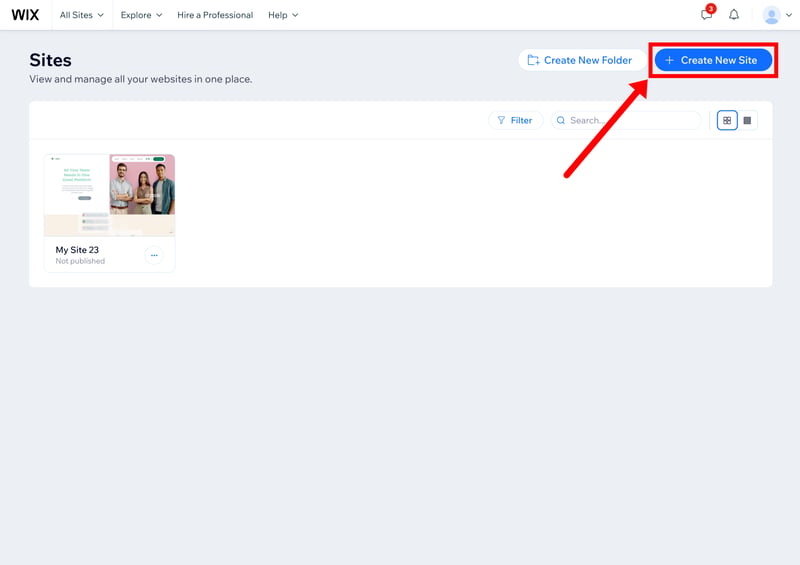
Your dashboard shows all your website projects.
Before you start designing, Wix will ask you to choose between Wix Studio and the standard Wix Editor. This is an important distinction to understand (and one that Wix could be a bit more forthcoming about):
The Wix Editor is the “classic” Wix experience, the latest version of the original drag-and-drop builder. It's best for simple projects and beginners who want to get online quickly.
Wix Studio is a newer, more advanced platform designed to compete with “pro” tools like Webflow. It offers more granular design control and better features for teams, making it a better fit for agencies and professional designers.
These are two distinct platforms with separate features and pricing models. While Wix currently supports both, it is clear the company is positioning Studio as its flagship platform for the future. For now, if you want the simplest path, stick with the Editor; if you need total creative control, Studio is the way to go.
While the builders are different, the ecommerce features are almost identical across both systems. Since the classic Wix Editor is the standard choice for beginners, that’s the version we’ll focus on in this review.

Wix Studio is Wix's new pro-level platform. It's more versatile, but also more complex.
Setting up your store in Wix's admin dashboard
Regardless of which builder you choose, your starting point will be Wix's admin dashboard. This is the central hub for managing your project.
The layout is pretty standard: there's a main navigation menu on the left and a search bar along the top. A checklist helps you set up the basics, like adding your first product or a payment method.
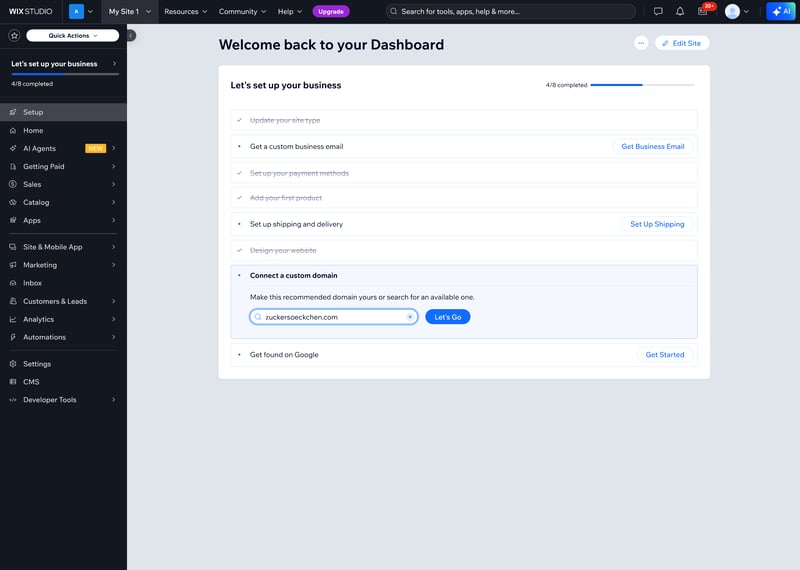
A quick setup checklist guides you through the most important steps.
While the layout is intuitive, the interface feels a bit “heavy” and sluggish. We noticed frequent delays when switching between menus, and some sections took several seconds to load. Every now and then, a page would fail to open entirely, and we had to reload everything.
Like most ecommerce platforms, Wix draws a clear line between back-office admin and shop design. All of the business operations (products, orders, and payments) happen in the dashboard, but any visual changes to your store happen in the editor.
Wix is built for beginners and people who can't code, but we wouldn't call it “simple” either. The classic editor is much more approachable than Wix Studio, but even this beginner-friendly option is so packed with options and features that it can feel pretty overwhelming for new users
Wix is certainly accessible for people without a technical background, but don't expect to have your store up and running in an hour. There's definitely a learning curve involved.
Lots of pop-ups, AI suggestions, and decisions to make
From the moment you start, Wix hits you with a steady stream of pop-ups, tooltips, and AI suggestions. There are a few major decisions you need to make early on, too — Editor vs. Studio, manual vs. AI setup.

Wix is leaning heavily into AI right now, and they make sure you know it.
While all these choices offer flexibility, they make the platform feel scattered. There isn’t always a clear, logical flow to the setup, and some areas feel cluttered. It feels less like a streamlined tool and more like a system that’s had too many features bolted on over the years.
Every no-code builder tries to strike a balance between creative freedom and ease of use. Finding that sweet spot is easier said than done. None have nailed it, and Wix is no exception.
While the interface is generally intuitive and accessible to users without a technical background, it’s far from minimalist. The sheer number of features, the choice of different platforms and setup paths, and the dense, sluggish dashboards all add complexity. You'll need some patience and a sense of direction, especially when you're just starting out.
Wix isn't the most intuitive website builder, but it's a powerful system that gives you a lot of freedom, if you're willing to put in the time to learn it.
Templates and Design
| Number of templates | 500 | 2/2 |
| Template quality |
| 2.5/3 |
| Website builder |
| 3/4 |
| Customizing shop pages |
| 3/4 |
| Custom code |
| 2/2 |
Wix was a website builder long before it added ecommerce features, and its focus is still very much on design. Wix's drag-and-drop editor is one of the most versatile visual builders out there.
Wix Editor: 500+ ecommerce templates and AI designs
When you first launch the editor, you have to choose a starting point: you can either pick a pre-made template or let Wix’s AI generate a site for you.

You can choose a design template or let the AI build your store for you.
If you choose the AI route, the process is mostly automated. Wix takes the information you’ve already provided about your business and creates a “brief”, which it then uses to build a site structure with a color scheme and sample content.
This isn't “vibe coding” though: You can’t refine the design with follow-up prompts or conversation; it’s a one-shot process. In our tests, the results were okay, but they felt a bit generic.
In early 2026, Wix introduced Wix Harmony, an AI-powered design platform. It’s meant to bridge the gap between traditional drag-and-drop editing and AI-driven design.
The idea is that you let the AI handle the initial layout, and you can then adjust the content or structure using prompts, or simply switch back to the classic visual editor to move things around manually. Since Wix Harmony is still rolling out, many features are in the early stages of development, so it’s a bit too early to judge its full potential
For now, we opted to stick with Wix’s classic templates. They offer more control and a more predictable setup. The selection is huge, too: there are thousands of templates in total, with roughly 500 designed specifically for online stores.
For our test project — a fictional baby clothing store — we found plenty of solid options:
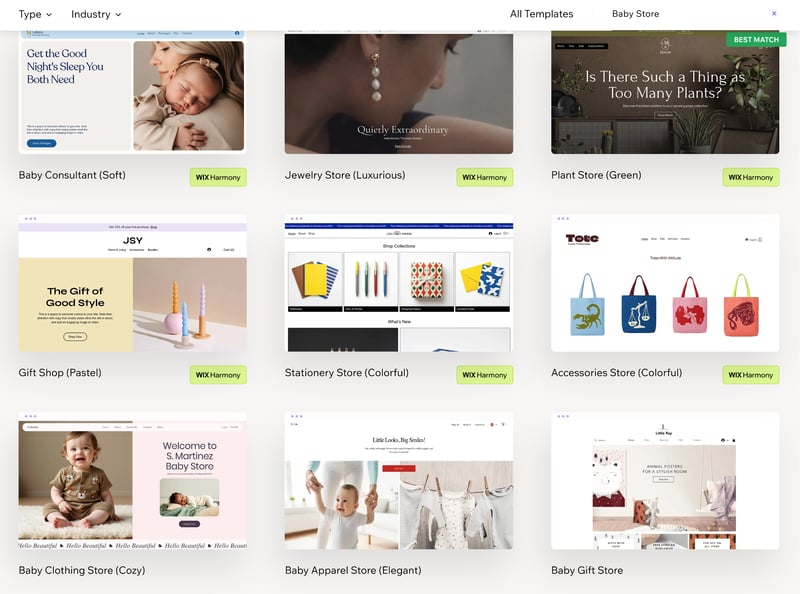
Wix offers an extensive range of templates.
For the most part, the quality is strong. Most designs look sleek and professional, even if some feel a bit repetitive. There’s more than enough variety to find a good fit, and best of all, every template is included for free.
| Number of templates | |
|---|---|
 | 3,000 |
 | 1,000 |
 | 500 |
 | 225 |
 | 190 |
 | 170 |
 | 70 |
 | 47 |
 | 34 |
 | 12 |
 | 11 |
Designing your store with Wix's drag-and-drop editor
Wix uses a “free-form” drag-and-drop editor. Pages are built using sections that house various elements like text, images, product galleries, and buttons. Unlike many other builders, you aren't forced into a strict grid; you can place and move elements almost anywhere on the page. Auxiliary gridlines help to keep things tidy.
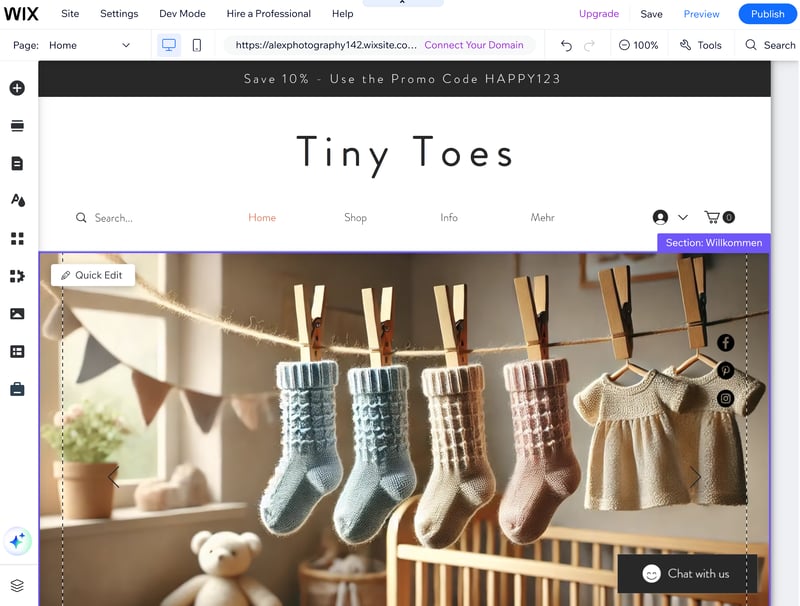
You can drag and drop elements freely.
You aren't stuck with your template’s original layout, either. You can redesign any page, add new sections, or rearrange the order of existing ones. Wix also provides a library of pre-made section layouts, including specific designs for product and category pages.
When you add an online store, Wix automatically generates the essential pages (such as cart, checkout, or order confirmation) for you. These don’t offer the same drag-and-drop freedom as regular pages, but rely on specific “Wix Stores” layout settings. You can’t move elements wherever you like, but you can adjust things like spacing, alignment, and dividers within the set structure.
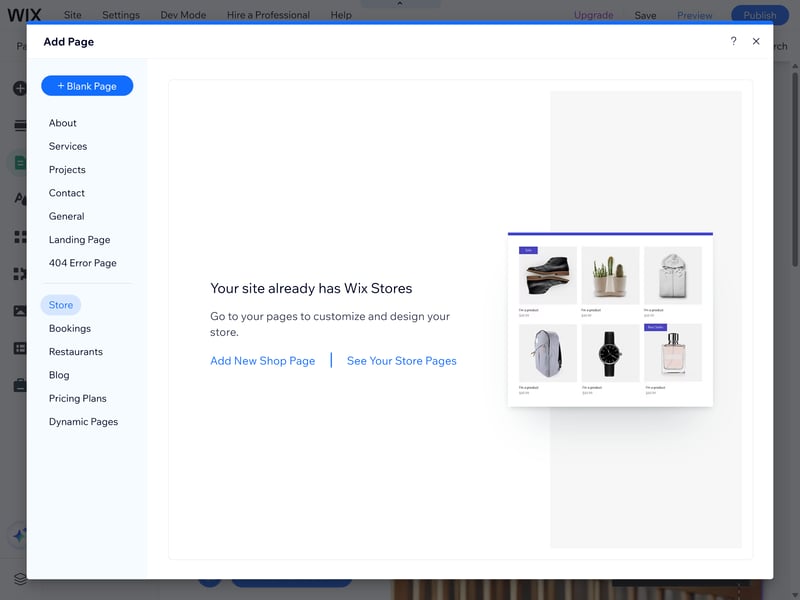
You can add new shop pages in the page menu.
Wix uses dynamic product pages. You only have to design the layout once — that single design can then be applied to every item in your store. Product-specific details, such as the product name, price, and images, are pulled automatically from your inventory.
You’re not limited to just one layout, though. If you want certain product pages to look different, you can create “variants”. These allow you to customize the design for specific products or categories while still keeping the benefits of dynamic pages.
Plenty of widgets and elements
Wix offers a massive library of elements you can use to build your site. Alongside the basics, like text, images, and videos, you also get a range of ecommerce widgets, including single product blocks and add-to-cart buttons.
Since you can add these to any page, you can sell from anywhere on your site rather than being restricted to the default product or category pages. You can feature products in your blog posts or on a specialized landing page, for example.
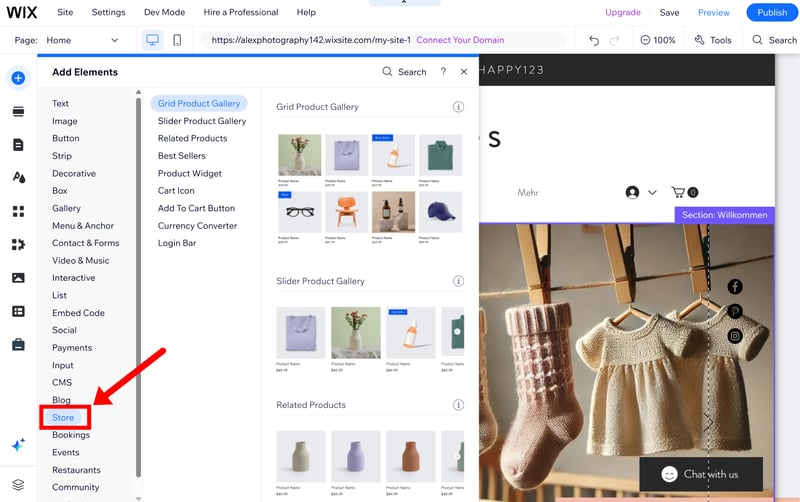
Wix boasts a massive selection of widgets and ecommerce elements.
Coding in Dev Mode
If you hit a wall with visual editing, you can switch on Dev Mode to unlock developer tools. This gives you access to Velo, Wix’s developer platform. It moves the system from “no-code” to “low-code”, allowing you to add custom JavaScript, manage your own databases, and build unique business logic. This is particularly useful if you need to create complex product filters or shopping rules that the standard tools can't handle.
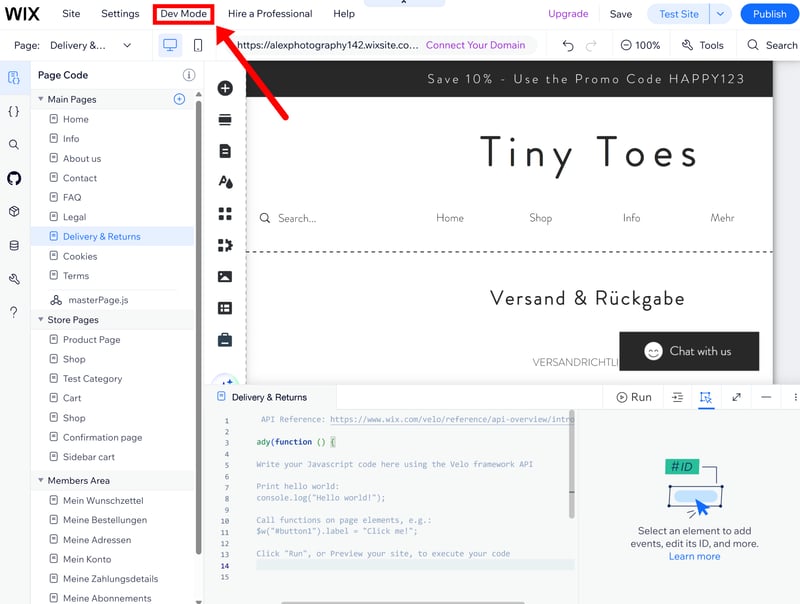
Dev Mode gives you direct access to your site's code.
Fine-tuning your mobile layout
Wix templates are mobile-friendly by default, meaning layouts automatically adjust to smaller screens. Wix also offers a separate mobile editor, allowing you to fine-tune the smartphone version of your site independently from the desktop layout. You can rearrange elements, hide entire sections, or adjust font sizes for mobile without affecting the desktop version of your design.
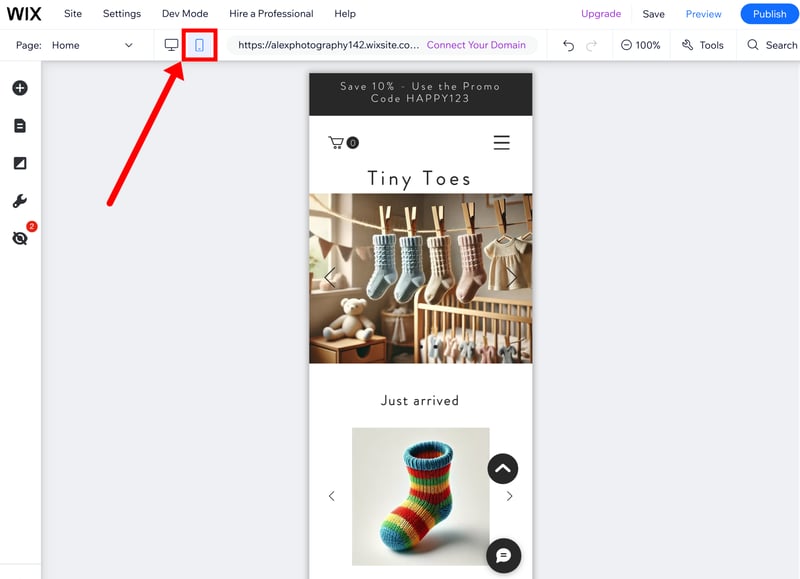
Switch to mobile view to adjust how your site looks on smartphones.
This gives you much more control than simpler builders that just scale everything down, but it also means you’ll need to check both views to ensure everything looks right.
For a no-code website builder, Wix offers a high degree of customization. Its drag-and-drop editor gives you more control over page design and layout than most competing platforms. You also get access to a massive template library, along with a wide range of pre-built sections to speed up the design process.
And if the standard visual tools aren’t enough, you can switch to Dev Mode and add your own custom logic. With Wix Harmony, there's even a new vibe coding option now.
The trade-off for all this power is a noticeable learning curve. If you’re new to web design, getting a polished result won’t feel nearly as effortless as it does with simpler, more “paint-by-the-numbers” builders. With so many features and settings to navigate, things can get overwhelming quickly.
Performance can also be an issue. The editor gets pretty sluggish, which can make the whole design process feel a bit clunky and frustrating.
Product Management
| Product types |
| 4/4 |
| Product features |
| 2/3 |
| Product variants |
| 3.5/6 |
| Product pricing |
| 2.5/3 |
| Product organization |
| 1.5/2 |
| Inventory |
| 1/2 |
Wix can technically accommodate up to 50,000 items, making it capable of handling larger inventories — in theory, at least. In practice, it's best suited for smaller stores with simple portfolios that don't need the level of depth and flexibility offered by dedicated ecommerce platforms like Shopify or WooCommerce.
Adding new products in the Wix dashboard
Inventory is managed under the “Store Products” section of the dashboard. All your products are listed in a table view, and you can add new items in just a few clicks.
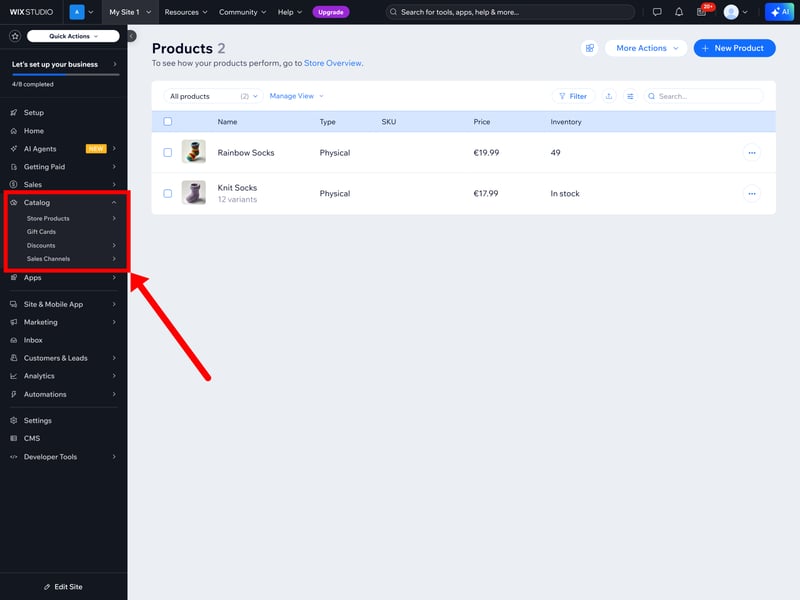
Managing your products in the Wix dashboard.
When you add a product, you’re first asked to select a type. By default, Wix supports physical goods, digital files, and print-on-demand items. Other product types require apps or add-ons. For example, you can use Wix Bookings to sell services or Wix Pricing Plans for recurring subscriptions.
Overall, Wix supports pretty much every product type under the sun:
Wix | Shopify | Squarespace | Ecwid | Hostinger | IONOS | BigCommerce | Jimdo | Sellfy | Square | WooCommerce | |
|---|---|---|---|---|---|---|---|---|---|---|---|
✓ | ✓ | ✓ | ✓ | ✓ | ✓ | ✓ | ✓ | ✓ | ✓ | ✓ | |
✓ | ✓ | ✓ | ✓ | ✓ | ✓ | ✓ | ✗ | ✓ | ✓ | ✓ | |
✓ | ✗ | ✓ | ✗ | ✓ | ✓ | ✗ | ✓ | ✗ | ✗ | ✗ | |
✓ | ✓ | ✓ | ✗ | ✗ | ✗ | ✗ | ✗ | ✗ | ✗ | ✗ | |
✓ | ✓ | ✓ | ✓ | ✓ | ✓ | ✓ | ✗ | ✗ | ✗ | ✗ | |
✓ | ✗ | ✗ | ✓ | ✓ | ✓ | ✓ | ✓ | ✗ | ✗ | ✗ | |
✓ | ✓ | ✓ | ✓ | ✗ | ✗ | ✗ | ✗ | ✓ | ✗ | ✗ | |
✓ | ✓ | ✗ | ✗ | ✗ | ✗ | ✗ | ✗ | ✗ | ✓ | ✓ | |
Total | 8 | 6 | 6 | 5 | 5 | 5 | 4 | 3 | 3 | 3 | 3 |
Editing your products
Wix’s product editor is fairly standard and easy to navigate. Photos and videos sit right at the top, followed by the usual fields for names, descriptions, pricing, variants (more on those in a moment), and shipping.
Beyond the basics, you can add “info sections” for things like technical specs or care instructions. There’s also support for custom input fields, which is handy for options like engravings or personalized messages, which you can set as mandatory if needed.
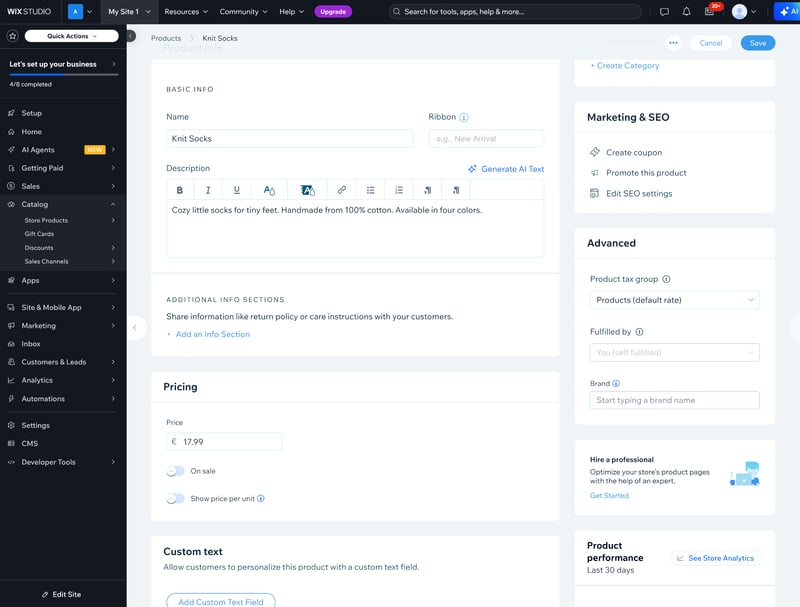
Editing your items.
Wix supports bulk editing, though not as elegantly as more ecommerce-focused platforms. You can update multiple products at once directly in the dashboard, including pricing, visibility, categories, and other basic product data. For larger changes or more complex catalogue and variant management, though, you’ll often need to use the CSV import/export system.
Unlike Shopify, with its powerful “metafields” system, Wix doesn’t let you create and manage custom attributes across your entire catalogue. Attributes are only handled at the individual product level.
Because of that, there’s no way to use them for site-wide filtering or more sophisticated catalogue management. That's one area where Wix isn't nearly as scalable as proper ecommerce tools.
Managing up to 1,000 variants per product
Wix allows for up to 1,000 variants per product, managed through a dedicated module within the product form. Once you’ve entered your options and choices, the system automatically generates every possible combination.
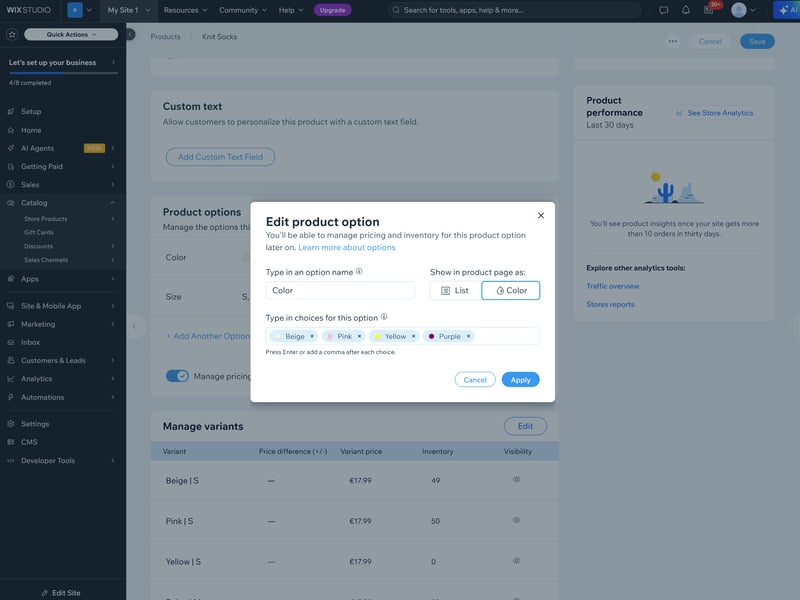
When you add options, Wix will automatically generate all possible variant combinations.
By default, these variants inherit the primary product details, but you can manually override pricing, stock levels, and other settings for each individual item.
Annoyingly, you can’t assign unique images to every variant. They’re limited to individual options, not full combinations. For example, if you sell a product in multiple colors and materials, you can only link photos to the colors themselves, rather than to each unique pairing.
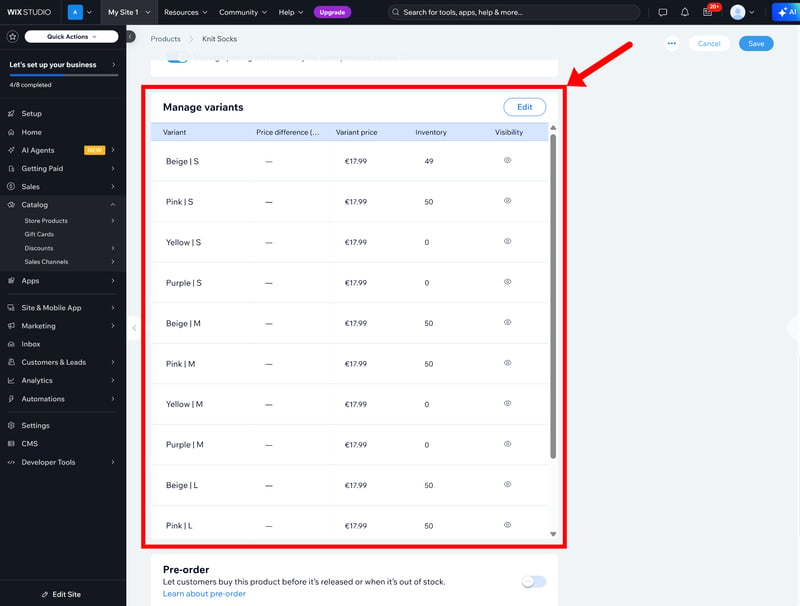
Managing variants in Wix.
The 1,000-variant cap is pretty generous and should be more than enough for most stores. Still, the system is mainly designed for standard products like different sizes or colors. If your products need more advanced customization, the built-in tools can start to feel limiting.
For example, creating products with many dependent options, highly detailed customization choices, or more complicated pricing rules often requires third-party apps or custom development with Velo.
Wix | BigCommerce | Ecwid | Hostinger | IONOS | Shopify | Square | Squarespace | WooCommerce | Sellfy | Jimdo | |
|---|---|---|---|---|---|---|---|---|---|---|---|
Max. number of options | 6 | unlimited | unlimited | unlimited | unlimited | 3 | 6 | 6 | unlimited | unlimited | 2 |
Max. number of variants | 1000 | 600 | unlimited | 100 | unlimited | 2048 | 250 | 250 | unlimited | unlimited | 36 |
Variant-specific images | ✗ | ✓ | ✓ | ✓ | ✓ | ✓ | ✓ | ✓ | ✓ | ✓ | ✗ |
Variant-specific pricing | ✓ | ✓ | ✓ | ✓ | ✓ | ✓ | ✓ | ✓ | ✓ | ✓ | ✗ |
Variant-specific SKU | ✓ | ✓ | ✓ | ✓ | ✓ | ✓ | ✓ | ✓ | ✓ | ✗ | ✗ |
Variant-specific inventory | ✓ | ✓ | ✓ | ✓ | ✓ | ✓ | ✓ | ✓ | ✓ | ✓ | ✗ |
Total | 3 | 4 | 4 | 4 | 4 | 4 | 4 | 4 | 4 | 3 | 0 |
Product pricing and discounts
Pricing options at the product level are fairly solid. If you toggle the “On Sale” option, an additional field appears for the discounted price; the system then automatically displays the original price with a strikethrough for comparison.
Wix also includes support for unit pricing (e.g., $/kg or $/L), which is a key legal requirement in many regions. By enabling the “Price per unit” toggle and entering the total quantity, the platform calculates and displays the base price automatically.
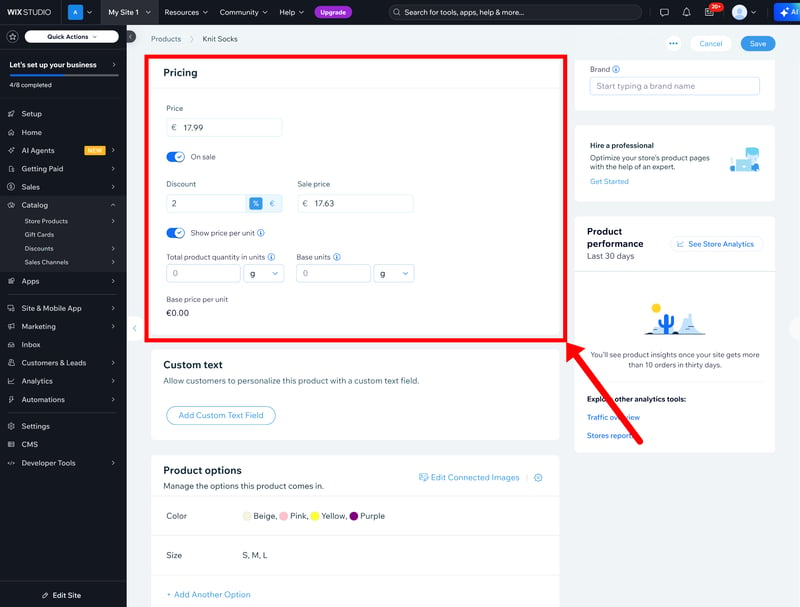
You can set a sale price in the product editor.
You can also set up bulk discounts for specific items, though these are managed through the dashboard’s general discount section rather than directly within the product form (more on that later).
Organizing your products with categories and filters
Product organization in Wix centers around categories. These form the backbone of your store’s navigation and determine how your products are grouped on the site.
You can create an unlimited number of categories and assign a single product to multiple groups simultaneously. Each category automatically generates its own landing page, which you can then customize within the editor.
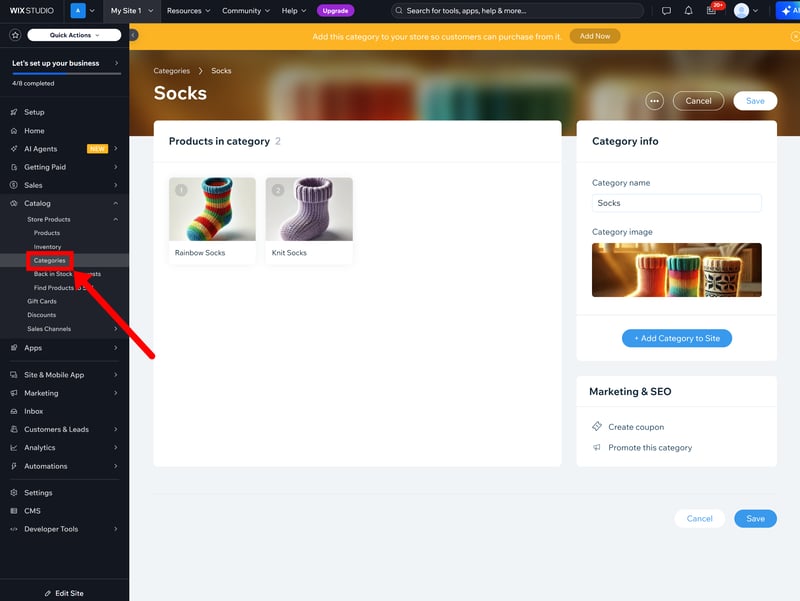
You can organize your products with categories.
To help shoppers narrow down their search, Wix offers built-in filtering and sorting on these category pages. Aside from standard filters like price and availability, the system can pull from your product variants, meaning options like “color” or “size” will automatically show up as filter criteria in your shop’s sidebar.
While these tools are pretty good for small to mid-sized inventories, they lack the sophistication found on more heavy-duty platforms. There's no system for tags or rule-based filtering based on custom attributes, for example, like you get with Shopify. Wix isn't really built for very complex catalogues.
Managing your inventory
Stock tracking in Wix is standard fare. When a customer makes a purchase, the stock level for that specific product or variant is updated automatically. You can choose to either hide out-of-stock items or keep selling them as backorders.
There are no built-in low-stock alerts or reorder notifications. If you want the system to tell you when it’s time to restock, you’ll need to install a third-party app or set up a custom workaround.
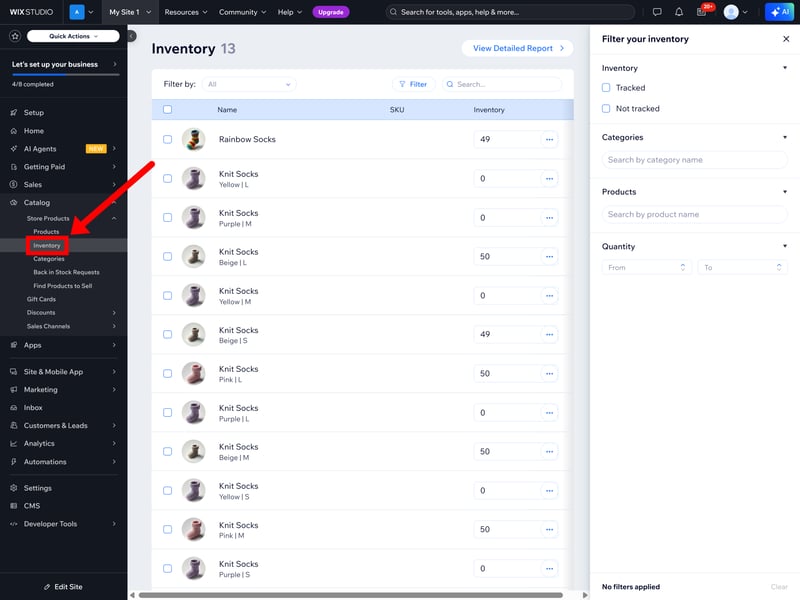
Inventory management in Wix.
For a small shop with a limited number of items, Wix’s built-in inventory tools are usually sufficient. But if you’re managing hundreds of variants or more complex setups, the system does feel underpowered.
Wix also lacks native support for more advanced use cases like multi-warehouse inventory or complex logistics. In that regard, it’s much less flexible and scalable than platforms like Shopify or other dedicated ecommerce solutions.
Wix is impressively flexible, allowing you to sell almost anything, from physical and digital goods to subscriptions, print-on-demand items, and services. With high caps on products and variants, it certainly looks like a contender for larger stores on paper.
The problem is that Wix is broad, but shallow. It works well for general needs, but once you move into complex product structures or specific business workflows, the platform starts to feel a bit thin. If you’re planning to scale, you’ll likely find that specialized alternatives like Shopify offer a level of flexibility that Wix just can’t match.
Sales Features
| Taxes |
| 2/3 |
| Shipping options |
| 2.5/3 |
| Discounts |
| 2.5/3 |
| Payment providers |
| 2.75/3 |
| Order management |
| 1.5/2 |
| Advanced features |
| 5/6 |
Running a store means handling the back-office essentials: payments, shipping, and taxes. Wix provides a decent set of built-in tools for these, which can be expanded via the App Market if you have more specialized requirements. But again, it doesn’t match the depth of platforms like Shopify.
Accepting payments with Wix
Just like Shopify and WooCommerce, Wix comes with its own payment solution, called Wix Payments. It handles credit and debit cards, along with digital wallets like Apple Pay and Google Pay, as well as region-specific options.
If you’d rather use an external provider, there are more than 80 third-party gateways available globally, including PayPal, Stripe, and Klarna. You can also accept cryptocurrency through integrations like CoinGate.
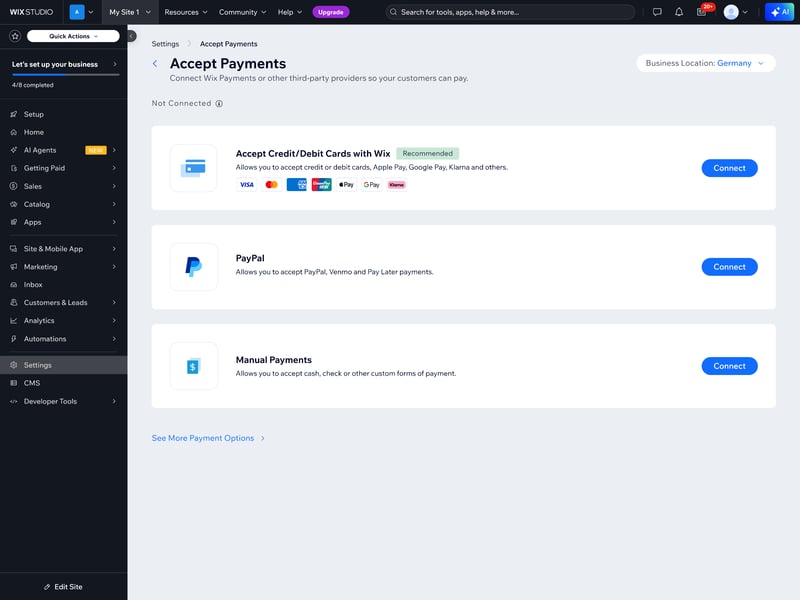
Wix offers its own payment gateway, Wix Payments.
You can also set up manual payment methods. These allow you to provide custom instructions for things like bank transfers, checks, or cash on delivery.
Wix | WooCommerce | Shopify | Ecwid | IONOS | BigCommerce | Squarespace | Hostinger | Jimdo | Sellfy | Square | |
|---|---|---|---|---|---|---|---|---|---|---|---|
Number of payment providers | 80 | 19 | 100 | 120 | 120 | 65 | 5 | 4 | 2 | 2 | 1 |
Paypal | ✓ | ✓ | ✓ | ✓ | ✓ | ✓ | ✓ | ✓ | ✓ | ✓ | ✗ |
Stripe | ✓ | ✓ | ✓ | ✓ | ✓ | ✓ | ✓ | ✓ | ✓ | ✓ | ✗ |
Square | ✗ | ✓ | ✗ | ✗ | ✗ | ✗ | ✓ | ✗ | ✗ | ✗ | ✓ |
Amazon Pay | ✗ | ✓ | ✓ | ✓ | ✓ | ✓ | ✗ | ✗ | ✗ | ✗ | ✗ |
Klarna | ✓ | ✓ | ✓ | ✓ | ✓ | ✓ | ✓ | ✗ | ✗ | ✗ | ✗ |
Mollie | ✓ | ✓ | ✓ | ✓ | ✓ | ✗ | ✗ | ✗ | ✗ | ✗ | ✗ |
Native payment solution | ✓ | ✓ | ✓ | ✗ | ✗ | ✗ | ✓ | ✗ | ✗ | ✗ | ✗ |
Manual payment methods | ✓ | ✓ | ✓ | ✓ | ✓ | ✓ | ✗ | ✓ | ✗ | ✗ | ✗ |
Total | 6 | 8 | 7 | 6 | 6 | 5 | 5 | 3 | 2 | 2 | 1 |
Setting up taxes
By default, Wix requires you to set your rates manually. You can define specific tax regions, such as countries or states, and use “tax groups” to apply different rates to specific product categories.
If you don't want to handle rates manually, you can automate the process through an integration with Avalara. While this isn't a native Wix feature, it's the platform's standard way to handle real-time tax calculations.

Tax settings in Wix.
Avalara is included in Business plans and higher without an additional fee, but it's capped at a certain number of transactions per month. If your sales volume exceeds that limit or if you need more advanced tax features, you'll have to pay for an upgraded Avalara plan. Other platforms offer a bit more automation straight out-of-the-box.
Shipping and fulfillment
Shipping setup in Wix is fairly comprehensive. To get started, you need to define your shipping zones (e.g., domestic vs. international). For each zone, you can calculate rates based on:
Flat rates (a fixed cost per order)
Order value (e.g., higher rates for more expensive orders)
Weight
Item quantity
Of course, you can offer free shipping as well.
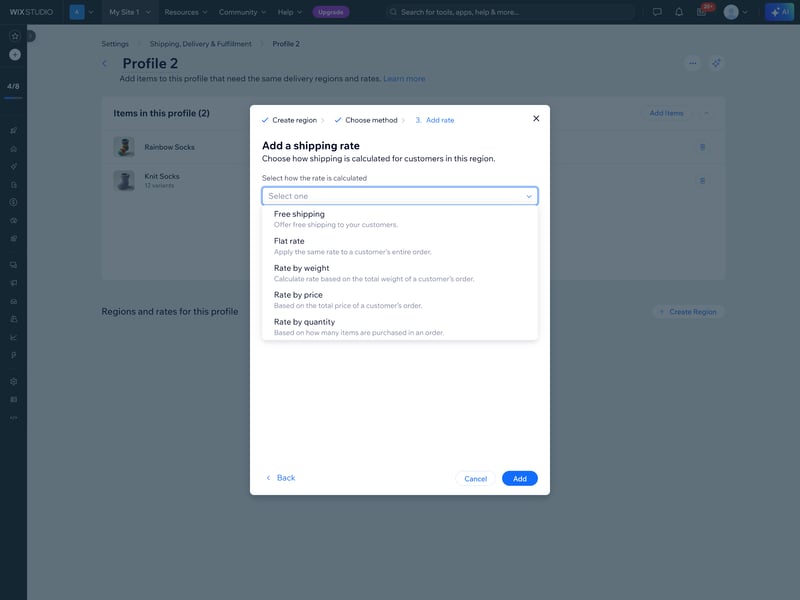
Adding a new shipping rate.
For businesses with a physical presence, Wix has dedicated settings for local delivery and pickup. You can set specific delivery areas, define time windows, and allow customers to choose a delivery date at checkout. For pickups, you can manage multiple locations and provide customers with specific instructions and available time slots.
Another useful feature is “delivery profiles”. These allow you to create unique shipping rules for different groups of products. This is helpful if you sell a mix of items, for example, you can set a higher shipping rate for heavy or oversized goods while keeping a standard rate for everything else.
The availability of real-time shipping rates (carrier-calculated rates) depends on the region. In the US, Wix supports automatic calculations for carriers like USPS. The App Market also offers a range of third-party apps like Shippo, ShipStation, or Sendcloud, that can handle everything from label printing to fulfillment automation.
Coupons, discounts, and promotions
Wix provides solid tools for running sales and promotions. It supports both coupon codes and automatic discounts that apply directly at checkout.
The coupon system covers all the bases: you can create coupons for discounts with fixed amounts, percentages, free shipping, and “Buy X, Get Y” deals.
There’s also a good amount of control behind the scenes. Coupons can be limited to specific products or categories, restricted by expiration date, or capped after a certain number of uses. Coupons work for subscriptions, too: discounts can be applied either to the first payment only or to recurring charges as well.
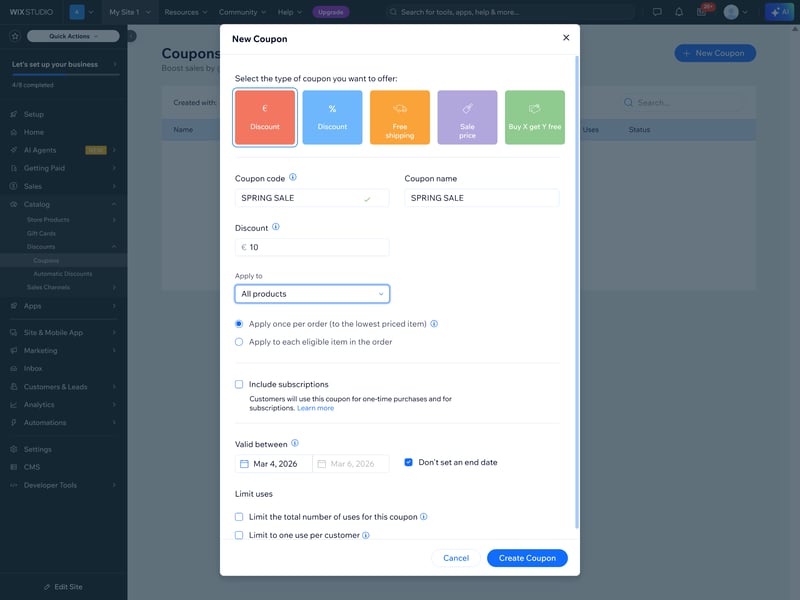
Attract customers with discounts.
If you want to run site-wide sales, Wix also supports automatic discounts that don’t require customers to enter a code manually. You can set up percentage discounts, fixed discounts, sale prices, and “Buy X, Get Y” offers here as well.
For anything more complex, like launching a loyalty or referral program, you’ll have to turn to the App Market for an add-on. But for everyday discounts, the native tools are more than capable.
Managing your orders
The “Orders” dashboard helps you keep track of your day-to-day sales and fulfillment in one place. If you’re looking for a specific order, you can filter the list by date, fulfillment status, or customer.
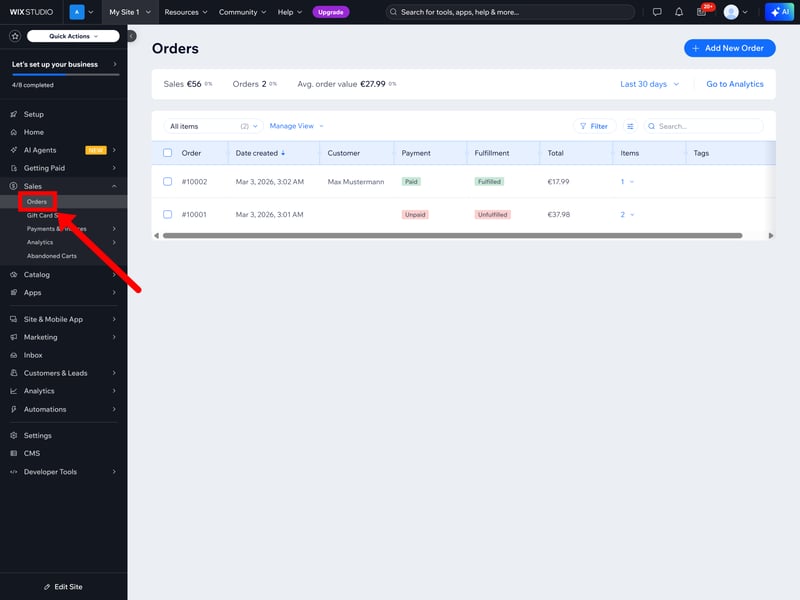
Managing orders in Wix.
When you open an order, you get the full breakdown: customer details, billing info, and a timestamped activity log. This is where you handle the bulk of your fulfillment tasks, such as:
Mark orders as paid
Update shipping status
Add tracking numbers
Print shipping labels (depending on integration)
Issue refunds
Add internal notes
Assign tags for internal organization
Overall, Wix offers solid order management for small and mid-sized stores, with useful tools for fulfillment, tracking, refunds, and day-to-day operations. For more advanced logistics workflows, warehouse management, and large-scale automation, however, you'll need to look to third-party apps.
Other features and integrations
Wix has an impressive set of built-in features, and can be further expanded through apps and third-party integrations.
Multilingual and Multi-currency
If you're running an international store, you can use the “Wix Multilingual” app to manage different language versions. It’s free to use, though auto-translation requires paid credits.
While you can display prices in multiple currencies to help international shoppers, the actual checkout only supports one primary currency.Multichannel selling
You aren't limited to selling on your own website. Wix allows you to sync your catalogue and sell directly through social media, online marketplaces, and search engines.Point of sale
For businesses with a physical presence, Wix POS handles in-person transactions while keeping your inventory and order data in sync with your online store.Dropshipping
If you prefer not to manage your own inventory, Wix supports dropshipping through dedicated integrations with platforms like Spocket, Modalyst, and Importify.Email marketing
Wix has a built-in email marketing platform. With Wix Email Marketing, you can create newsletters, automations, and simple campaigns without any external tools.Custom development and API
For more complex or bespoke needs, Velo by Wix offers a full development environment with API access. You can build out custom logic or connect your store to external software and databases.App market
Wix's app market features more than 800 extensions and integrations. Alongside Wix’s own specialized tools, you’ll find a huge variety of third-party apps covering everything from advanced marketing and design to niche, industry-specific requirements.
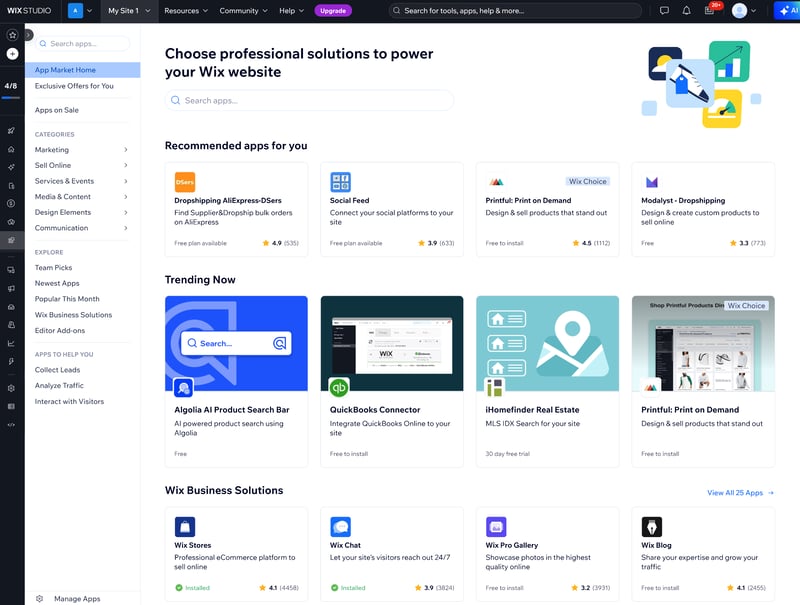
The Wix App Market offers over 800 extensions.
Wix handles the essentials decently well. Between the broad support for payment providers and the flexible shipping and discount rules, the fundamentals are all there. For smaller stores, the built-in tools should be enough to handle daily operations.
Once again, though, Wix lacks the depth and sophistication of more dedicated ecommerce platforms. Compared to solutions like Shopify or WooCommerce, it clearly sits a tier below when it comes to scalability, operational flexibility, and advanced sales workflows. Once your store becomes more complex, those limitations start to show.
Customer Support
| Documentation and tutorials |
| 2/2 |
| Support channels |
| 1/2 |
| Speed and quality |
| 1/3 |
| Customer reviews |
| 1/3 |
Wix offers two main self-service support options: a traditional help center and an e-learning platform called Wix Learn.
The Help Center is a comprehensive knowledge base with articles covering almost every feature and area of the platform. It also includes an AI-powered search tool that quickly points you to relevant content, along with a short AI-generated summary.
Overall, the content is well organized and easy to navigate. Articles often include screenshots, links, info boxes, and sometimes videos. If features differ between the Wix Editor and Wix Studio (or depend on your subscription tier) this is usually explained upfront.
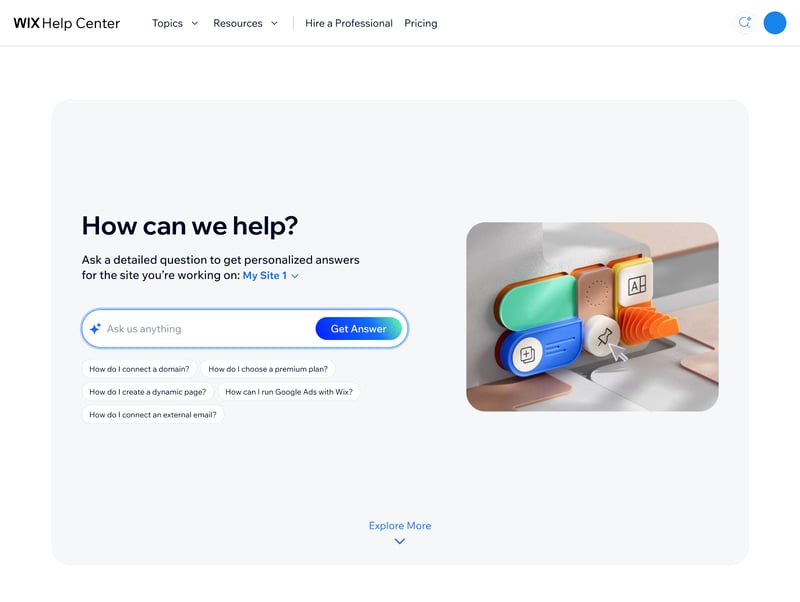
Wix's Help Center with the built-in AI assistant.
If you prefer a more guided approach, Wix Learn is worth checking out. It’s a free e-learning platform with video courses covering topics like website creation, ecommerce setup, marketing, and SEO.

Take a video course on Wix Learn to master the basics.
Direct support via chat and ticket
Can’t find what you’re looking for? If you need personal assistance, you can contact Wix support via live chat or by submitting a ticket.
The chat starts with an AI assistant that assesses your issue. If it can’t resolve the problem (or if you prefer to speak to a human either way) you’ll be connected to a support agent.
English-language live chat is available Monday through Friday from 2 AM to 6 PM EST. Outside these hours, your request is turned into a ticket and handled via email. In our case, it took two days to receive a response.
Mixed customer feedback on Trustpilot & Co.
A single support experience is only a snapshot. For a broader perspective, it’s worth looking at review platforms like Trustpilot, where feedback on Wix tends to be more critical overall.
Common complaints include slow response times and frustrating chatbot interactions that fail to fully resolve issues. Some users also report that the support team struggles with more complex or less typical problems.
The feedback isn’t entirely negative, though. Quite a few users mention quick responses and helpful agents, suggesting that the quality of support can vary depending on the issue and support representative.
Wix puts a lot of emphasis on self-service support, including a detailed Help Center and the Wix Learn video platform. If you’re willing to look things up yourself, you can usually find answers fairly quickly.
Direct support is more hit-or-miss. Most requests are filtered through chatbots first, which can make it difficult to reach a human agent. Response times and support quality also seem to vary quite a bit, especially when dealing with more complex issues.
Pricing
| Costs for a small shop | $11.75 | 5/6 |
| Costs for medium-sized shop | $11.75 | 6/6 |
| Costs for large shop | $11.75 | 3/3 |
| Pricing model |
| 0.5/3 |
| Trial version |
| 2/2 |
Wix offers four pricing tiers, but only three are designed for ecommerce: Core, Business, and Business Elite. All ecommerce plans support up to 50,000 products, which should be more than enough for most small and mid-sized stores.
The main differences come down to advanced business features. Tools like automatic tax calculation and more advanced shipping features, including shipping label printing, are only available on the Business plan and above.
Here’s a closer look at Wix’s pricing tiers:
| Core | Business | Business Elite | |
|---|---|---|---|
| Monthly price | from $11.75 | from $15.50 | from $55.00 |
| Contract period (months) | 1 - 36 | 1 - 36 | 1 - 36 |
| Product management | |||
| Number of products | 50,000 | unlimited | unlimited |
| Product filters | ✓ | ✓ | ✓ |
| Product variants | ✓ | ✓ | ✓ |
| Product inventory | ✓ | ✓ | ✓ |
| Product reviews | ✓ | ✓ | ✓ |
| Internationalization | |||
| Multiple languages | ✓ | ✓ | ✓ |
| Multiple currencies | ✗ | ✗ | ✗ |
| Automatic tax calculation | ✓ | ✓ | ✓ |
Payment fees vary depending on your payment method and region. For card payments, Google Pay, and Apple Pay in the EU, you can expect fees of around 1.9% per transaction plus $0.30.
Wix offers substantial discounts if you commit to a plan for two or three years upfront, making the long-term cost significantly lower than paying month to month.
However, these discounts only apply to the initial term. Once it renews, pricing returns to the standard rate, which can be considerably higher.
Comparing Wix to the competition
Comparing ecommerce pricing isn’t easy, since every platform structures its plans and features differently. For a somewhat fair comparison of overall platform costs — i.e. the base subscription price before transaction fees, apps, and other extras — we came up with three common store setups and calculated the base monthly cost for each.
Small store: 10 products, up to $10,000 in annual sales, with a custom domain
Medium store: 500 products, up to $200,000 in annual sales, with product variants
Large store: 10,000 products, up to $2 million in annual sales, with variants, product filters, and multilingual support
Here's the pricing chart:
| Small shop | Mid-size shop | Large shop | |
|---|---|---|---|
| $2.75 | $2.75 | |
| $10.00 | $10.00 | $19.93 |
| $10.00 | $10.00 | $19.93 |
| $11.75 | $11.75 | $11.75 |
| $12.60 | $22.00 | |
| $14.00 | $14.00 | $68.00 |
| $22.00 | $119.00 | |
| $23.00 | $23.00 | |
| $25.00 | $45.00 | $105.00 |
| $29.00 | $299.00 | |
| $29.00 | $29.00 | $29.00 |
As you can see, Wix is firmly on the cheaper side, at least initially. With the long-term discounts applied, it's one of the more affordable ecommerce builders on the market, especially for larger stores. Plus, even Wix’s cheapest ecommerce plan already includes many key features that competing platforms often reserve for higher tiers.
These prices don’t last forever, though. Once the discounted term ends, renewal costs rise sharply. At that point, Wix starts competing more directly with platforms like Shopify on price, while offering a lot less flexibility and scalability overall.
Wix is one of the more budget-friendly ecommerce builders, especially if you commit to a two- or three-year plan upfront. Even the cheapest ecommerce tier covers the essentials, without strict limits on products or variants.
The low introductory prices don’t last forever, though, and renewal costs can rise sharply once the initial term ends. Plus, the subscription fee is only part of the overall cost. You still need to factor in payment processing fees and shipping expenses — and depending on your setup, you may also need to pay for apps or third-party integrations.
Final Verdict: Wix Is a Great Generalist, but No Match for Shopify & Co.
Wix isn’t an ecommerce-first platform. It’s a general-purpose website builder that also supports online stores. That distinction defines both the strengths and the weaknesses of the platform.
As an all-in-one website builder, Wix is pretty impressive. It combines one of the better no-code editors on the market with a solid set of ecommerce tools, making it a good fit for businesses that care about branding, content, and design flexibility as much as selling products.
The limitations become more noticeable as your store grows. As your catalogue grows, your workflows become more complex, or you need more advanced integrations and automation, Wix starts to feel much less efficient than dedicated ecommerce platforms. It simply doesn’t offer the same scalability, ecosystem, or operational depth as Shopify or WooCommerce.
Wix makes the most sense for smaller stores, creator brands, and content-focused websites that also want to sell online. If ecommerce is the core of your business — especially if you plan to scale aggressively — a dedicated ecommerce platform will be the safer long-term choice.

Wix User Feedback
We looked through user reviews on Trustpilot and various software review sites to get a better sense of how real users feel about Wix. Here are some of the most common pros and cons:
Easy to start, quick results
Many users like how quickly they can launch a website or online store without needing any coding skills. Templates, drag-and-drop tools, and built-in features make it easy to create a professional-looking site in a relatively short amount of time.All-in-one platform
Reviewers frequently praise the convenience of having everything in one place — including website management, ecommerce, bookings, email marketing, newsletters, and integrations.Modern templates and design flexibility
Many users highlight Wix’s modern templates and flexible editor, which allow them to create polished, professional-looking websites without hiring a designer or agency.
Frustrating editor behavior
One of the more common complaints involves the editor experience. Some users report layouts shifting unexpectedly during edits, or describe the editor as unintuitive and difficult to manage across desktop and mobile views.Pricing, upsells, and subscription frustration
Several reviewers mention rising prices, aggressive upselling, and frustration over features being locked behind higher-tier plans or paid add-ons.Payment issues, account locks, and security emails
Some store owners report issues related to payments and payouts, including delayed transfers, account verification problems, or temporary account restrictions.
Top Wix Alternatives
Wix is not the right fit for your online store. after all? Here are a few alternatives worth considering:
Shopify or BigCommerce: More scalable ecommerce platforms
If ecommerce is your main focus, a dedicated platform may be the better choice. Solutions like Shopify and BigCommerce are built specifically for online stores, offering greater scalability, more advanced ecommerce features, and a larger app ecosystem.WooCommerce: More technical flexibility and control
Want full control over your store’s technical setup? WooCommerce turns a WordPress website into a highly customizable online store with deep technical flexibility. The downside is that you’ll need to manage hosting, maintenance, updates, and security yourself.
Find the best Wix alternatives here: