Best Shopify Alternative in 2026: 13 Ecommerce Platforms Reviewed


Shopify is the go-to platform for online stores these days. And for good reason: No other website builder balances powerful ecommerce tools, ease of use, and scalability quite as well. That’s why Shopify is our overall top pick. But it’s not necessarily the right fit for everyone.
Let's look at some of the best Shopify alternatives to see what they do better, worse, or just differently than our top pick.


Why not Shopify?
Shopify is our favorite ecommerce website builder, beating out ten other platforms. We still had plenty to criticize:
Limited no-code design
Shopify's page builder prioritizes functionality over creative flexibility. If you want complete control over your site's design (without writing code), it doesn't offer the same level of creative freedom as more design-focused website builders.Expensive themes
Shopify offers more than 1,000 themes, but only 24 are free. Premium themes typically cost between $100 and $400, which can add to your upfront expenses.Closed system
Shopify's closed ecosystem makes it easy to use, but it also comes with trade-offs. You're tied to Shopify's infrastructure and have less freedom than with open-source platforms like WooCommerce.Product option limits
Shopify supports more than 2,000 variants per product, but you're limited to three option types (such as color, size, and material). Many platforms are a lot less strict here.Customer support could be better
Users on review sites like Trustpilot don't hold back when it comes to Shopify's customer support. Many complain about slow response times and generic answers. We also found the experience a bit shallow and impersonal. Phone support is reserved for enterprise customers.Higher starting costs
Shopify isn't the most affordable platform, especially for smaller stores. In addition to higher starting prices, themes, apps, and third-party payment providers can increase your costs over time.Extra transaction fees
If you don't use Shopify Payments, Shopify's own payment gateway, you're charged additional transaction fees on every sale.
Shopify clearly isn't perfect. If these drawbacks outweigh the platform's strengths for your business, it may be worth exploring the alternatives. So which platform should you choose instead?
Best Shopify Alternatives: Our Top 5
No ecommerce platform is perfect for everyone. Whether you want more flexibility, lower costs, or greater design freedom, there are plenty of Shopify alternatives to choose from. Here are five worth considering:
WooCommerce: Open-Source alternative for more flexibility

Shopify's all-in-one SaaS approach makes selling online incredibly simple, but it also limits how much control you have over your store. Since your hosting, software, and infrastructure are all managed by Shopify, you can't customize every aspect of your setup or easily work around the platform's limitations.
WooCommerce* offers a lot more freedom. As an open-source WordPress plugin, it gives you complete ownership over your store and the freedom to customize almost every aspect of your setup. You can choose your own hosting provider, extend your store with thousands of plugins, and tailor the shopping experience to your exact needs.
That flexibility comes with extra responsibility, though. Unlike Shopify, WooCommerce leaves much more of the technical side in your hands.
WooCommerce might be a good Shopify alternative if you:
want full control over your store and your data
don't mind getting more involved with the technical side
want the freedom to customize and scale your store however you like
already use WordPress or are willing to learn it
Where WooCommerce beats Shopify
WooCommerce is the better choice if you want as much control and flexibility as possible, and you're okay with putting in the extra work to get it.
Unlimited customization
WooCommerce gives you far more freedom than Shopify. Thanks to WordPress's huge ecosystem of themes and plugins, you can customize almost every aspect of your store.Full ownership
With WooCommerce, you choose your hosting provider and retain complete control over your store and data. You're not tied to a single platform or ecosystem.Native WordPress integration
WooCommerce integrates seamlessly with WordPress. If you already have a WordPress website or are familiar with the platform, getting started is relatively straightforward.Greater scalability
Because WooCommerce is open-source, you're free to build and grow your store however you like. There are no platform-imposed limits on how your business evolves.
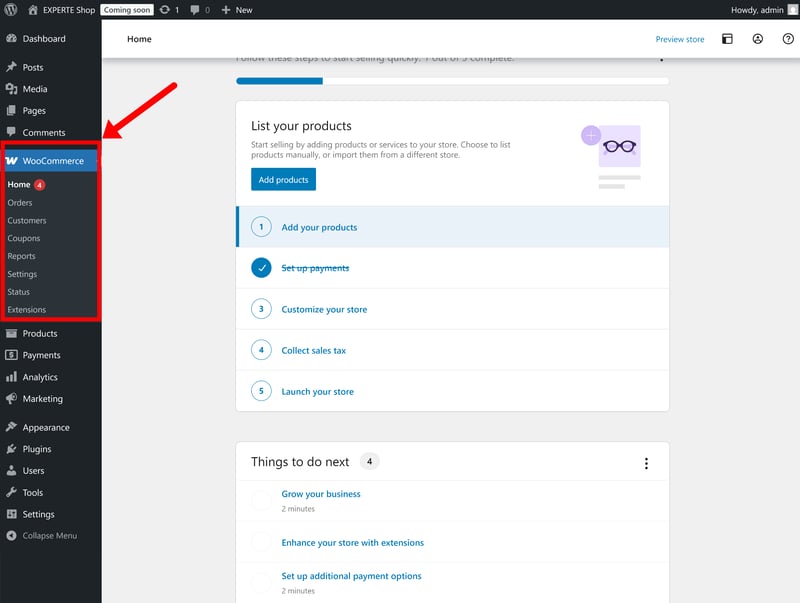
WooCommerce integrates directly into the WordPress dashboard.
Where WooCommerce falls short compared to Shopify
Greater flexibility comes with greater responsibility. WooCommerce requires more time, technical knowledge, and ongoing maintenance than Shopify.
More complicated setup
Getting started is much more involved than with Shopify. You'll need to arrange web hosting, install WordPress and WooCommerce, and configure everything yourself.More ongoing maintenance
Updates, security, backups, and performance optimization are your responsibility. While Shopify handles these tasks automatically, WooCommerce requires a more hands-on approach.Heavy reliance on plugins
Many features that come built into Shopify require separate WordPress plugins in WooCommerce. While this gives you more flexibility, it also adds complexity and maintenance.No dedicated support
Unlike Shopify, WooCommerce doesn't offer a centralized support team. You’ll need to find help on your own, in the official documentation or community forums.Steeper learning curve
You don't need to know how to code to use WooCommerce, but some technical knowledge will help you get the most out of the platform.
Wix: A Website Builder Alternative for Simple Stores

Unlike Shopify (and WooCommerce), Wix* wasn't built primarily for ecommerce. It's a website builder with built-in selling tools that puts design and ease of use front and center.
Wix lacks the depth and scalability of dedicated ecommerce platforms, but that may not matter if you're running a smaller store or simply want an easy way to sell online alongside your website.
Wix might be a good Shopify alternative if you:
want to get started quickly without technical hurdles
value design flexibility and ease of use
need a website with built-in ecommerce functionality
run a smaller online store
don't need advanced ecommerce features
Where Wix beats Shopify
Wix can’t compete with Shopify as an ecommerce platform, but outshines it as a general-purpose website builder:
More design flexibility
Wix's drag-and-drop editor lets you customize your website more freely (without coding). It gives you more visual control over your site's design and layout.Better for website-first businesses
Wix is a solid option if your store is just one part of a larger website — such as a portfolio, blog, or company site.More features built in
Many features that require third-party apps on Shopify come included with Wix. That means less time managing (and paying extra for) integrations.
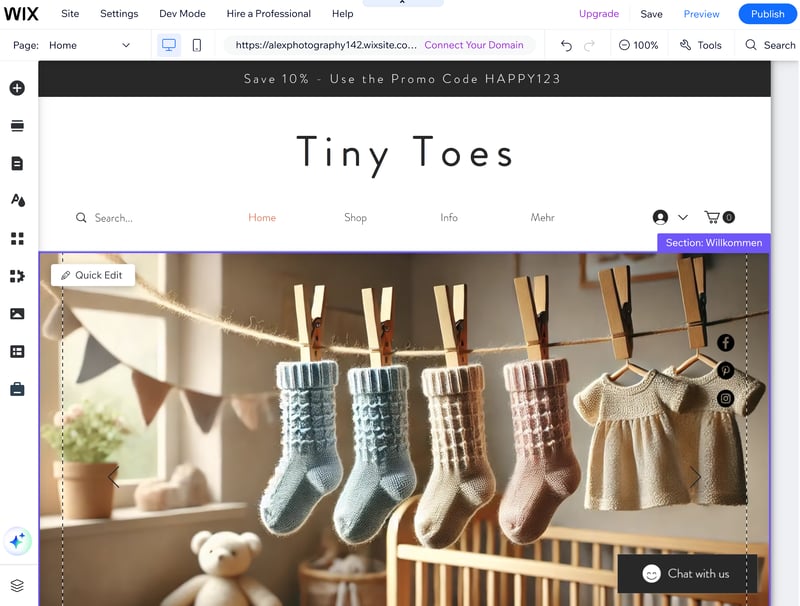
Wix is an all-purpose website builder with ecommerce features.
Where Wix falls short compared to Shopify
As an all-rounder, Wix simply can't match the depth and scalability of a dedicated ecommerce platform like Shopify. And even on its home turf, Wix is held back by performance issues and an increasingly bloated interface:
Less powerful ecommerce features
Wix is first and foremost a website builder, with sales tools added on top. What's there is solid, but overall, Wix simply lacks the depth and flexibility of a dedicated ecommerce platform.Limited scalability
In theory, Wix supports stores with thousands of products, but it's best suited to smaller catalogs and simpler requirements. It simply wasn't built to scale with larger shops.Cluttered, sluggish interface
Wix claims to be very beginner-friendly, but there's definitely a learning curve. The sheer number of features can make the editor feel overwhelming. It's also prone to slowdowns and occasional lag.
Ecwid: Flexible store add-on for existing websites

If you already have a website and simply want to start selling online, Ecwid* could be a good fit. It's an ecommerce add-on that lets you turn your existing website into an online store (though you can also use its built-in website builder if you're starting from scratch).
Ecwid might be a good Shopify alternative if you:
already have a website and just want to add ecommerce functionality
don't want to migrate to a completely new platform
want to get started quickly with minimal setup
plan to sell across multiple channels, including your website and social media
Where Ecwid beats Shopify
Ecwid's USP is the ability to add ecommerce to an existing website, but it's a pretty capable all-in-one solution as well:
Easy integration with existing websites
Ecwid integrates with virtually any website or content management system. That means you can add ecommerce functionality to your existing site instead of migrating to a completely new platform.Built-in multichannel selling
Ecwid makes it easy to sell across multiple channels, including social media and online marketplaces. Many of these tools are built into the platform.No variant limits
Unlike Shopify, Ecwid doesn't restrict the number of product options you can offer. You can create as many variants as your catalog requires.
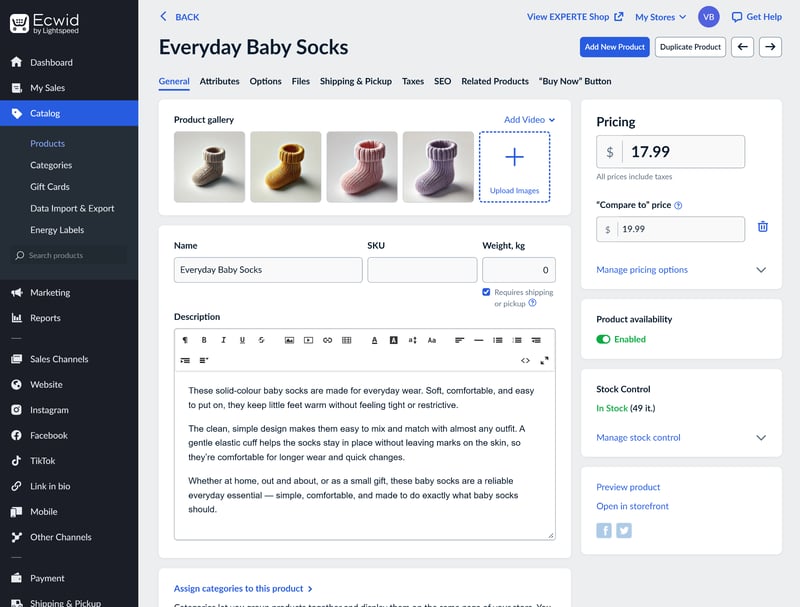
Managing products in Ecwid.
Where Ecwid falls short compared to Shopify
Ecwid is an impressive ecommerce add-on, but as a standalone store solution, it's definitely no match for Shopify in terms of features or scalability:
Less powerful ecommerce tools
Ecwid's ecommerce features are solid, but they don't come close to matching Shopify's. You might outgrow the platform sooner or later.Smaller app ecosystem
Ecwid's app marketplace is respectable, but much smaller than Shopify's. That means fewer integrations and extensions to choose from.Limited customization
Ecwid's website builder doesn't offer as much creative freedom. There are only a handful of templates, and customization relies on predefined layouts.
BigCommerce: A scalable alternative for larger stores

BigCommerce* is one of Shopify's closest competitors. Like Shopify, it's a hosted, all-in-one platform designed to support stores of all sizes. The two have a lot in common, but BigCommerce might have a bit of an edge when it comes to larger catalogs and B2B businesses.
BigCommerce might be a good Shopify alternative if you:
need a powerful SaaS platform that can grow with your business
sell internationally across multiple markets and currencies
prefer built-in features over third-party apps
run a B2B business or have more complex requirements
Where BigCommerce beats Shopify
BigCommerce packs more functionality into the core platform, reducing your reliance on apps. It also has stronger tools for B2B sales and international stores.
More built-in features
Many features that require third-party apps on Shopify are included out-of-the-box with BigCommerce. That means fewer integrations to manage and potentially lower costs.Stronger B2B tools
BigCommerce includes robust B2B features, such as custom pricing, quote requests, and customer-specific catalogs.Better support for international sales
BigCommerce supports multiple currencies, localized storefronts, and country-specific settings, making it a strong choice for businesses selling across multiple markets.
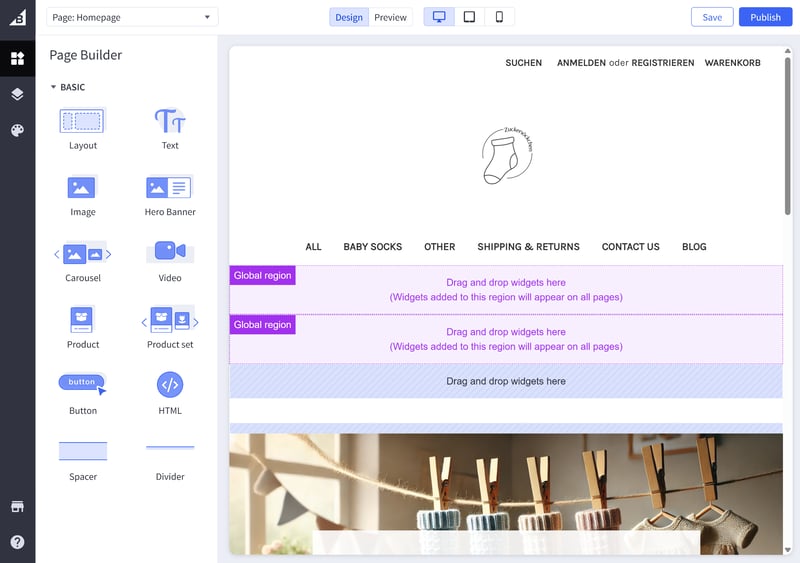
BigCommerce's drag-and-drop page builder in action.
Where BigCommerce falls short compared to Shopify
Since BigCommerce and Shopify are so similar, it's the finer details that matter—and Shopify wins out in most areas. BigCommerce is less intuitive, harder to customize, and overall less polished:
More complex interface
BigCommerce isn't as intuitive as Shopify, especially for new users. The learning curve is much steeper.Rigid website builder
BigCommerce's page builder feels dated and overly technical. It's not particularly intuitive, and advanced customization often requires coding.Revenue-based pricing
BigCommerce ties its plans to your annual revenue. Once you exceed the sales limit for your current plan, you'll need to upgrade to a more expensive tier.
More Alternatives
Still haven't found the right platform? There are plenty of other Shopify alternatives to consider. We've tested 11 ecommerce website builders in depth. Here's our full ranking, along with links to our detailed reviews:


Final Thoughts: Shopify Is Good, but Not the Only Option
Shopify earned the top spot in our comparison, but that doesn't automatically make it the best choice for every store. The right platform depends on your needs and priorities:
WooCommerce is ideal if you want maximum flexibility and full control over your store (and don’t mind spending extra time on setup and maintenance).
General-purpose website builders like Wix might be a better fit for simple or content-heavy stores.
Ecwid makes sense if you already have a website and simply want to add ecommerce functionality.
BigCommerce is well-suited to larger stores, international sellers, and B2B businesses.
But keep in mind: no platform is perfect. Every option comes with trade-offs, and what works best for one business may not work best for another.
If Shopify still seems like the best fit but you're worried about the learning curve, our Shopify tutorial can help you get started.