IONOS WordPress Hosting Review 2026: The Best Hosting Deal for WordPress?


Managed WordPress hosting is now a standard offering from most hosting providers. To stand out, many companies promise new features and bold improvements. IONOS, for example, claims to have “completely reimagined” affordable WordPress hosting. But does it deliver?
We put IONOS’s managed WordPress hosting to the test to see how well it lives up to its promises.


IONOS* is a German internet service provider. It’s best known for its web hosting solutions, but it also offers a wide range of cloud products and B2B services. With 6.2 million customers, IONOS is one of Europe’s largest hosting and cloud providers.
We’ve already tested several IONOS solutions, from traditional web hosting to its in-house website builder. Now, we’re reviewing its WordPress hosting plans.
IONOS WordPress Hosting Review
Affordable entry point for WordPress
For a single website, IONOS is very budget-friendly. You get plenty of storage, unlimited traffic, a free domain for the first year, and an email address.
Weak performance
In multiple performance tests, IONOS ranked near the bottom. Pagespeed is poor, and uptime is disappointing.No migration service
Want to move an existing WordPress site to IONOS? You're on your own, since the provider offers no migration service to help with the transfer.Slow admin panel
The dashboard can be painfully slow at times, and it pushes too many upsell prompts for paid add-ons.
Setup & Ease of Use
| Installation & setup |
| 3/3 |
| Migration |
| 0/2 |
| Control Panel |
| 4/10 |
Setting up a WordPress website with IONOS is straightforward, though it requires some patience. The process begins with creating an account and selecting a WordPress hosting plan.
IONOS then manually reviews orders, a verification step that can take up to 24 hours before the plan and dashboard become fully accessible. Most competing hosts process account activation much faster.
Once login credentials arrive, access the IONOS customer portal and select the "Websites & Shops" tile to initiate the WordPress installation. The setup itself completes quickly with no additional wait times.
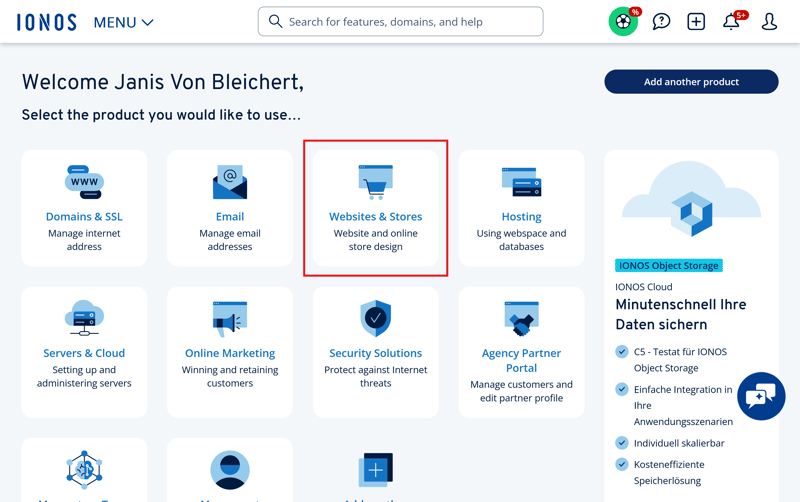
Product overview in the IONOS dashboard.
Quick and easy WordPress installation
At first, your WordPress package appears as "Untitled" and is marked "not set up". To change that, click "Set up Website," and IONOS launches its built-in one-click installer.
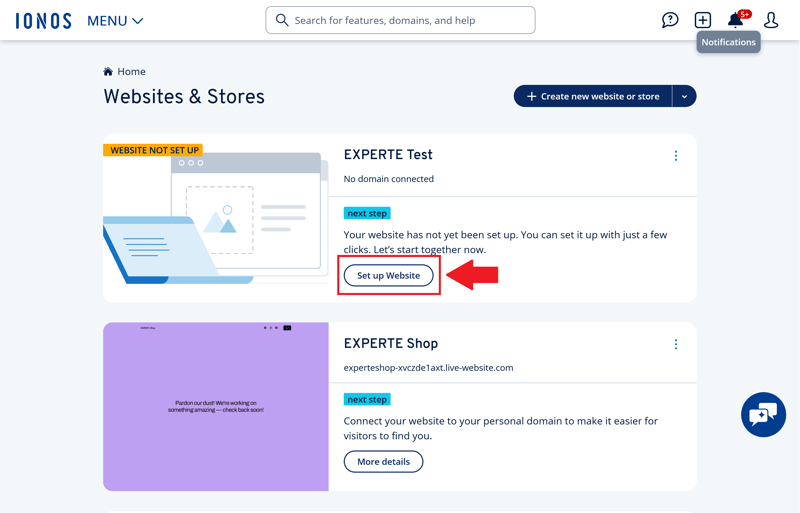
WordPress isn’t installed yet.
From this point, the process is virtually foolproof. Once you assign a project name, the setup begins—taking just around two minutes in testing. Users without an active domain can temporarily utilize a free system subdomain provided by the host.
Upon completion, you can immediately access the core WordPress environment or use IONOS's setup wizard to select recommended themes and plugins. While this guided assistance benefits beginners, experienced users will likely prefer bypassing it to jump straight into the native WordPress dashboard.
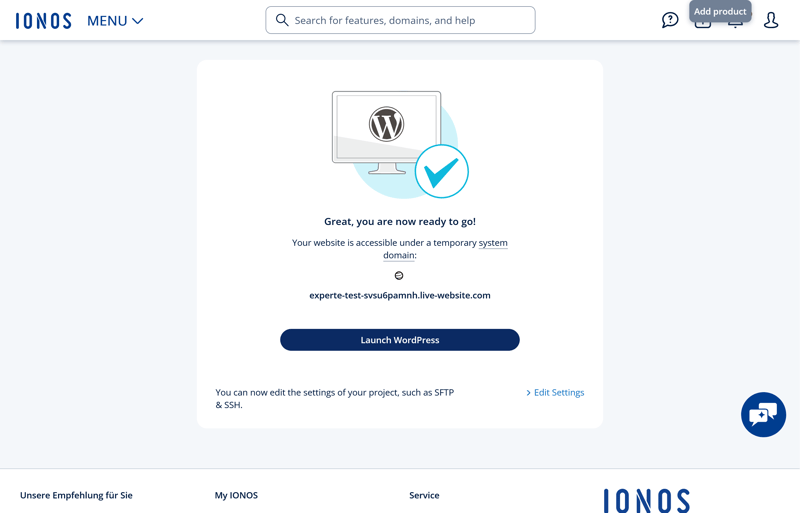
Quick and easy: the WordPress installation.
IONOS adds its own overview page to the WordPress backend, acting as a central hub for details like security status, the active PHP version, and essential WordPress features.
It also includes a small setup wizard to help you get started, alongside quick links to routine tasks. If you prefer using the default WordPress dashboard, you can switch back with a single click.
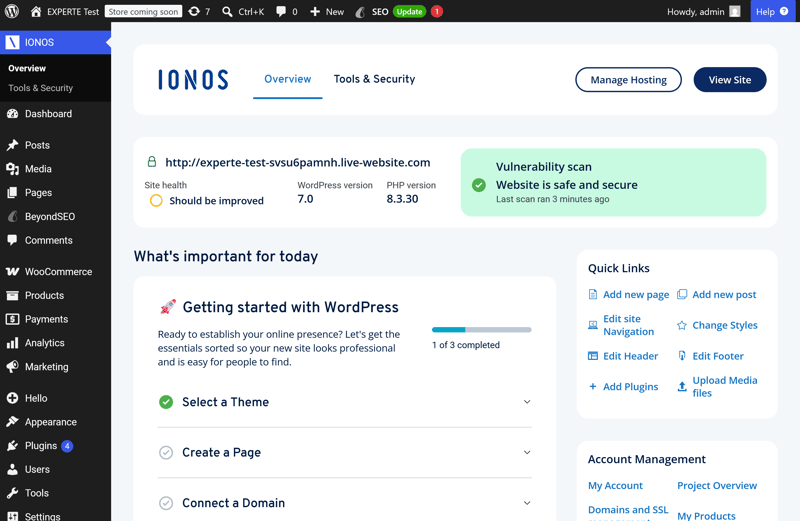
The IONOS overview page in the WordPress backend.
Like many other providers, IONOS installs several plugins without asking—seven during our testing. Alongside its own in-house extensions, this includes larger extensions like WooCommerce or BeyondSEO.
That means IONOS makes a bigger mark on a fresh WordPress install than many other hosts. How many extensions get preinstalled depends on the plan you choose.
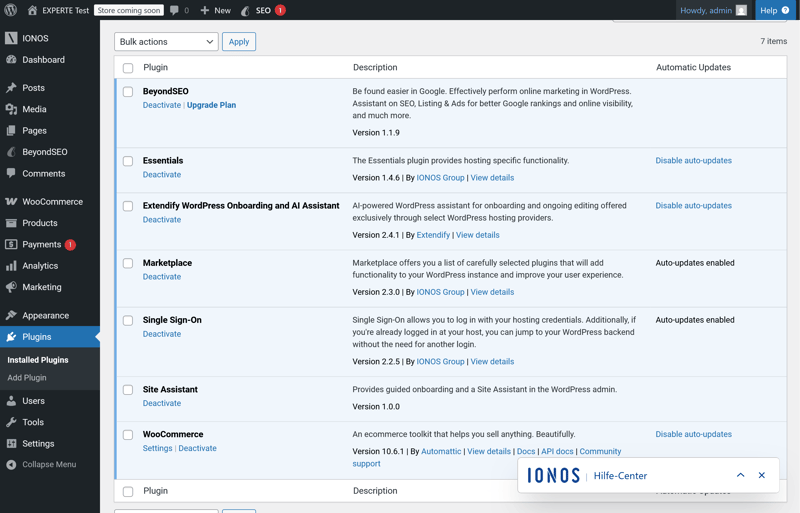
IONOS installs a lot of plugins by default
Unlike most managed WordPress hosts that help migrate your existing sites to their platform, IONOS does not offer an automated migration tool. You will need to move your site manually or use a migration plugin. Check out our WordPress migration tutorial to learn the best way to do it.
A clean dashboard with a few rough edges
IONOS uses a central dashboard with a modern, uncluttered design. Generous white space and large controls make navigation intuitive, ensuring even beginners will feel comfortable right away.
Because there's no sidebar, many features take several clicks to reach. The dashboard also feels sluggish in places. Even pages you've already opened often take a few seconds to load again. That's not a good sign for a hosting provider, and it foreshadows trouble in our performance test.
IONOS provides a dedicated dashboard for each website, allowing you to monitor your security status, storage usage, optimization score, and key metrics. You can also launch directly into your WordPress installation from this menu.
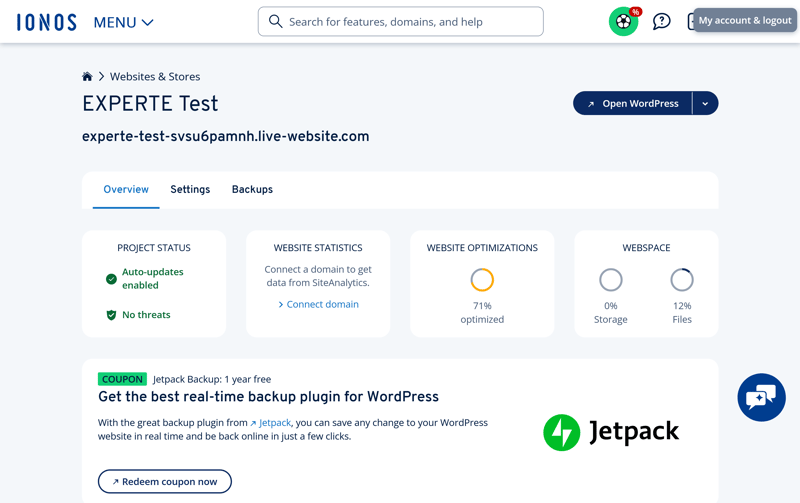
Website management with IONOS.
There is also a general hosting overview covering key elements like web space and databases. IONOS keeps website management cleanly separated from core technical settings, making it much easier to stay organized when managing multiple projects on the platform.
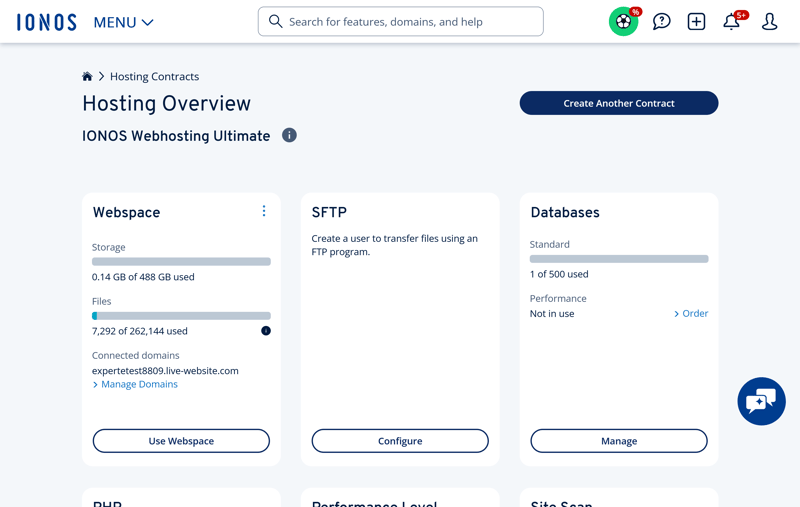
The separate hosting overview.
What remains genuinely annoying, however, is the constant promotion of IONOS products and paid add-ons throughout the customer area. These range from subtle hints to prominent ad banners.
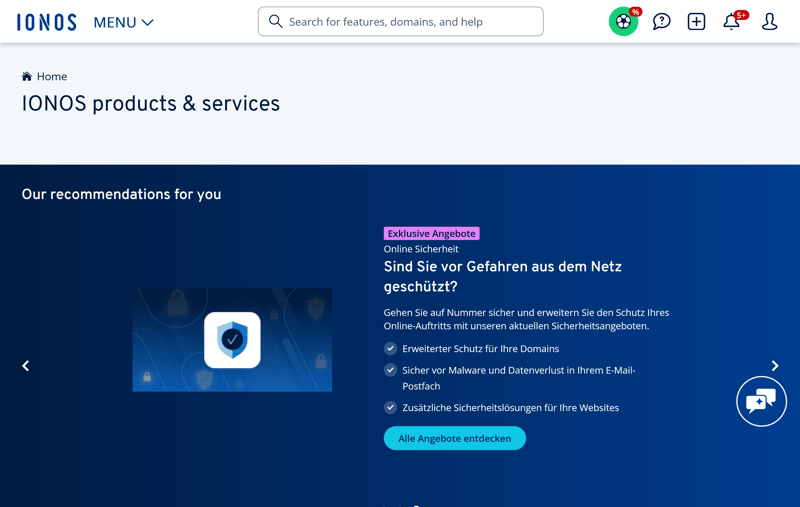
The IONOS dashboard is full of ads.

IONOS gets a lot right: setup is simple, the interface is clean, and the most important features are easy to find.
However, the high number of preinstalled plugins, the absence of a migration service, and the persistent self-promotion leave the impression that IONOS designs its platform around its own priorities rather than the user's.
None of these drawbacks is a dealbreaker on its own, but together, they make site management feel unnecessarily complicated.
Technology & Features
| Server stack & protocols |
| 1.5/2 |
| PHP |
| 5.5/8 |
| Caching & CDN |
| 2.5/5 |
| Features |
| 2/5 |
The technical setup behind a WordPress hosting plan tells you far more than any marketing pitch. It reveals how modern a provider's infrastructure actually is and what level of real-world performance you can expect. IONOS relies on up-to-date hardware, though it cuts corners on a few key features.
Modern hardware, older server technology
For its managed WordPress hosting, IONOS relies on high-speed NVMe SSDs. These perform much faster than traditional SSDs, significantly lowering access times for both files and databases.
To manage WordPress content, IONOS utilizes MariaDB. This database system serves as a well-established, high-performance alternative to MySQL and remains widely used throughout the web hosting industry.
 IONOS |  Bluehost |  Cloudways |  DreamHost |  GoDaddy |  Hostinger |  Kinsta |  SiteGround |  WordPress.com |  WP Engine | |
|---|---|---|---|---|---|---|---|---|---|---|
Server locations | 2 countries | 9 countries | 8 countries | 3 countries | 3 countries | 11 countries | 21 countries | 7 countries | 19 countries | 12 countries |
Web server | Apache | Apache | NGINX | NGINX | NGINX | LiteSpeed | NGINX | NGINX | NGINX | NGINX |
Control Panel | Custom | cPanel | Custom | Custom | Custom | Custom | Custom | Custom | Custom | Custom |
Database | MariaDB | MySQL | MariaDB | MySQL | MySQL | MariaDB | MariaDB | MySQL | MariaDB | MySQL |
Storage type | NVMe | NVMe | SSD | NVMe | NVMe | NVMe | SSD | SSD | SSD | SSD |
| Protocols | ||||||||||
HTTP/2 | ✓ | ✓ | ✓ | ✓ | ✓ | ✓ | ✓ | ✓ | ✓ | ✓ |
HTTP/3 | ✗ | ✗ | ✗ | ✗ | ✗ | ✓ | ✓ | ✗ | ✓ | ✓ |
The choice of web server is less convincing. IONOS still runs on Apache. While this web server is mature and offers broad compatibility, modern alternatives like NGINX or LiteSpeed typically deliver better performance under heavy load.
IONOS also lags behind several competitors regarding supported protocols. HTTP/3 is not available yet. On mobile or unstable connections, HTTP/3 can significantly improve load times and responsiveness, an area where other providers have already moved ahead.
Server location: Germany
Managed WordPress hosting for IONOS customers runs exclusively on servers based in Germany. The company says it operates around 40 data centers worldwide, but for managed WordPress, you can't choose a different server location.

Managed hosting runs on servers in Germany.
Up-to-date PHP version, but limited flexibility
PHP is the backbone of every WordPress site. It processes page requests, executes plugins, and retrieves content from the database. The specific PHP version you run, alongside your allocated resources, directly impacts your site's speed, compatibility, and overall stability.
IONOS supports up to PHP 8.4, which is fully sufficient for recent WordPress releases and virtually all plugins. However, PHP 8.5 is already available, and IONOS does not support it yet.
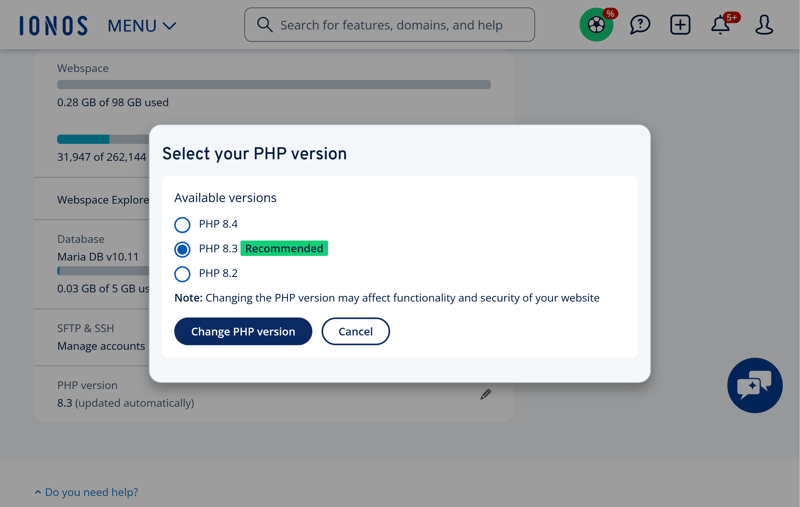
You pick the PHP version yourself.
The downside? As a managed hosting customer, you can’t tweak PHP settings through the IONOS dashboard. That’s frustrating for experienced users.
Still, IONOS sets a solid baseline. The default memory limit is 512 MB, plenty for most WordPress sites. The maximum execution time of 360 seconds is also generous, so even large updates or imports should run smoothly.
The 128 MB upload limit is a little tight, though. It’s fine for images or documents, but larger backups or media files might not upload without extra steps.
IONOS | Bluehost | Cloudways | DreamHost | GoDaddy | Hostinger | Kinsta | SiteGround | WordPress.com | WP Engine | |
|---|---|---|---|---|---|---|---|---|---|---|
PHP version configurable | ✓ | ✓ | ✓ | ✓ | ✓ | ✓ | ✓ | ✓ | ✓ | ✓ |
PHP settings configurable | ✗ | ✓ | ✓ | ✓ | ✗ | ✓ | ✗ | ✓ | ✗ | ✗ |
Max PHP version | 8.4 | 8.5 | 8.4 | 8.5 | 8.3 | 8.5 | 8.5 | 8.5 | 8.4 | 8.4 |
Max memory limit | 512 MB | unlimited | unlimited | 768 MB | 512 MB | 3072 MB | 512 MB | 768 MB | 512 MB | 512 MB |
Max execution time | 360s | unlimited | unlimited | unlimited | 180s | unlimited | 300s | 120s | 850s | 43300s |
Max upload size | 128 MB | unlimited | unlimited | 1028 MB | 1024 MB | 3072 MB | 128 MB | 256 MB | 2048 MB | 50 MB |
Limited caching, CDN for an extra fee
Caching is one of the most critical factors in WordPress performance. It temporarily stores static content so the server does not have to rebuild each page from scratch for every visit. The more effectively a host handles caching at the infrastructure level, the less you need to rely on third-party plugins or external optimization services.
IONOS provides basic server-side caching, and its automatic cache purging operates reliably. When you update your site, visitors will not see outdated content. Beyond these core basics, however, its built-in caching capabilities remain fairly limited.
IONOS | Bluehost | Cloudways | DreamHost | GoDaddy | Hostinger | Kinsta | SiteGround | WordPress.com | WP Engine | |
|---|---|---|---|---|---|---|---|---|---|---|
Server side caching | ✓ | ✓ | ✓ | ✓ | ✓ | ✓ | ✓ | ✓ | ✓ | ✓ |
Object Caching | ✗ | ✓ | ✓ | ✓ | ✓ | ✓ | ✗ | ✓ | ✓ | ✓ |
CDN | ✗ | ✓ | ✗ | ✓ | ✓ | ✓ | ✓ | ✓ | ✓ | ✓ |
Cache exclusions | ✗ | ✓ | ✓ | ✗ | ✗ | ✓ | ✓ | ✓ | ✗ | ✓ |
Automatic cache purge | ✓ | ✓ | ✓ | ✓ | ✓ | ✓ | ✓ | ✓ | ✓ | ✓ |
IONOS offers little beyond that. Object Cache isn't available at all, not even as a paid add-on. You also can't set custom cache exceptions, so there's no way to exclude specific pages or sections from caching.
A content delivery network (CDN), which speeds up load times by distributing static content like images across multiple servers, isn't included in managed plans. At IONOS, you'll have to pay extra for it.
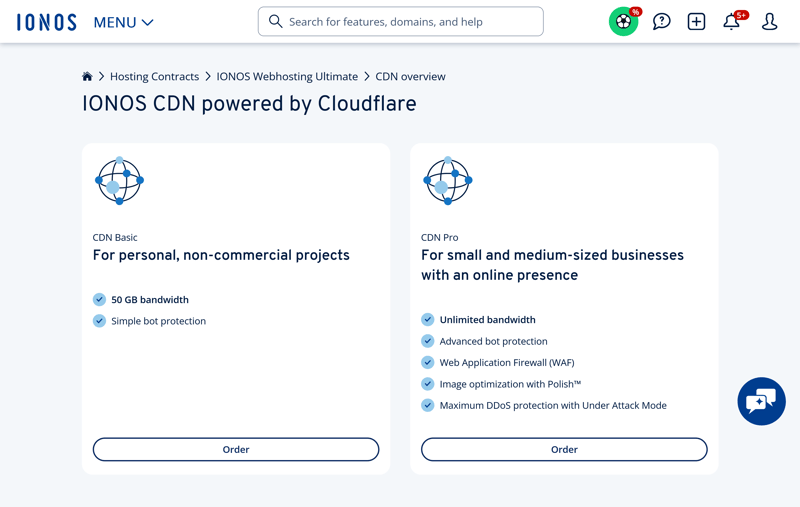
IONOS also does not pre-install any WordPress caching plugins—whether proprietary or third-party—nor does it offer caching management controls within its hosting dashboard. If the built-in server-side caching falls short, configuring and optimizing caching is entirely left to you.
Overall, IONOS falls short on caching compared to nearly every other managed WordPress host we have tested.
Other features of IONOS WordPress hosting
We can't cover every feature in detail, but here are a few more things IONOS WordPress hosting customers get:
WP-CLI, SSH, and SFTP access: Access your websites through secure SSH and SFTP connections. The WordPress command-line tool WP-CLI is also available.
Web FTP: The "Webspace Explorer" in the IONOS dashboard lets you access your WordPress files directly. You can even edit the wp-config.php file without any hassle.
Domain and email: Every plan includes one free domain and at least one email address for the first year, but only if you sign up for a 12-month term.
Website stats: The IONOS analytics section offers useful insights into visitor behavior to help you grow your reach.
Website optimization: IONOS scans your website and suggests ways to improve performance and security. Unfortunately, many of these recommendations push paid add-ons.
No list of banned WordPress plugins: Unlike many hosts, IONOS doesn’t publish a list of restricted WordPress plugins. That said, it may still block certain plugins from being installed.
No WordPress Multisite: IONOS does not allow Multisite installations in its managed plans.
IONOS covers the basics but falls short on extras. Its feature set is enough to keep WordPress running smoothly, yet true managed WordPress hosting should offer more, particularly regarding optimization and performance. IONOS simply skimps too much on caching.
In many ways, the service feels like traditional hosting with a "managed" label rather than a platform built specifically for WordPress optimization. It can work well for simple projects, but as your requirements grow, the platform's limitations quickly become clear.
Security
| Free SSL | No | 0/2 |
| Server protection |
| 3/4 |
| WordPress updates |
| 2/2 |
| Backups |
| 1/2 |
Security in WordPress hosting extends beyond individual features. What truly matters is whether the host proactively mitigates key risks, alerts you promptly, and provides assistance during an emergency. IONOS addresses many essential areas, though not all security features are included by default in its managed WordPress plans.
Only one SSL certificate included
IONOS includes one free SSL certificate with each managed WordPress plan. The certificate installs automatically as soon as you connect a domain, making your website accessible over HTTPS without requiring manual setup.
If you require additional certificates, however, you will need to pay extra for them. This stands in contrast to most other managed WordPress hosts we have evaluated, which provide unlimited free SSL certificates.
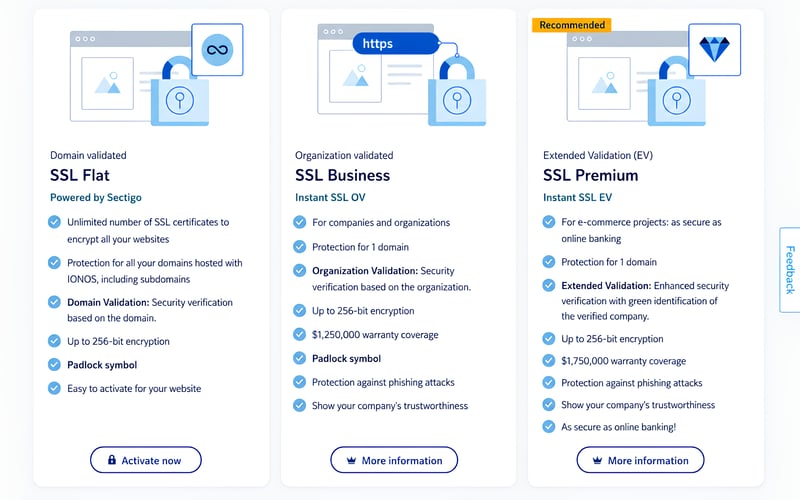
You’ll need to purchase additional SSL certificates from IONOS.
To guard against attacks, IONOS uses a firewall and DDoS protection. The web application firewall runs in the background, scanning incoming and outgoing traffic in real time to block common web application attacks.
Better security with SiteLock and malware scanning
IONOS integrates SiteLock, a third-party security service, into the customer dashboard. From there, you can monitor your website's overall security status and view detailed risk ratings across various vulnerability areas.
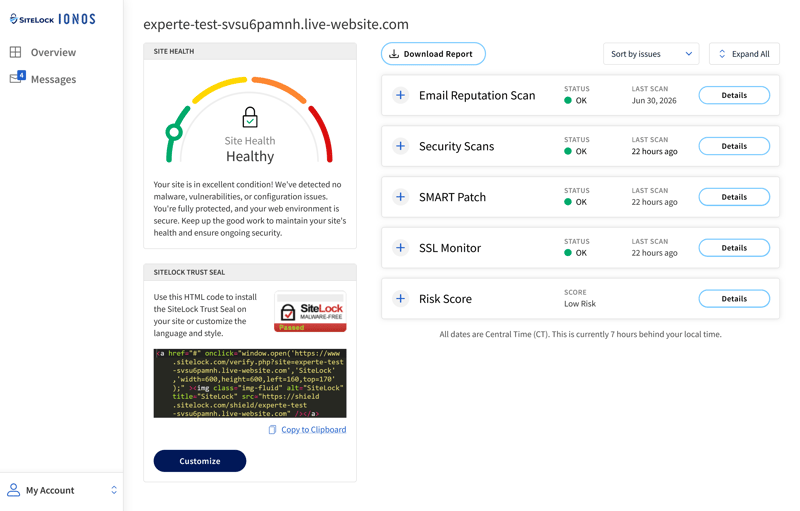
SiteLock shows your website’s health status.
Malware scanning is also included. IONOS automatically checks your website for malicious software. Detection comes with every plan, but removing malware is only included in higher-tier plans.
That's an important distinction. Scans help you spot problems early, but if malware turns up, you may still need to take action yourself, seek help, or upgrade your plan.
IONOS also includes a vulnerability scanner in the WordPress dashboard. It checks the WPScan database daily and alerts you if any installed plugins or themes have known security flaws.
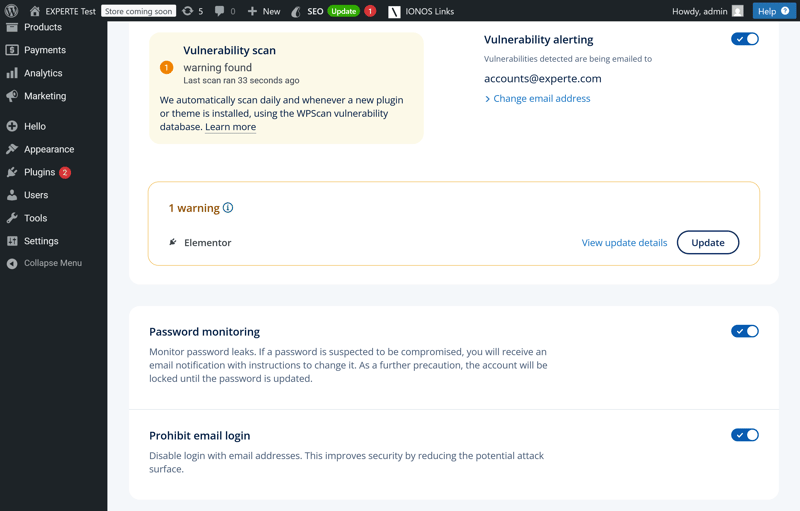
The vulnerability scanner flags Elementor as a risk.
You can also generate a SiteLock trust seal to show visitors your website is secure, and you can download a security report.
Confusing automatic backups
IONOS is vague regarding its backup retention policy. The official documentation cites conflicting retention periods, listing seven days in some sections and fourteen in others. Clear upfront information is critical so users know exactly how far back emergency restore points remain available.
In practice, the backup history proves even more erratic. While IONOS does generate automatic backups, they followed no predictable or advertised schedule during testing.
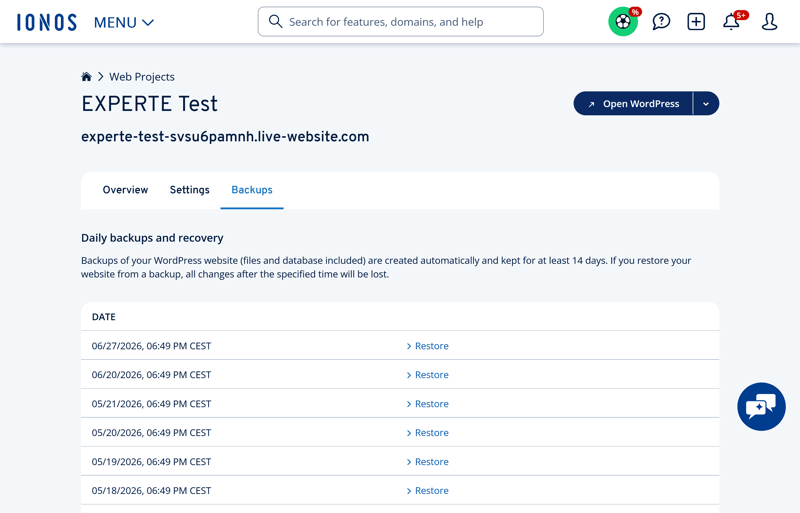
IONOS creates backups irregularly.
At first, the host creates daily backups as expected. Then a long gap follows, after which only weekly restore points appear. Even when queried, support could not clarify the underlying logic behind this behavior.
Flexible settings for WordPress updates
Updates represent a vital line of defense for WordPress security, as outdated core files, themes, and plugins are among the most common vulnerabilities targeted by attackers.
A managed host should deliver reliable automated updates while granting users clear control over the schedule and scope. To handle this, IONOS includes a dedicated update manager within the account dashboard.
The tool proves surprisingly versatile. You can set the WordPress core, active theme, installed plugins, and even the PHP version to update automatically—configuring each component independently. Rather than forcing a blanket update schedule, this flexibility lets you focus automation on your most critical areas.
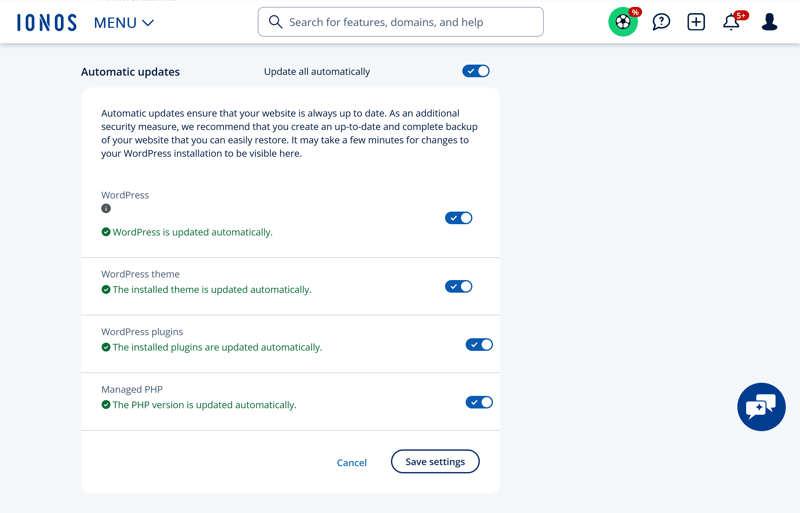
The IONOS update manager.
Plugin-level update settings, which some hosts provide, offer a higher degree of granularity. These allow you to set specific plugins to update automatically while excluding others that might be prone to breaking.
IONOS does not perform proprietary update checks or manual server-side maintenance. Instead, the provider simply lets you configure your preferences for WordPress auto-updates, leaving WordPress itself to process and execute the actual updates in the background.
IONOS | Bluehost | Cloudways | DreamHost | GoDaddy | Hostinger | Kinsta | SiteGround | WordPress.com | WP Engine | |
|---|---|---|---|---|---|---|---|---|---|---|
Unlimited free SSL certificates (on all plans) | ✗ | ✓ | ✓ | ✓ | ✗ | ✓ | ✓ | ✓ | ✓ | ✓ |
Firewall | ✓ | ✓ | ✓ | ✓ | ✓ | ✓ | ✓ | ✓ | ✓ | ✓ |
DDoS protection | ✓ | ✓ | ✓ | ✓ | ✓ | ✓ | ✓ | ✓ | ✓ | ✓ |
Login protection | ✗ | ✓ | ✓ | ✗ | ✓ | ✗ | ✓ | ✓ | ✓ | ✗ |
Malware scanning | ✓ | ✓ | ✓ | ✓ | ✓ | ✓ | ✓ | ✗ | ✓ | ✓ |
Auto updates WordPress core | ✓ | ✓ | ✗ | ✓ | ✓ | ✓ | ✗ | ✓ | ✓ | ✓ |
Auto updates WordPress plugins/themes | ✓ | ✓ | ✗ | ✓ | ✓ | ✓ | ✗ | ✓ | ✓ | ✗ |
Daily automated backups (on all plans) | ✓ | ✗ | ✓ | ✓ | ✗ | ✗ | ✓ | ✓ | ✗ | ✓ |
Min. 14 day backup retention (on all plans) | ✗ | ✗ | ✓ | ✓ | ✓ | ✓ | ✓ | ✓ | ✗ | ✓ |
IONOS catches many security risks early and helps mitigate common WordPress threats. However, that alone does not constitute a truly comprehensive security framework.
What matters most is how the system responds when an incident occurs. Malware removal is restricted to higher-tier plans, backup messaging remains inconsistent, and backup history proved unreliable during testing. IONOS demonstrates clear weaknesses in the precise areas needed most during an emergency, leaving critical questions unanswered.
Performance
| Response speed (TTFB) | 0.39 s | 8/10 |
| TTFB outliers | 1.02 % | 1/5 |
| Pagespeed (LCP) | 1.28 s | 0/10 |
| Uptime | 98.92 % | 0/5 |
For our performance test, we set up IONOS the same way we do for every other managed WordPress host we compare. We built an identical WordPress demo page on a plan costing around $20 using the Elementor page builder, then monitored it over six weeks.
We don't just measure loading times. We also track uptime, stability during regular operation, and how well the built-in caching features actually work. You can find a detailed explanation of our testing method in our comparison of the fastest WordPress hosts.
For our rating, we look at four key metrics:
- 1.
Response speed (TTFB): How quickly does the server respond to the initial page request?
- 2.
Slow responses (outliers): How much does server speed vary during unusually slow requests?
- 3.
Pagespeed (Largest Contentful Paint): How fast does the most important visible content on the site appear?
- 4.
Uptime: How reliably does the website stay online without downtime?
Response speed has room for improvement
Time to First Byte (TTFB) measures how quickly a server responds to a request before any content is transferred. Because this test runs without caching, it serves as a reliable metric for evaluating raw server performance.
IONOS averages 0.387 seconds, putting it in 10th place out of the 14 WordPress hosts we tested:
| Response time (TTFB) | |
|---|---|
| 0.186 s |
| 0.23 s |
| 0.232 s |
| 0.264 s |
| 0.266 s |
| 0.271 s |
| 0.305 s |
| 0.387 s |
| 0.631 s |
| 0.819 s |
So most other providers respond faster. Still, the result is decent on its own.
Frequent outliers
We count any page load where the first server response takes longer than one second as an outlier. With IONOS, this happens on slightly more than one out of every 100 page loads. That outlier rate of 1.02% puts the provider in 9th place out of the 14 hosts we tested.
| TTFB outlier | |
|---|---|
| 0.09 % |
| 0.1 % |
| 0.2 % |
| 0.28 % |
| 0.41 % |
| 0.51 % |
| 0.54 % |
| 1.02 % |
| 1.07 % |
| 2.22 % |
Last place for Pagespeed
Things get really disappointing when it comes to Largest Contentful Paint (LCP). This metric shows when the largest visible piece of content on a page appears – the moment when most visitors feel like the website has finally loaded and is ready to use.
At 1.282 seconds, IONOS lands in last place in our comparison. Pages load noticeably slower here than with any other host we tested, and the gap to the top performers is significant.
| Pagespeed (LCP) | |
|---|---|
| 0.46 s |
| 0.519 s |
| 0.573 s |
| 0.612 s |
| 0.683 s |
| 0.683 s |
| 0.782 s |
| 0.792 s |
| 0.949 s |
| 1.282 s |
Last place in uptime
IONOS falls behind the competition in uptime, too. With an uptime of just 98.920%, it lands in last place here as well. Uptime measures how reliably a website stays online. The lower the number, the more likely visitors are to see an error message instead of your site.
| Uptime | |
|---|---|
| 100 % |
| 100 % |
| 100 % |
| 100 % |
| 100 % |
| 99.992 % |
| 99.977 % |
| 99.976 % |
| 99.932 % |
| 98.92 % |
This result is a red flag for managed WordPress customers. A managed plan should give you a highly reliable platform, so you don't have to scramble to fix outages yourself. That makes it all the more disappointing when reliability is exactly what's missing.
The benchmark results paint a clear picture. IONOS fails to impress in any of the tested categories, finishing last in two of them.
This does not mean WordPress websites on IONOS are unusable or slow across the board. However, when compared directly to competing managed WordPress hosts, the performance gap is significant. If you have high expectations for speed, efficiency, and reliability, you are better off choosing a different provider.
Support
| Documentation |
| 1/2 |
| Support channels |
| 1/2 |
| Speed and quality |
| 1/3 |
| Ratings on review platforms |
| 2/3 |
When something goes wrong, quality support is worth its weight in gold. What matters most is whether you can quickly find the right answers and, if needed, reach a knowledgeable support agent.
IONOS offers several support channels, though fewer overall than many other managed WordPress hosts. Alongside a help center, you will find an AI chatbot and a phone hotline. However, there is no standard live chat, you cannot submit support tickets on your own, and IONOS no longer actively advertises email support.
A comprehensive help center
The help center contains a large volume of articles, though only about 25 focus specifically on WordPress. These guides are easy to follow and walk you through basic tasks step-by-step. For more advanced topics, however, they often lack sufficient detail and helpful screenshots.
There is also a practical drawback: because IONOS sells many different hosting products, it is not always immediately clear whether a given article applies to your specific plan.
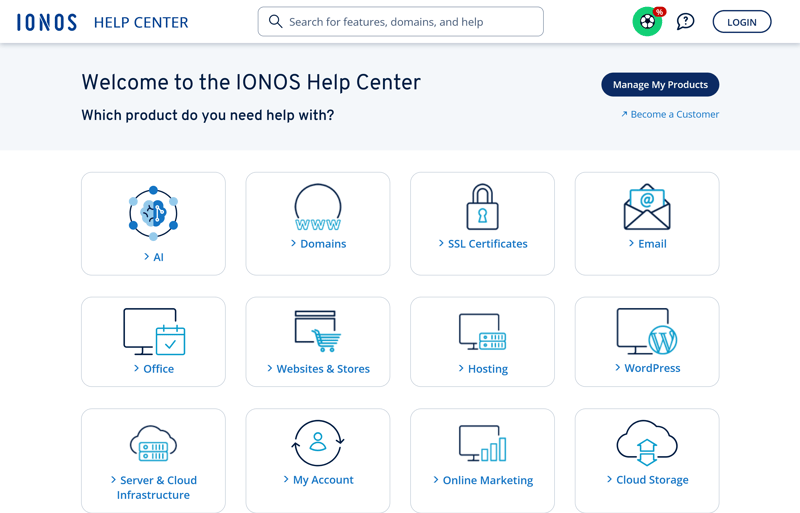
The IONOS help center is packed with articles.
AI chat can’t be trusted
IONOS’s AI support chat disappoints. It rarely gives truly useful answers and too often redirects you to call the hotline instead. At times, it even references menus or settings that do not exist in the IONOS dashboard. Currently, the chatbot provides little real value—a frustrating limitation, especially given the absence of live chat with actual support agents.
Personal advisor remains out of reach
IONOS handles phone support differently than most competitors by assigning you a dedicated personal advisor who is meant to handle your calls when available. In practice, however, you shouldn't count on reaching them; in our testing, we never once connected with our assigned advisor.
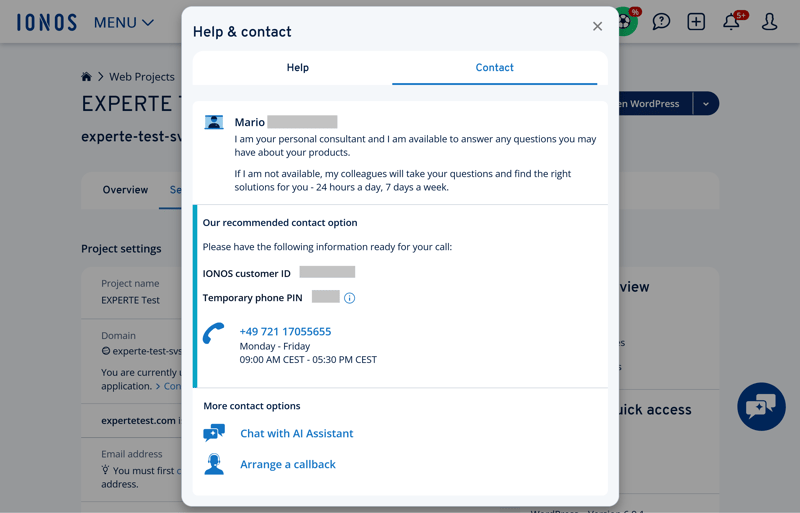
IONOS gives you a personal advisor, but whether you’ll actually reach them is another question.
Beyond that, phone support still fell short. Our issue could not be resolved on the spot, and despite promises that support would follow up via email, we never received a response.
What customers say about IONOS support
On review sites, IONOS support earns high marks for accessibility. Many customers report fast, reliable help with straightforward issues.
The complaints start when things get more technical or administrative. Some customers say they were bounced between IONOS departments. Others ran into billing or cancellation headaches.
IONOS leans heavily into its phone support network. That setup wouldn't be an issue if alternative contact channels were equally reliable, but they aren't.
The help center adequately covers standard questions yet frequently falls short for WordPress-specific troubleshooting. The AI chat proved unimpressive in testing, meaning if your issue isn't resolved quickly, you will almost certainly end up on the phone. If you prefer getting help through other channels, you are largely out of luck.
Costs
| 1 project, 10 GB storage | $5.50 | 3/3 |
| 10 projects | $55.00 | 0/3 |
| 50 GB of storage | $6.00 | 3/3 |
| Fair pricing |
| 4/6 |
IONOS offers four managed WordPress plans, each with clear upgrades. The main differences come down to storage space, the number of email addresses, and security features.
All plans include NVMe SSD storage, unlimited traffic, and automatic WordPress updates. Each plan supports only one WordPress installation.
Start: The most affordable plan, built for simple WordPress websites with modest storage needs. It includes 25 GB of storage, one email address, vulnerability and malware scans, and automatic backups for seven days.
Grow: This plan doubles the storage to 50 GB and includes five email addresses. Otherwise, it’s essentially a larger version of the Start plan.
Boost: This plan increases storage to 75 GB and offers ten email addresses. The key security upgrade: malware isn’t just detected automatically, it’s also removed.
Ecommerce: The largest plan is designed for ecommerce projects using WooCommerce or other large WordPress websites. It includes 100 GB of storage, ten email addresses, and malware scan and repair.
Here’s an overview of the IONOS plans:
| Start | Grow | Boost | |
|---|---|---|---|
| Monthly price | from $3.00 | from $5.00 | from $7.50 |
| Contract period (months) | 1 - 36 | 1 - 36 | 1 - 36 |
| Included | |||
| WordPress projects | 1 | 1 | 1 |
| Storage | 25 GB | 50 GB | 75 GB |
| Storage type | NVMe | NVMe | NVMe |
| Domains | 1 | 1 | 1 |
| Email accounts | 1 | 5 | 10 |
| Databases | 1 | 1 | 1 |
| Bandwith | unlimited | unlimited | unlimited |
| SSL certificates | 1 | 1 | 1 |
| Backups | |||
| Backup interval | Daily | Daily | Daily |
| Backup retention | 7 days | 7 days | 7 days |
| Manual backups | ✓ | ✓ | ✓ |
| Features | |||
| External domains | ✓ | ✓ | ✓ |
| SSH access | ✓ | ✓ | ✓ |
| CDN | ✗ | ✗ | ✗ |
| Cronjobs | ✗ | ✗ | ✗ |
| Staging environment | ✗ | ✗ | ✗ |
IONOS pricing compared
Comparing WordPress hosting plans is tricky, since every provider structures its pricing differently and varies in technology, resources, and features. For a fair comparison, we looked at the effective monthly cost across three common use cases:
1 WordPress project with 10 GB storage
10 WordPress projects
50 GB storage
Here’s how IONOS stacks up in each scenario:
| 1 project, 10 GB storage | 10 projects | 50 GB storage | |
|---|---|---|---|
| $3.49 | $4.49 | $4.49 |
| $5.50 | $55.00 | $6.00 |
| $6.49 | $64.90 | $14.47 |
| $6.50 | $65.00 | $20.00 |
| $7.49 | $12.49 | $12.49 |
| $8.49 | $8.49 | $8.49 |
| $17.99 | $179.90 | $24.99 |
| $24.00 | $24.00 | $24.00 |
| $32.08 | $119.17 | $302.50 |
| $41.67 | $187.50 | $283.33 |
IONOS is a strong choice if you only need hosting for a single WordPress website. For small projects with modest storage needs, it ranks among the most affordable options available.
However, the dynamic shifts when managing multiple WordPress sites. Because each managed plan accommodates only a single installation, expenses accumulate rapidly. This structure makes IONOS less appealing for agencies, developers, or anyone overseeing several distinct websites.
Conversely, if you simply require additional storage for a single site, IONOS becomes a solid contender again. Its 50 GB tier stands out as one of the more budget-friendly options on the market, making it well-suited for larger, media-heavy, or content-dense websites.
The fine print at IONOS
Before signing up, keep in mind a few key details and limitations we noticed during our test:
No bandwidth limits: IONOS doesn’t cap server bandwidth or monthly visits. In fact, the provider advertises unlimited traffic without a fair-use policy.
Higher renewal costs: After the first term, prices jump significantly. The low introductory rates only apply to your first contract year. If you choose a monthly plan, you’ll pay the higher rate from the start.
Free domain included: All plans include a free domain for the first 12 months if you sign up for a one-year term.
Free backup restoration: You can restore existing backups at no extra cost.
Monthly plans available: You can choose between a monthly plan or a 12-month contract.
No hidden fees: There are no hidden charges, though some extra features or optional upgrades may cost more.
Money-back guarantee: All plans come with a 30-day money-back guarantee.
IONOS hits a sweet spot on price for single WordPress websites. You get generous storage and unlimited traffic at a highly competitive starting rate, with extra fees kicking in only if you require add-ons like additional SSL certificates, a CDN, or enhanced malware protection.
However, if you plan to run multiple WordPress sites, the overall value declines rapidly. Because each managed plan accommodates only a single installation, expenses accumulate quickly. Be sure to keep an eye on renewal pricing as well: the low introductory rate applies strictly to your first contract term.
Final Verdict: Low Cost Isn’t Enough
The main selling point for IONOS managed WordPress hosting is its price. If you only need to host a single WordPress site and want to minimize costs, IONOS is one of the most attractive options available.
However, managed hosting should do more than just save you money; it should also save you time and deliver a fast, reliable foundation for your WordPress projects. On these fronts, IONOS only partially delivers. Performance is particularly disappointing: in our benchmarking, the provider ranked last in two key categories—page load speed and uptime.
Ultimately, the low price fails to offset these critical drawbacks. Many competitors deliver richer feature sets, greater ease of use, and significantly stronger performance, often at comparable price points.

IONOS Customer Reviews
How do IONOS customers rate the provider's WordPress hosting? We've gathered ratings from some of the biggest review platforms for you:
Affordable entry point
Customers consider IONOS reasonably priced, especially thanks to its (time-limited) introductory rates.Many products in one place
Customers appreciate that IONOS bundles domains, hosting, email, WordPress, website builder, servers, and cloud services in one place. That means you don't have to juggle accounts with several providers.Easy management
Many customers find the account clear and easy to navigate. Domains, hosting, email, contracts, and invoices all live in one central place.Trustworthy provider
Trust matters a lot to many customers. Thanks to its size and long track record, IONOS comes across as more trustworthy than small budget providers. German customers also see the company's German server location as a plus.
Not built for demanding projects
Some customers see IONOS as a solution for standard websites. If you need extensive optimization options or high-performance managed WordPress hosting, a specialized provider is a better fit.Annoying upselling
Upselling during checkout is a common complaint. Many users report being pushed toward aggressively marketed IONOS products.Short backup retention
Customers criticize that IONOS keeps automatic backups for only seven days on managed plans. If you spot a problem later, you might not have a suitable restore point.Features locked behind paywalls
A common complaint is the sheer number of paid add-ons. Features that come standard with other managed WordPress hosts must be booked separately at IONOS, which quickly erodes the appeal of the low starting price.Inconsistent support quality
Alongside positive experiences, the support team draws notable criticism. Many customers report unclear responsibilities, frequent transfers between departments, and long resolution times.
Here's an overview of the reviews:
IONOS Alternatives
Not sure IONOS is right for your project? One of these alternatives might be a better fit:
More affordable than IONOS
Hostinger is a viable option if you want an affordable provider with more WordPress features. It also stays budget-friendly when you run multiple projects.More powerful than IONOS
SiteGround is worth considering if performance and reliability matter more to you than the lowest price. Its managed WordPress hosting is technically much more capable and delivered better results in our tests.More flexible than IONOS
Cloudways is the better choice if you want to customize your hosting resources. Instead of rigid plans, you pick the server power and infrastructure that match exactly what your project needs.
Here are the five best alternatives to IONOS: