Managed WordPress Hosting in 2026: Benefits & Best Providers


Let’s be honest: running a WordPress site shouldn’t require spending hours troubleshooting errors, fine-tuning server performance, or configuring complex security protocols. If that doesn't sound appealing to you, managed WordPress hosting may be the exact solution you need.
In this article, we'll explore the key advantages of managed WordPress hosting and reveal which providers earned our top recommendations.


What Is Managed WordPress Hosting?
Managed WordPress hosting is a specialized hosting solution designed specifically for WordPress. How does it differ from regular web hosting? Here’s the breakdown:
With regular web hosting, providers essentially give you server space and a few basic tools to manage your website. Everything else is up to you: software updates, backups, performance tweaks, and security.
Managed hosting works differently. Here, the provider handles many of those technical tasks for you. Instead of wrestling with server configurations, you can focus on what matters most: growing your business, creating content, or refining your products.
Managed WordPress hosting takes it a step further. The entire environment is fully optimized for WordPress. Servers, caching layers, security tools, and automatic updates are all fine-tuned for the platform. As a result, your site typically runs faster, more securely, and more reliably than on standard web hosting.
Managed WordPress hosting handles much of the technical workload for you while optimizing your site’s overall performance. While that comes with plenty of benefits, there are also a few trade-offs to keep in mind.
Pros and Cons of Managed WordPress Hosting
Easy, user-friendly management
A typical hosting backend can quickly overwhelm beginners. Good managed hosts offer clean, intuitive dashboards that make site administration simple, even if you have little to no technical experience.Quick 1-click installation
For newcomers, setting up WordPress for the first time can be a hurdle. With managed hosting, installation usually takes just a single click.Strong technical support
Dedicated, platform-specific support is a huge advantage of managed hosting. You get direct access to experienced WordPress experts whenever you hit a snag.Built-in performance optimization
Managed hosts fine-tune their server infrastructure exclusively for WordPress. They also include performance features like server-side caching and content delivery networks (CDNs).Comprehensive security measures
You don't have to manage security on your own. Advanced protection—such as web application firewalls, malware scans, and automatic threat mitigation—comes pre-configured.Automatic backups
Losing your website is every owner’s worst nightmare. But with a recent backup, recovering your data is much easier. Managed providers create regular backups automatically, so you can restore your site if something goes wrong.Automatic updates
Managed hosts can also automate updates for WordPress itself and WordPress plugins. This helps you avoid the security risks of outdated software.
Higher costs
Because managed WordPress hosting includes hands-off maintenance and specialized tools, it commands a higher price tag than basic web hosting.Less control
Since the provider manages the server environment, you have limited root access and fewer low-level configuration choices. If you prefer tweaking server files yourself, these guardrails might feel restrictive.Plugin restrictions
You also have less control over plugins with managed hosting. Many providers block certain WordPress plugins, often for security or compatibility reasons.
Best Managed WordPress Hosting: 14 Top Providers Compared
Decided that managed WordPress hosting is the right choice for your site? The next step is choosing the best host for your specific project. We evaluated 14 leading providers and highlighted our top recommendations. Here is a quick overview of our top picks:
Hostinger: The EXPERTE.com Test Winner

Hostinger* is a Lithuanian hosting provider offering web hosting, VPS solutions, and specialized managed WordPress plans. It is equally well-suited for beginners running a single site and for users managing extensive multi-site setups.
What we like about Hostinger
Hostinger’s biggest selling point is its exceptional value for money. Even entry-level plans come with generous resource allocations and key managed WordPress capabilities.
The platform also streamlines WordPress management. Setup takes just minutes, and administering multiple websites requires zero server expertise. It remains approachable for newcomers while providing enough headroom for scaling projects.
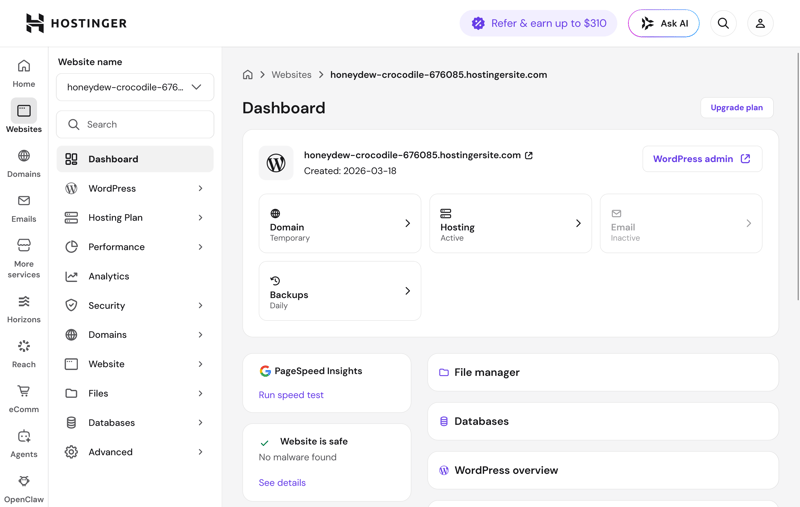
Managing websites with Hostinger is simple.
Hostinger also delivers impressive technical performance. It finished first in our page speed testing while maintaining robust security protocols. Instead of merely flagging malware, Hostinger automatically removes detected threats across all plans—a service many competitors charge extra for.
Who is Hostinger good for?
Hostinger is a solid choice if you want to run one or more WordPress websites on a budget. Freelancers, small businesses, and agencies get enough power for business websites or smaller online stores. The easy-to-use control panel also makes it a great choice for beginners.
What are Hostinger’s drawbacks?
The low introductory rates come with a caveat: renewal prices increase substantially after the initial contract term. Be sure to factor long-term renewal rates into your decision.
Another drawback involves back-up frequency: Hostinger’s cheapest plan includes only weekly automated backups. If you publish content daily, you may lack a recent restore point when an issue arises.
Additionally, Hostinger lagged slightly behind top-tier competitors in our uptime benchmark, recording a higher frequency of brief outages during testing.
Hostinger’s pros and cons:
Excellent value for money
Hostinger includes generous system resources and managed WordPress tools right out of the box, eliminating the need for expensive tier upgrades.Generous multi-site caps
Depending on your plan, you can host up to 100 WordPress websites under a single account. This makes it a cost-effective choice for agencies and multi-project managers looking to minimize per-site overhead.Hands-off maintenance
Hostinger automates WordPress software updates and handles malware removal in the background, freeing you from manual site maintenance.
Significant renewal price increases
Promotional pricing applies strictly to your first billing cycle. Once renewed, subscription rates jump substantially.Subpar uptime performance
Across six weeks of testing, Hostinger's uptime fell short of the top-performing hosts in our test field, which could pose a risk for mission-critical business portals or high-volume online shops.
SiteGround: A Well-Rounded Managed WordPress Hosting Provider

SiteGround* is a Bulgarian hosting company founded in 2004. Its product lineup includes shared web hosting, managed WordPress plans, WooCommerce solutions, and scalable cloud hosting.
What we like about SiteGround
SiteGround delivers a well-rounded hosting service, scoring high marks across core performance metrics. Users get fast page load speeds, reliable infrastructure, and strong built-in WordPress security features out of the box.
Everyday administrative tasks are straightforward. Setting up new WordPress installations takes just a few clicks, while automated backups and updates run seamlessly in the background without needing manual server configuration.
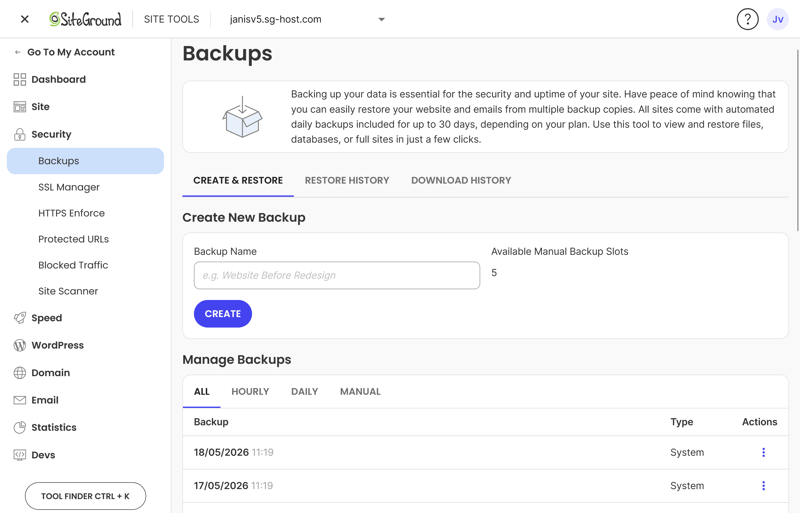
SiteGround lets you create backups automatically or manually.
SiteGround’s multi-site support on higher-tier plans offers clear advantages. Higher tiers allow hosting an unlimited number of WordPress sites under a single account, allowing costs to be spread across multiple projects. This provides flexibility compared to hosts that restrict users to a single site per plan even on higher tiers.
Who is SiteGround for?
SiteGround suits business-critical WordPress websites where stability matters most and site owners want to minimize hands-on server management. The platform offers performance and security protections for high-traffic company sites and client projects.
What are SiteGround’s drawbacks?
The primary limitation is post-promotional pricing. Like many managed hosts, SiteGround offers discounted introductory pricing for the first billing cycle, after which renewal rates increase substantially.
What are the pros and cons of SiteGround?
Reliable speed and uptime
Consistently fast page rendering and near-perfect network uptime make it well-suited for commercial websites.Comprehensive WordPress security
SiteGround protects WordPress at the hosting level and proactively addresses known vulnerabilities.Easy WordPress management
SiteGround simplifies setting up and administering WordPress. Core functions are intuitive and easy to locate within the dashboard, allowing beginners to manage their site effortlessly while keeping essential tools accessible for power users.
High renewal prices
Promotional rates rise sharply upon renewal, making SiteGround noticeably more expensive over time.Limited server customization
Because server settings are heavily automated, deep custom configurations are restricted. Advanced projects may need a flexible cloud host instead.
Cloudways: Flexibility for Demanding WordPress Projects

Cloudways* is a managed cloud hosting platform owned by DigitalOcean. Rather than operating its own hardware, Cloudways leverages the infrastructure of top cloud providers, allowing you to build a WordPress hosting package tailored directly to your requirements
What do we like about Cloudways?
Flexibility is Cloudways’ biggest advantage. You select the underlying cloud provider and determine how much server power you need. If your site's resource demands change, you can adjust performance settings with just a few clicks.
This structure is ideal for multi-site setups. Cloudways imposes no artificial limits on the number of WordPress websites you can install on a plan. You allocate your overall server resources as you see fit, eliminating the need to purchase separate plans for every new site.
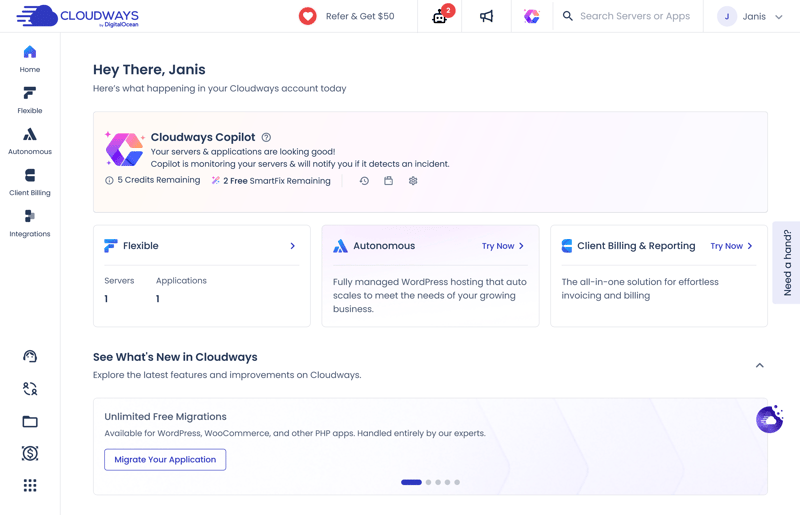
Cloudways works well for multiple projects.
The billing structure is equally flexible. Operating on a pay-as-you-go model with no fixed contract terms, you can scale up, downsize, or cancel your setup at any time without long-term lock-in.
Who is Cloudways for?
Cloudways is an excellent choice for users managing multiple WordPress sites or those who need precise control over server resources for specialized projects. However, complete beginners launching their first website may find the platform challenging, as navigating the setup requires a basic understanding of hosting infrastructure.
What are Cloudways’s drawbacks?
Compared to traditional managed WordPress hosts, Cloudways requires a more hands-on approach. Core WordPress, plugin, and theme updates are not automated out of the box, shifting routine maintenance to you. Neglecting these updates can leave your site exposed to security risks or software bugs.
What are the pros and cons of Cloudways?
Flexible server architecture
Cloudways avoids rigid plan structures by letting you select your cloud provider and scale server resources whenever your project requires it.Unlimited website hosting
You can host as many WordPress sites as your server resources allow, without buying a separate plan for every new project.Transparent pay-as-you-go billing
Cloudways operates without minimum contract terms, so you only pay for the exact server capacity and time you actually use.
Demanding setup process
Without basic hosting or server knowledge, setup and day-to-day management are noticeably more challenging than with standard WordPress plans.Manual update management
Cloudways does not automatically update WordPress, plugins, or themes, meaning you must manage regular site maintenance yourself.
Kinsta: Premium Hosting from WordPress Experts

Kinsta* is a California-based hosting provider founded in 2013. From the outset, the company has focused exclusively on managed WordPress hosting, offering high-performance solutions in the premium segment.
What we like about Kinsta
Kinsta stands out with a polished platform that makes running mission-critical WordPress sites simple. You'll feel right at home from your first login. The fast, intuitive dashboard presents even complex information clearly, helping you manage your site efficiently without drowning in technical details.
As a WordPress specialist, Kinsta reliably handles numerous technical tasks behind the scenes.
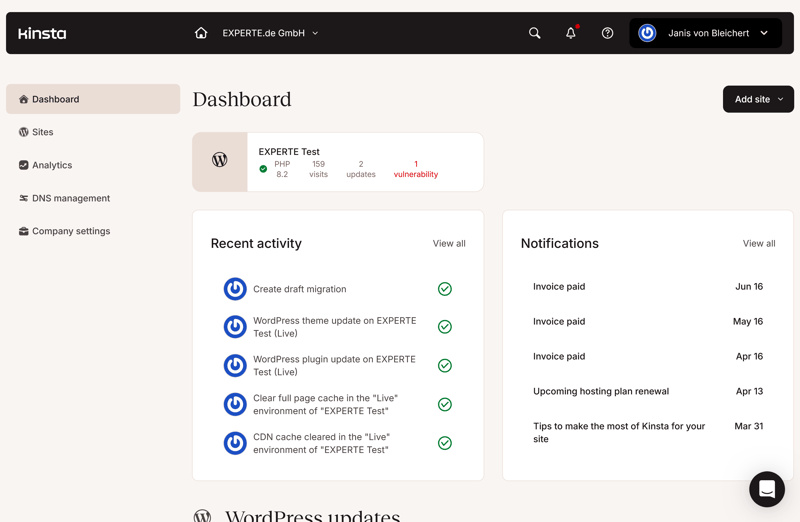
Kinsta’s dashboard is exceptionally well-designed.
The support is also top-notch. During our testing, we received quick, detailed responses from support agents who accurately diagnosed our WordPress issues. That makes all the difference when your website is critical to your business.
Who is Kinsta for?
Kinsta is a solid choice if your WordPress website is central to your business and technical downtime could quickly become costly. It's ideal for high-traffic business sites or large WooCommerce stores. For simple sites on a tight budget, the premium price tag usually isn't worth it.
What are Kinsta’s drawbacks?
Kinsta charges a steep monthly fee even for a single WordPress site, while storage and bandwidth allowances are relatively limited. You'll also need to purchase domains and email hosting separately through third-party providers.
What are Kinsta’s pros and cons?
Highly refined WordPress platform
Kinsta's hosting environment is built entirely around WordPress. Setup, management, and underlying technology work seamlessly together, allowing you to run even complex websites reliably.Expert support
If you run into technical issues, you won't end up with generic hosting support. The team knows WordPress inside out and provides fast, expert assistance.Free managed migration
Kinsta migrates existing WordPress websites for free. Their migration team handles the entire transfer, minimizing the risk of downtime or technical errors.
High cost per website
Even the entry-level plan costs more than higher-tier packages from other managed WordPress hosts. If you manage multiple websites, the monthly fees accumulate quickly.No all-in-one solution for domains and email
Kinsta focuses solely on hosting. You'll need to set up domains and email accounts through third-party providers.
Bluehost: Best for Multiple WordPress Websites

Bluehost* is a U.S.-based hosting provider and one of WordPress's officially recommended hosting partners. The company offers traditional web hosting, managed WordPress hosting, and specialized plans tailored for WooCommerce.
What we like about Bluehost
Bluehost's WordPress plans pack a lot of power. Instead of a stripped-down starter package, you get a feature-rich hosting environment with generous resources and room to scale. Bluehost also gives you more technical flexibility than many restrictive managed platforms.
Bluehost isn't just for standalone websites. Even the entry-level plans allow you to host multiple WordPress sites, while higher-tier plans support up to 100 projects. That's a major advantage if you run several business sites or manage client projects under a single account.

Some Bluehost plans support up to 100 projects.
Bluehost also takes security seriously. Key security features are built directly into the platform, saving you from having to rely on a patchwork of third-party plugins. Fast server response times and flawless uptime during our testing round out a strong overall performance.
Who is Bluehost a good fit for?
Bluehost is a good fit if you want to manage multiple WordPress websites under a single hosting plan. It's ideal for freelancers, businesses with several online properties, or agencies managing an expanding portfolio of client projects.
However, if you need to migrate an existing WordPress site, Bluehost might not be the best choice. During our testing, the automated migration process failed repeatedly.
What are Bluehost’s drawbacks?
Bluehost splits system management between its custom dashboard and a separate cPanel, which quickly becomes confusing. Certain settings are duplicated across both interfaces, while others can only be found in one.
Customer support could also be improved. While response times are fast, support agents don't always successfully resolve specific technical issues.
What are the pros and cons of Bluehost?
Generous project limits
Depending on the plan, you can host up to 100 WordPress websites. The more sites you run, the lower your cost per site becomes.Strong technical foundation
Bluehost offers a modern WordPress environment complete with performance-enhancing features, flexible server settings, and a wide array of developer tools.Perfect uptime
During our six-week testing period, our demo site remained online without a single outage. For business websites, this level of reliability is a major plus.
Price hikes upon renewal
Certain plans more than double in price after the initial contract term. Make sure to evaluate Bluehost based on its standard renewal rates rather than just the promotional pricing.Website migration issues
The migration tool failed repeatedly during our test. Since Bluehost didn't offer a manual migration service either, we were left to resolve the issue on our own.
Final Results
Plenty of other managed hosting providers are worth considering. You can find our ranking of the 14 best options, along with links to detailed reviews, here:


How We Tested: Our Evaluation Criteria
To ensure a fair comparison, every managed WordPress hosting provider undergoes the exact same evaluation process. We award up to 100 points across six key categories. Beyond technical benchmarks, we also evaluate how seamlessly setup, management, and customer support perform in real-world scenarios.
- 1.
Setup & Ease of Use (15%)
First, we set up a new WordPress website. Next, we test migrating an existing project and evaluate the user-friendliness of the customer dashboard. Providers score highest when key administrative tasks don't require a steep learning curve. - 2.
Technology & Features (20%)
In this category, we examine the technical foundation of each plan, including storage technology, web server architecture, and supported transfer protocols. We also account for PHP limits, caching mechanisms, and advanced developer tools. - 3.
Security (10%)
Managed WordPress hosting should protect your website at the server level. We assess how effectively each host defends against cyberattacks, handles malware scanning and removal, and manages updates and backups. The best providers automate as much of this as possible without charging extra fees or locking features behind higher plan tiers. - 4.
Performance (30%)
For our performance testing, we host an identical WordPress demo site with each provider over a six-week period. During this time, we measure average server response times (Time to First Byte), track slow outliers, assess the load speed of the main visual content (Largest Contentful Paint), and monitor overall uptime. - 5.
Support (10%)
We don't just verify available contact channels; we test how efficiently they function in practice. By submitting actual support requests, we evaluate response times, communication clarity, and problem-solving effectiveness. Additionally, we review documentation quality—such as knowledge bases, video tutorials, and courses—while factoring in public customer reviews. - 6.
Costs (15%)
To evaluate pricing fairly, we don't simply compare baseline package rates. We analyze true long-term expenses across various real-world usage scenarios.
The table below shows how the 14 managed WordPress hosting providers scored across each category and overall:
 Hostinger |  SiteGround |  Cloudways |  Kinsta |  Bluehost |  WordPress.com |  GoDaddy |  WP Engine |  DreamHost |  IONOS |
|---|
| Hostinger | SiteGround | Cloudways | Kinsta | Bluehost | WordPress.com | GoDaddy | WP Engine | DreamHost | IONOS | |
|---|---|---|---|---|---|---|---|---|---|---|
Setup & Ease of Use15% | ||||||||||
3/3 | 3/3 | 3/3 | 2.5/3 | 2/3 | 3/3 | 2/3 | 3/3 | 3/3 | 3/3 | |
2/2 | 2/2 | 1.5/2 | 1.5/2 | 0.5/2 | 1.5/2 | 2/2 | 2/2 | 2/2 | 0/2 | |
9/10 | 8/10 | 8/10 | 10/10 | 7/10 | 4/10 | 4/10 | 6/10 | 8/10 | 6/10 | |
Technology & Features20% | ||||||||||
2/2 | 1/2 | 1/2 | 1.5/2 | 1.5/2 | 1.5/2 | 1.5/2 | 1.5/2 | 1.5/2 | 1.5/2 | |
8/8 | 6.5/8 | 8/8 | 5.5/8 | 8/8 | 6/8 | 4.5/8 | 5/8 | 7.5/8 | 5.5/8 | |
5/5 | 5/5 | 4/5 | 4/5 | 5/5 | 4.5/5 | 4.5/5 | 5/5 | 4.5/5 | 2.5/5 | |
5/5 | 5/5 | 5/5 | 5/5 | 5/5 | 4/5 | 3/5 | 4/5 | 4/5 | 2/5 | |
Security10% | ||||||||||
2/2 | 2/2 | 2/2 | 2/2 | 2/2 | 2/2 | 0/2 | 2/2 | 2/2 | 0/2 | |
3/4 | 3/4 | 4/4 | 4/4 | 4/4 | 4/4 | 4/4 | 3/4 | 3/4 | 3/4 | |
2/2 | 2/2 | 0/2 | 0/2 | 2/2 | 2/2 | 2/2 | 1/2 | 2/2 | 2/2 | |
1/2 | 2/2 | 2/2 | 2/2 | 0/2 | 0/2 | 1/2 | 2/2 | 2/2 | 1/2 | |
Performance30% | ||||||||||
8/10 | 10/10 | 10/10 | 10/10 | 10/10 | 4/10 | 10/10 | 10/10 | 2/10 | 8/10 | |
3/5 | 4/5 | 3/5 | 5/5 | 1/5 | 4/5 | 5/5 | 5/5 | 0/5 | 1/5 | |
10/10 | 6/10 | 8/10 | 6/10 | 2/10 | 8/10 | 4/10 | 6/10 | 4/10 | 0/10 | |
0/5 | 5/5 | 5/5 | 2/5 | 5/5 | 5/5 | 4/5 | 2/5 | 5/5 | 0/5 | |
Support10% | ||||||||||
1.5/2 | 1/2 | 1/2 | 2/2 | 1.5/2 | 2/2 | 2/2 | 1/2 | 1.5/2 | 1/2 | |
1.5/2 | 0.5/2 | 1.5/2 | 1/2 | 2/2 | 1.5/2 | 1.5/2 | 1/2 | 1/2 | 1/2 | |
3/3 | 3/3 | 2.5/3 | 3/3 | 1/3 | 3/3 | 1.5/3 | 0/3 | 2/3 | 1/3 | |
3/3 | 2/3 | 2/3 | 3/3 | 2/3 | 2/3 | 2/3 | 2/3 | 2/3 | 2/3 | |
Costs15% | ||||||||||
3/3 | 2/3 | 0/3 | 0/3 | 2/3 | 2/3 | 2/3 | 0/3 | 0/3 | 3/3 | |
3/3 | 2/3 | 2/3 | 0/3 | 3/3 | 0/3 | 0/3 | 0/3 | 0/3 | 0/3 | |
3/3 | 2/3 | 1/3 | 0/3 | 2/3 | 1/3 | 2/3 | 0/3 | 0/3 | 3/3 | |
4/6 | 3.5/6 | 4/6 | 5/6 | 4/6 | 5/6 | 4/6 | 2/6 | 4/6 | 5/6 | |
Final Thoughts: Managed WordPress Hosting Should Fit Your Project
Managed WordPress hosting pays off if you want to spend as little time as possible managing the technical side of your website. The best provider for you ultimately depends on your specific needs:
- 1.
Hostinger is our top overall pick because it combines affordable pricing with a robust managed hosting offering.
- 2.
SiteGround offers a well-balanced mix of performance, security, and ease of use, albeit at a higher price point.
- 3.
Cloudways grants you greater control over resources and server configurations but requires more technical expertise.
- 4.
Kinsta stands out with top-tier customer support and a modern dashboard, though it comes at a premium cost.
- 5.
Bluehost provides a solid range of features at a reasonable price, but its performance lags behind the competition.
Of course, there are plenty of other solid options beyond our top five. For detailed reviews of all 14 providers, check out our full comparison of the best WordPress hosting providers.